
Appsmith
Contact
Appsmith
Open-source low-code platform for building internal tools, admin dashboards, and data apps — with 50+ data source connectors, granular RBAC, and self-hosting on any infrastructure.
Appsmith as a Lovable Alternative: Comparison & Decision Guide (2026)
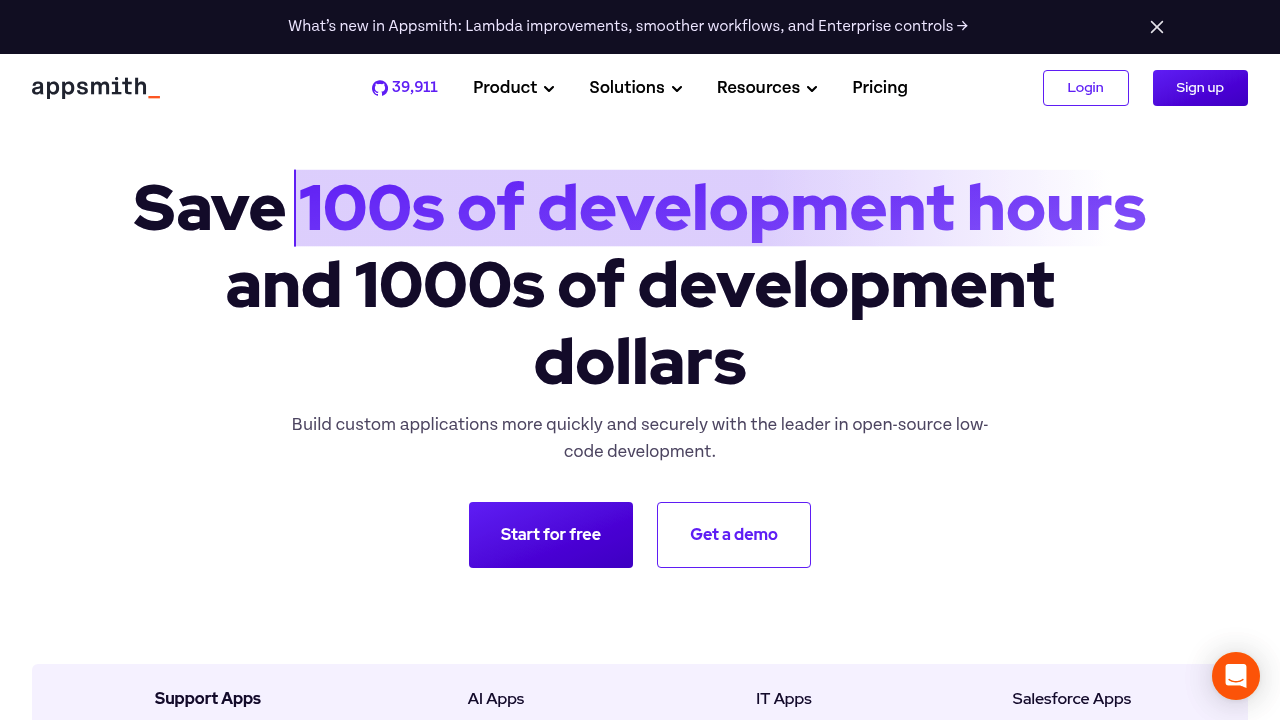
Appsmith is an open-source, low-code platform for building internal tools — admin dashboards, data management UIs, approval workflows, and operational apps — with a drag-and-drop builder and support for 50+ data source integrations. It is a credible Lovable alternative specifically for teams building internal applications where data connectivity, access control, and self-hosting are priorities.
Compared to Lovable, Appsmith gives you far more control over how your app connects to existing databases, APIs, and business systems — without writing a full backend. The tradeoff is that Appsmith is explicitly designed for internal tools and does not serve the use case of building consumer-facing products or public-facing apps that Lovable excels at.
Non-technical founders building a user-facing product for external customers, or anyone who needs Lovable's AI-first conversational building experience, will find Appsmith too limited in scope for those requirements.
Appsmith vs. Lovable: Quick Comparison
| Decision area | Appsmith | Lovable |
|---|---|---|
| Primary approach | Open-source low-code builder for internal tools with drag-and-drop UI | AI chat-to-code generation for new apps |
| No-code support | Mostly — drag-and-drop builder; some JavaScript needed for advanced logic | Partial — prompts generate code, limited visual editing |
| Learning curve | Moderate — accessible builder, but data source configuration requires technical understanding | Low — natural language prompts for beginners |
| Output stack | Appsmith-rendered app (cloud or self-hosted); React under the hood | React + Supabase (exportable, standalone) |
| AI capability / builder style | AI features for query generation and widget creation; Appsmith AI assistant | AI-first; natural language is the primary interface |
| Visual editing | Yes — drag-and-drop widget builder with layout canvas | Limited — primarily AI text generation |
| Figma import | Not publicly documented | Not publicly documented |
| Templates / starter projects | Yes — extensive template library (CRM, support, e-commerce admin, etc.) | Yes — starter templates available |
| Deployment | Appsmith Cloud or self-hosted (Docker, Kubernetes, AWS, GCP, Azure) | Managed cloud deployment on Lovable infrastructure |
| Custom domain | Supported on cloud; full control on self-hosted | Yes — on paid plans |
| Database | 50+ connectors: PostgreSQL, MySQL, MongoDB, DynamoDB, Airtable, etc. | Supabase integration built-in |
| Authentication | Built-in — email/password, Google, GitHub; SSO (SAML/OIDC) on enterprise | Via Supabase auth |
| Mobile support | Responsive apps; mobile-optimized layouts available; native mobile app: Not publicly documented | Responsive web apps; native mobile: Not publicly documented |
| Git/GitHub workflow | Yes — Git sync for version control and CI/CD workflows | Yes — GitHub sync supported |
| Code export / portability | App definition exportable as JSON; self-hosting provides infrastructure portability | Yes — can export React/Supabase code |
| Collaboration | Yes — multi-user editing, granular role-based access control | Collaboration features available |
| Error handling / debugging | Query logs, response viewer, error states, debugger panel | AI-assisted error correction |
| Support quality / onboarding help | Docs, Discord community, dedicated support on Business/Enterprise | Documentation, community, AI-assisted help |
| Pricing model | Free community edition; Business and Enterprise paid tiers | Credit/token-based pricing |
| Free plan | Yes — Community edition is free and full-featured for self-hosted | Yes — limited free tier |
| Paid plans | Business and Enterprise tiers — pricing at appsmith.com/pricing | Starter and Pro plans with credit bundles |
What Appsmith Does Differently
Open-Source with Mature Self-Hosting Options
Appsmith is Apache 2.0 licensed and maintains an active open-source community on GitHub with thousands of stars and regular releases. You can deploy Appsmith on Docker in minutes, or to Kubernetes for production workloads, with official support for AWS, GCP, and Azure.
For organizations that cannot send business data to external SaaS platforms due to compliance, data residency, or security requirements, Appsmith's self-hosting is a genuine solution — not a workaround. Lovable has no equivalent self-hosting option; all builds and deployments happen on Lovable's managed infrastructure.
50+ Native Data Source Connectors
Appsmith ships with native integrations for over 50 data sources: PostgreSQL, MySQL, MongoDB, Redis, Elasticsearch, DynamoDB, Snowflake, Google Sheets, Airtable, Stripe, Twilio, HubSpot, REST APIs, GraphQL, and more. Each connector is configured through a visual form — no coding required to connect to your existing systems.
This connectivity model is fundamentally different from Lovable's approach, which builds new data layers via Supabase. Appsmith assumes you already have data somewhere and helps you build UI on top of it. For businesses with established databases and APIs, this reduces the need to migrate or replicate data into a new system.
Granular Role-Based Access Control
Appsmith includes a sophisticated permission system: you can define which users or groups can view, edit, or use specific apps, datasources, pages, or even individual widgets. This granularity is critical for internal tools where different team members (sales, ops, engineering, finance) should see different data or have different editing privileges.
Lovable's access control model is less granular — it's designed for building apps, not for managing who can do what within a complex internal tooling ecosystem. For enterprises managing access at scale across multiple internal apps, Appsmith's RBAC is a meaningful operational advantage.
Known Limitations
- Not designed for consumer-facing products: Appsmith is explicitly an internal tool builder. Building a public-facing product — with a landing page, user registration, marketing flows, and external customer access — is outside Appsmith's design intent. Attempting this in Appsmith requires significant workarounds that Lovable handles natively.
- Business logic still requires JavaScript: Appsmith's drag-and-drop builder handles UI layout and data connectivity well, but complex business logic — calculated fields, conditional flows, multi-step transformations — typically requires writing JavaScript in Appsmith's query and transformer blocks. True no-coders will hit this ceiling.
- Business/Enterprise pricing not fully published: Appsmith's Community edition is free and well-documented. Business and Enterprise tier costs are not prominently listed on the pricing page — you need to contact the sales team for quotes. This makes budget planning difficult for teams that need paid features (SSO, audit logs, priority support).
- Self-hosting requires operational overhead: While self-hosting is a strength for compliance, it adds DevOps burden. Upgrading Appsmith, managing container orchestration, handling backups, and monitoring server health require someone with infrastructure skills. Small teams without DevOps expertise may find this overhead impractical compared to a managed platform like Lovable.
- AI capabilities are supplementary, not primary: Appsmith's AI features generate queries and suggest widgets but cannot build a complete application from a natural language description. If your evaluation criteria includes "AI builds my app from a prompt," Appsmith does not meet that bar — Lovable remains significantly more capable for AI-driven full app generation.
Who Should Choose Appsmith Over Lovable?
- Operations and IT teams building internal dashboards on existing infrastructure: If your team needs to surface data from an existing PostgreSQL database, MongoDB instance, or business API into a usable internal UI — without building a full custom application — Appsmith's connector ecosystem and drag-and-drop builder deliver this faster than Lovable's approach.
- Companies with data compliance or residency requirements: Organizations in healthcare (HIPAA), finance, legal, or government that cannot use managed cloud platforms for sensitive data can self-host Appsmith on compliant infrastructure. Lovable cannot serve these requirements.
- Engineering teams who want open-source tooling with Git-based workflows: Appsmith supports Git sync — you can store your app definitions in a repository, apply branching, and do code reviews on internal tool changes. This fits well with engineering-shaped teams that manage everything through Git.
- Teams that need to rapidly build admin interfaces on top of an existing product's database: Startups and scaleups that have a live product and need admin tooling (user management, order processing, support queues, metrics dashboards) can use Appsmith to build these tools much faster than with custom code — while staying connected to their live database.
When Lovable Is Still the Better Choice
- You're building an external-facing product for end customers: Lovable creates apps that real users outside your company interact with. Appsmith's design intent is internal — trying to build a consumer product in it means working against the tool's architecture and component model.
- You need AI-first, conversational app generation: Lovable generates entire applications from natural language descriptions. Appsmith's AI assistance is query-level and supplementary — it doesn't generate a complete app from a prompt. For rapid AI-driven prototyping, Lovable is substantially ahead.
- You're a solo non-technical founder without infrastructure skills: Lovable handles hosting, database, auth, and deployment as a managed service. Appsmith's self-hosted option requires infrastructure competency. The managed cloud version of Appsmith reduces this, but it's still a more technically demanding platform for true beginners.
- You need clean code export for developer handoff: Lovable exports a real React + Supabase codebase that a developer can take over. Appsmith exports app definitions as JSON and runs on Appsmith's rendering engine — it's not transferable to arbitrary React development environments the way Lovable's output is.
Pricing Comparison & Cost at Scale
Appsmith Pricing Overview
- Community (Free): Full-featured self-hosted edition — unlimited apps, unlimited users, unlimited data sources. No cost beyond your hosting infrastructure.
- Business: Adds SSO, audit logs, granular access control, and priority support. Pricing not publicly listed — contact Appsmith sales for a quote.
- Enterprise: Full enterprise features including dedicated support, custom SLAs, and advanced compliance tooling. Custom pricing.
Lovable Pricing Overview
- Free: Limited monthly credits for building and testing
- Paid plans: Starter and Pro with credit bundles — billed monthly
Cost-at-Scale Analysis
| Scenario | Appsmith | Lovable | Notes |
|---|---|---|---|
| Solo developer, small internal tool | Free (self-hosted) — ~$5-20/mo hosting | Free or low paid plan | Appsmith Community is genuinely free for self-hosters |
| 10-person internal team, no SSO needed | Free (Community self-hosted) | Not applicable (wrong use case) | Appsmith Community has no per-seat limit; Lovable isn't suited for this use case |
| Enterprise team, SSO + audit logs required | Business plan — contact for pricing | Not applicable | Contact Appsmith for Business pricing before budgeting |
| Startup building consumer product | Wrong tool for this | Paid plan — credit-based | Use Lovable for consumer products, not Appsmith |
Prices are subject to change. Verify current plans at appsmith.com/pricing before committing.
How Appsmith Compares to Other Lovable Alternatives
- Appsmith vs. ToolJet: The two most comparable open-source internal tool builders. Appsmith has a larger plugin/widget ecosystem and more mature enterprise features. ToolJet's AI Copilot is more integrated. Both are strong for internal tooling; the choice often comes down to specific connector needs and community preference.
- Appsmith vs. Momen: Momen targets a broader range of app types including public-facing products. Appsmith is more focused on internal tools with better enterprise access control. For internal dashboards, Appsmith; for building any web app including consumer products, Momen is more versatile.
- Appsmith vs. Plasmic: Plasmic is a frontend/CMS tool for integrating with existing codebases; Appsmith is a complete internal tool platform. Different use cases — Plasmic for design-developer collaboration on UI, Appsmith for operational tooling on top of data sources.
FAQ
Is Appsmith free to use?
Yes — Appsmith's Community edition is free and open-source (Apache 2.0). You can self-host it at no software cost. Business and Enterprise tiers add features like SSO and audit logs and have separate pricing not publicly listed. Check appsmith.com/pricing for current details.
Can Appsmith replace Lovable for building a consumer-facing product?
No. Appsmith is designed for internal tools and admin dashboards, not for consumer-facing products. If you need to build an app that external customers will use — with a public landing page, user registration, and end-user UX — Appsmith is the wrong tool. Lovable, Momen, or Bubble are better fits for that use case.
Is Appsmith good for beginners with no technical background?
Partially. The visual drag-and-drop builder is accessible for basic internal tools. However, connecting data sources, writing query logic, and configuring permissions require technical familiarity. True beginners without any database or API knowledge will likely find Lovable or Momen more immediately productive for their first project.
Do I need to know how to code to use Appsmith?
Not for basic use. Appsmith's widget library and connector forms are visual and code-free. For advanced business logic — complex calculations, conditional flows, data transformations — JavaScript is required in Appsmith's transformer blocks. Budget time for learning if you're new to both Appsmith and JavaScript.
Can I self-host Appsmith for free?
Yes. The Appsmith Community edition is free to self-host using Docker or Kubernetes. You pay for your hosting infrastructure (a small VPS can run Appsmith for ~$5-20/mo) but not for the software itself. This is one of Appsmith's strongest competitive advantages for teams with compliance or cost constraints.
How does Appsmith's AI compare to Lovable's AI?
They serve different purposes. Lovable's AI generates complete full-stack products from natural language — it's designed for founders building new apps from scratch. Appsmith's AI assists with query generation, widget suggestions, and data binding within an existing internal tool context. Appsmith's AI is not a replacement for Lovable's full app generation capability.