
AppStruct
Contact
AppStruct
AI-powered no-code app builder for web, mobile, desktop, and Telegram Mini Apps with prompt-based generation and cross-platform publishing.
AppStruct as a Lovable Alternative: Comparison & Decision Guide (2026)
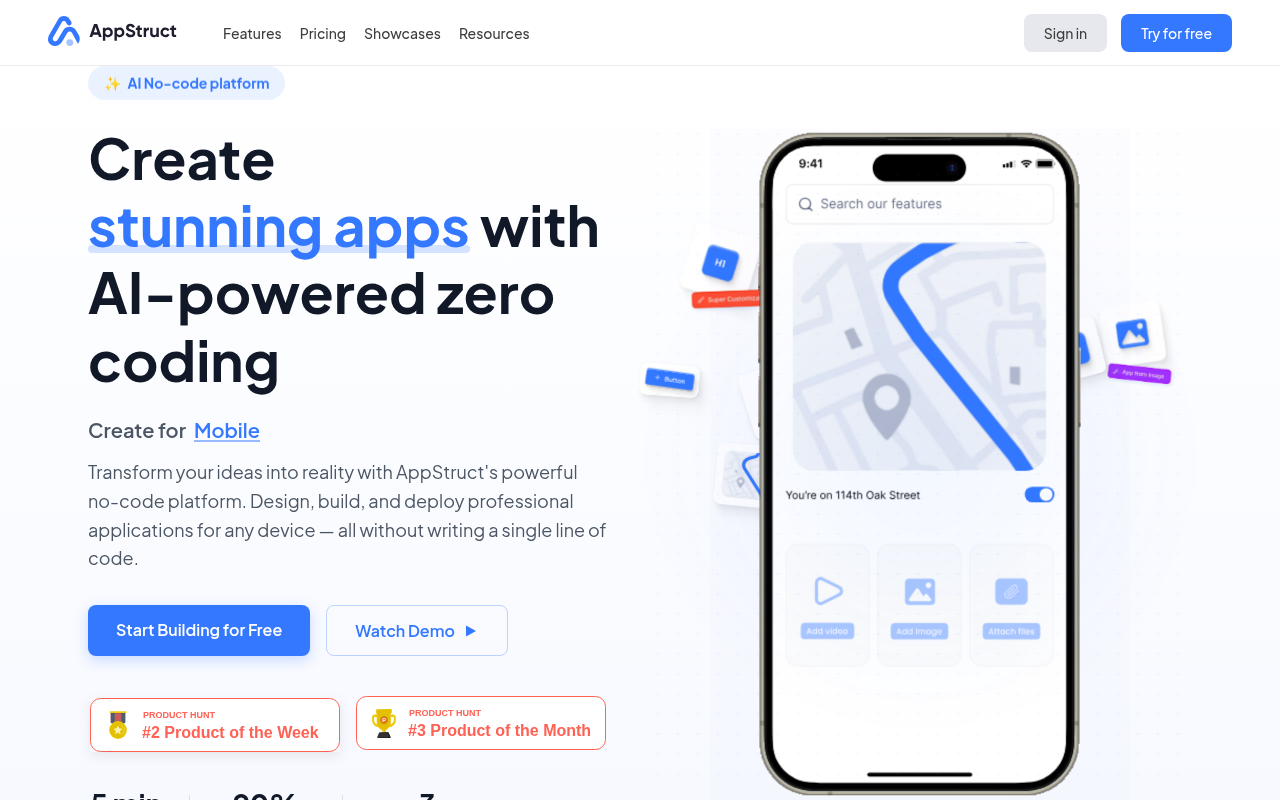
AppStruct is a strong Lovable alternative for founders and operators who want one prompt-first builder that can ship web, mobile, desktop, and Telegram Mini Apps without touching code. For builders comparing it directly with Lovable, the real question is not whether the tool can generate an app from prompts. The real question is whether its workflow matches the kind of product you need to ship and maintain after the first burst of AI-generated momentum.
AppStruct is best for non-technical founders, agencies, Telegram-first businesses, mobile-first startups, and small teams that want one builder for web plus app-store style distribution without a developer workflow. That makes it especially relevant for beginners and no-coders who care about launch speed, publishing convenience, and fewer moving parts. It is less ideal for teams that already know the app should evolve into a developer-owned codebase.
The practical decision against Lovable is therefore about trade-offs. If you want a more product-first builder with a cleaner route toward engineering ownership, Lovable often stays easier to justify. If you want the builder itself to absorb more of the shipping, packaging, and stack setup work, AppStruct can make more sense.
AppStruct vs. Lovable: Quick Comparison
| Dimension | AppStruct | Lovable |
|---|---|---|
| Primary approach | cross-platform app generation for web apps, mobile apps, desktop tools, and Telegram Mini Apps that need to launch fast from prompts instead of from a repo | Prompt-first web app builder for startup-style products and MVPs |
| No-code support | Very strong; the public product story is explicitly no-code, prompt-first, and positioned around creating full apps without writing code | Strong for prompt-driven product creation, but still closer to product-building than business-software administration |
| Learning curve | Lower than Lovable for people who care more about getting a launchable app into several surfaces than about understanding developer-style iteration patterns | Usually low for first drafts, then rises as product complexity and prompt precision grow |
| Output stack | Managed AI no-code platform that packages one project into web, iOS, Android, desktop, and Telegram Mini App delivery paths | Web app output with a stronger product-MVP orientation |
| AI capability | AI-powered app generation with natural-language starting prompts, assisted edits, and platform-aware output for multiple surfaces | Prompt-to-app generation with iterative edits |
| Visual editing | Yes; the platform combines generated starting points with no-code editing and product configuration after the first draft | Yes |
| Figma import | Not publicly documented | Not publicly emphasized as the core differentiator |
| Templates / starter projects | Prompt-first starting point with product archetypes for app launches, while the public materials emphasize generation speed more than a giant template marketplace | Templates and starter projects are part of the broader Lovable workflow |
| Deployment | Hosted deployment plus publishing paths for web and app-store style releases, including Telegram Mini Apps | Hosted web deployment for generated apps |
| Custom domain | Not prominently documented on the public homepage copy, but branded deployment is implied by the product's launch positioning | Supported for public product launches |
| Database | Managed platform data layer; public messaging focuses on app creation and publishing rather than custom database ownership | Managed database path for generated apps |
| Authentication | Not deeply documented in public marketing copy | Auth support for generated apps |
| Mobile support | A core differentiator because AppStruct explicitly positions itself around iOS, Android, and cross-platform shipping rather than only browser-based output | Mostly web-first |
| Git/GitHub workflow | Not publicly documented | Closer to code ownership than classic no-code tools |
| Code export / portability | The product story is convenience and distribution speed, not source-code export or developer-owned repos, so long-term portability appears weaker than Lovable's code-friendly buyer expectations | A major buyer expectation in the Lovable category |
| Collaboration | Better for small founder or operator teams that need one builder to cover several launch surfaces, but less documented for engineering-style collaboration than Lovable-adjacent code workflows | Useful for startup teams, but not primarily an enterprise workflow suite |
| Error handling / debugging | More about refining generated app behavior and shipping flows than about repo-level debugging, custom architecture inspection, or developer handoff | Product iteration is smoother than deep enterprise workflow debugging |
| Support quality | Public site materials, pricing details, and launch positioning are clear enough for evaluation, though the public documentation footprint looks lighter than mature enterprise no-code suites | Documentation and community-driven onboarding |
| Pricing model | AppStruct's pricing is easier to understand than many credit-heavy builders because the official public story presents a free plan plus named monthly tiers instead of abstract usage bundles only.; The more important cost question versus Lovable is whether you truly need mobile, desktop, and Telegram distribution from the same product. If you do, the higher monthly entry can still be economically rational because it replaces several parallel build paths.; If your use case is only a web MVP, AppStruct can become the more expensive choice because part of what you pay for is multi-surface packaging that a simple browser-first launch might not need. | Builder-style plans and credit logic |
| Free plan | Free plan available according to the official homepage and pricing metadata | Usually suitable for prototyping and evaluation |
| Paid plans | Official public pricing points to Standard at $54 per month and Professional at $86 per month, with annual billing discounts advertised | Paid tiers unlock more serious product work |
What AppStruct Does Differently
It treats multi-platform reach as the core promise, not a later upgrade
Lovable is easier to read as a browser-first product builder. AppStruct instead tries to answer the founder question of how to get one app idea onto the web, into mobile stores, onto desktop, and into Telegram without rebuilding the product several times.
Its no-code flow is closer to app publishing than to developer handoff
That matters for non-technical builders. AppStruct is appealing when the team wants shipping convenience and distribution breadth more than a code-forward workflow that engineers can later take over.
Telegram Mini App support changes the buyer journey
Many Lovable comparisons stop at web app output. AppStruct becomes more decision-relevant when the audience already sells, supports, or acquires users inside Telegram and wants the app to live where those users already are.
Known Limitations
- It is weaker than Lovable if code ownership, GitHub continuity, or later engineering handoff are strategic requirements rather than nice-to-haves.
- Public pricing is clear enough to compare at the headline level, but the platform does not publicly explain long-term limits and portability with the same confidence that technical teams usually want before committing.
- If your product only needs a web MVP, AppStruct can feel over-scoped because part of the value proposition is cross-platform packaging you may never use.
- The public marketing story is strong on shipping surfaces and weaker on advanced implementation detail, so technical evaluators may find fewer public answers than they would like when comparing it with Lovable.
Who Should Choose AppStruct Over Lovable
AppStruct makes more sense when the app is tightly shaped by its native strengths instead of by generic AI-builder hype. In practice, that means you should choose it when its platform model directly reduces the hardest part of your workflow, not simply because it can also turn prompts into a UI.
- Choose AppStruct when you need one no-code builder to cover web, mobile, desktop, and Telegram from the same product idea.
- Choose it when the people launching the app are founders or operators who care more about distribution speed than about code repos.
- Choose it when Telegram Mini Apps or mobile-store presence are part of the go-to-market plan from the start.
- Choose it when shipping breadth matters more than preserving a developer-friendly escape hatch.
When Lovable Is Better
This is the section many alternative pages weaken, but it matters here because Lovable is still one of the clearer product-first builders in the category. If your use case leans toward a standalone product, stronger front-end flexibility, or a cleaner mental model for startup MVP work, Lovable can be the more sensible default.
- Stay with Lovable when the project is mainly a web product and long-term engineering flexibility matters more than shipping to several surfaces.
- Stay with Lovable when developer handoff, custom front-end control, or code-oriented evolution is part of the roadmap from day one.
- Stay with Lovable when you want a product-first builder without paying extra for mobile, desktop, or Telegram packaging you might not need.
- Stay with Lovable when the app will be judged more by product polish and future custom engineering than by distribution footprint.
Pricing and Cost Predictability
AppStruct is not only about subscription price. It is about the shape of the bill once the app becomes useful, the number of people who touch it, and the platform rules that control ongoing iteration. That matters because the cheapest-looking AI builder can become the most expensive one if the limits map badly to the way your team actually works.
- AppStruct's pricing is easier to understand than many credit-heavy builders because the official public story presents a free plan plus named monthly tiers instead of abstract usage bundles only.
- The more important cost question versus Lovable is whether you truly need mobile, desktop, and Telegram distribution from the same product. If you do, the higher monthly entry can still be economically rational because it replaces several parallel build paths.
- If your use case is only a web MVP, AppStruct can become the more expensive choice because part of what you pay for is multi-surface packaging that a simple browser-first launch might not need.
Prices are subject to change. Check the official pricing page before making a production choice.
Decision Matrix
This comparison is easiest when you stop asking which tool is generally better and start asking which tool is better for the exact kind of app you are trying to ship. The following quick calls capture the practical split between AppStruct and Lovable.
- Need web + mobile + desktop + Telegram from one no-code workflow: AppStruct
- Need a browser-first MVP with a clearer code-forward future: Lovable
- Need a founder-friendly route to app-store style distribution without developers: AppStruct
- Need stronger developer handoff and future custom engineering freedom: Lovable
Lock-In, Ownership, and Long-Term Risk
AppStruct earns attention by collapsing multiple launch surfaces into one managed builder. That convenience is exactly where lock-in grows: once web, mobile, desktop, and Telegram delivery all run through one platform, moving away later becomes a bigger operational decision than switching a simple web builder.
That trade-off can still be fair for non-technical teams that mainly need launch speed. It is a worse trade for teams that expect the app to become a long-lived engineering asset with repo ownership and custom architecture choices.
Workflow Fit for Teams
Compared with Lovable, AppStruct feels more distribution-oriented than code-oriented. It suits teams that define success as getting a usable app live across several customer surfaces quickly, even if that means staying inside a more managed platform.
It is less ideal when the team wants the AI builder to be the first step toward a more custom engineering roadmap rather than the permanent home of the product.
What Builders Are Saying
External coverage positions AppStruct as an unusually broad no-code builder because it targets mobile, web, desktop, and Telegram output from one AI-assisted workflow. The recurring caution is that this convenience story is stronger than the public proof for technical portability or deep developer workflows.
- https://www.producthunt.com/products/appstruct
- https://earlybird.so/products/appstruct/
- https://www.productcool.com/product/appstruct
Final Verdict
AppStruct is a strong Lovable alternative for founders and operators who want one prompt-first builder that can ship web, mobile, desktop, and Telegram Mini Apps without touching code.
The best way to test the fit is to rebuild one small but real workflow or product slice in both tools. If AppStruct solves the long-term shipping problem more honestly than Lovable does, it deserves the switch. If it only looks impressive in the first ten minutes, Lovable is probably still the stronger default.
Sources
- https://appstruct.ai/
- https://appstruct.ai/pricing
- https://appstruct.ai/
- https://www.producthunt.com/products/appstruct
- https://earlybird.so/products/appstruct/
- https://www.productcool.com/product/appstruct
FAQ
Is AppStruct a good Lovable alternative?
Yes, for multi-platform launches. It is a better Lovable alternative when the main goal is shipping one app across web, mobile, desktop, and Telegram without code.
Does AppStruct have a free plan?
Yes. The official site publicly advertises a free starting tier.
Who should choose AppStruct over Lovable?
Non-technical founders and operators. It is especially relevant when Telegram or app-store distribution matters from the beginning.
What is the biggest tradeoff?
Portability. You gain launch breadth and convenience, but not the same confidence around code-oriented ownership or developer handoff.