Appy Pie AI App Generator
Contact
Appy Pie AI App Generator
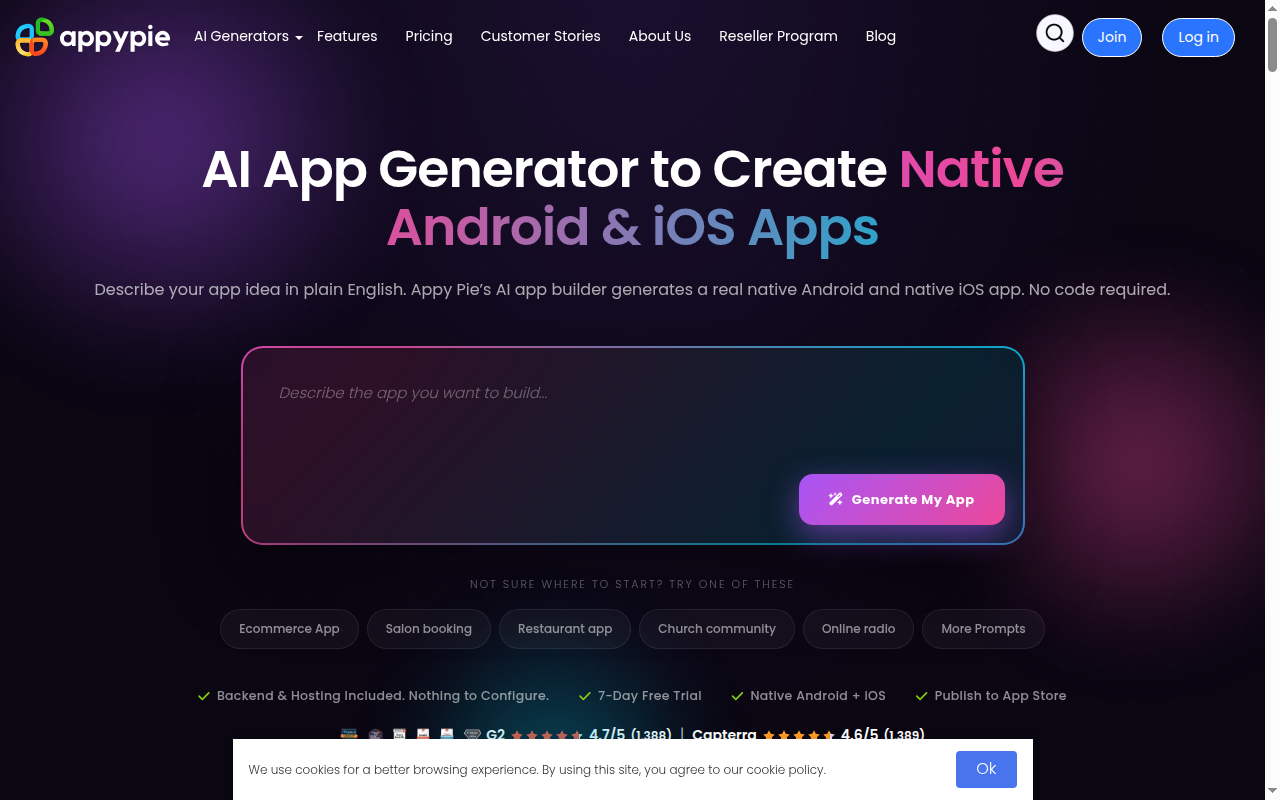
Appy Pie AI App Generator turns plain-English prompts into native Android and iOS apps with backend, templates, publishing support, and no-code editing.
Appy Pie AI App Generator as a Lovable Alternative: Comparison & Decision Guide (2026)
Appy Pie AI App Generator is a better Lovable alternative for non-technical founders who care more about native mobile publishing and template-backed speed than flexible web-app craftsmanship.
Compared with Lovable, it offers a much more packaged no-code mobile path, but that convenience comes with more platform abstraction and less developer-style control.
If you want React code you can shape like a normal software project, Lovable is usually the cleaner fit.
Appy Pie AI App Generator vs. Lovable: Quick Comparison
| Criteria | Appy Pie AI App Generator | Lovable |
|---|---|---|
| Primary approach | AI full-stack/mobile builder | Prompt-based web/full-stack generation |
| No-code support | High | High |
| Learning curve | Low | Low to medium |
| Output stack | Native Android/iOS app output | Web apps with managed builder workflow |
| Visual editing | Strong no-code editor | Strong |
| Templates / starters | Heavy template support | Moderate |
| Deployment | Cloud and app stores | Managed web deployment |
| Custom domain | Supported / depends on publish path | Supported |
| Database | Included backend/database | Usually paired with managed backend workflow |
| Authentication | Included | Common use case |
| Mobile support | Native iOS/Android | Web-first |
| Git / portability | More platform-led | Moderate |
| Collaboration | Team friendly | Good for collaborative prompting |
| Support quality / onboarding | More guided | Managed onboarding |
| Pricing model | Starts at $16/month with 7-day free trial | Typically paid hosted builder |
| Free plan | Yes | Varies |
What Appy Pie AI App Generator Does Differently
Native mobile publishing focus
Appy Pie is positioned around Android and iOS delivery, including store submission help, rather than a web-app-first workflow.
No-code editing after generation
Its visual editor matters for beginners who want to keep editing without leaving the platform.
Template-assisted speed
The platform claims 200+ templates and category-specific scaffolds, which is useful for standard business app patterns.
Compliance and publishing narrative
Healthcare, finance, and store-publishing claims are more central here than in Lovable's core product story.
Known Limitations
- The product is more opinionated and template-driven, so customization depth can feel narrower than a code-first web app builder.
- Published pricing starts low, but store publishing and feature-heavy apps can still become a recurring platform commitment.
- Lovable is usually better if you want to shape a bespoke web product instead of fitting into a mobile-builder workflow.
- The strongest value is mobile-first; if your product is mostly a web SaaS, some of the packaged mobile flow is wasted complexity.
- Because Appy Pie abstracts more infrastructure, portability and developer ergonomics are not its strongest selling points.
Who Should Choose Appy Pie AI App Generator Over Lovable
- Choose Appy Pie over Lovable if your end goal is a native Android or iOS app, not primarily a web application.
- Choose it if you want a no-code editor and publishing support after AI generation instead of living in generated code.
- Choose it if your use case matches common business app patterns like delivery, booking, community, or ecommerce.
- Choose it if you need a more guided path for non-technical teams who care about app-store output.
When Lovable Is Still Better
- Stay with Lovable if you want a modern web product workflow with more direct control over the generated application.
- Stay with Lovable if your team prefers code-centric iteration over templates and no-code editing.
- Stay with Lovable if native mobile publishing is not part of the near-term roadmap.
Pricing and Cost Predictability
Official AI App Generator page says free to build, 7-day trial to publish, and paid plans from $16/month.
Starts at $16/month with 7-day free trial is the clearest public baseline, but the real decision depends on what you need after the first build. Lovable is often easier to justify for a web-first product, while this alternative becomes more compelling when its differentiator lines up with the roadmap.
That means the cheapest-looking option is not always the least expensive one in practice. If your roadmap includes mobile, backend, self-hosting, or heavy design recreation, switching tools later can cost more than starting on the better-fit platform.
Lock-In, Portability, and Workflow Risk
This is one of the most important places to compare any Lovable alternative honestly. A builder can feel cheap or fast on day one, then become expensive once you need migration, collaboration, custom integrations, or deeper debugging.
Appy Pie AI App Generator should be judged on how much it lets you keep after the AI magic wears off. Code ownership, Git workflows, native deployment paths, and editing freedom matter more than launch-day screenshots.
For teams making a real product decision, this section matters more than flashy prompt demos. It is usually better to accept a slightly slower start if it avoids a painful rebuild later.
Beginner Decision Matrix
- If you want the easiest path to a first browser-based app demo, Lovable usually stays simpler.
- If you want Appy Pie AI App Generator because of one specific advantage, make sure that advantage matters in the first 90 days, not just in theory.
- If you expect to ship mobile, manage real backend state, or own the codebase deeply, this alternative becomes much easier to justify.
- If you are comparing tools only by vibe or speed, you are likely underestimating maintenance, iteration, and migration costs.
Community Signals and External Proof
No AI app builder should be judged only by its own marketing site. External reviews, discussions, and community threads help reveal whether the product's core pitch is actually reaching real users.
These links do not prove that every claim is perfect, but they do show the product has a visible footprint outside its own landing page. That matters for a directory page where buyers are explicitly comparing alternatives.
What the Official Sources Actually Confirm
The public official materials are strong enough to explain positioning, output model, and pricing baseline. Where exact implementation details are not clearly documented, they should be treated as not publicly documented rather than guessed.
Migration and Team Fit
Tool choice is rarely just about solo builders. Founders, agencies, designers, and small product teams all hit different pain points once the first version exists and someone has to keep shipping.
Appy Pie AI App Generator is more attractive if your next phase depends on its core strength, whether that is native mobile, stronger production scaffolding, or open-source ownership. If not, Lovable's smoother first-run experience may still win.
The practical question is simple: which workflow gives your team the fewest expensive surprises after the first successful demo?
Feature-by-Feature Buying Notes
Buyers often overvalue the first prompt and undervalue the fifth iteration. In reality, the fifth change request is where product quality starts to diverge between builders.
Check how the tool handles revisions, previews, auth, payments, data models, and real deployment. Also check whether the AI helps you move forward without trapping you in a brittle generated structure.
That is why this page treats support quality, code control, and workflow portability as first-class criteria instead of nice-to-haves. Those details usually decide whether an alternative stays useful beyond launch week.
Questions to Ask Before You Commit
Before replacing Lovable with any alternative, ask what happens after the first version ships. Can you revise the architecture without rebuilding everything, or are you mostly rearranging what the platform has already decided for you?
Also ask who will maintain the product when the original prompt stops being enough. Some teams need design freedom, some need backend reliability, and some just need the fastest route to something investors or customers can click.
A good alternative is not the one that sounds the smartest on launch day. It is the one that keeps working when the project gains real data, real users, and real constraints.
Decision Summary for Teams
Teams comparing Lovable alternatives should rate each builder on three things: how quickly it produces a useful first version, how well it survives later iterations, and how expensive it becomes once the product starts behaving like software instead of a demo.
Appy Pie AI App Generator makes the most sense when its biggest strength maps directly to your next milestone, not just to your curiosity. If that mapping is weak, the safer decision is often to keep Lovable and avoid a tool switch that adds motion without improving outcomes.
That framing keeps the comparison honest. The right answer is not which builder feels most magical, but which one best matches the shape of the product you are actually trying to ship.
Final Verdict
Appy Pie AI App Generator is a better Lovable alternative for non-technical founders who care more about native mobile publishing and template-backed speed than flexible web-app craftsmanship.
Compared with Lovable, it offers a much more packaged no-code mobile path, but that convenience comes with more platform abstraction and less developer-style control.
If you want React code you can shape like a normal software project, Lovable is usually the cleaner fit.
FAQ
Is Appy Pie better than Lovable for complete beginners?
Usually yes for mobile-first beginners. Appy Pie is built around no-code editing and publishing help, which reduces the amount of technical setup a beginner has to manage.
Does Appy Pie create native mobile apps or web wrappers?
Its official AI App Generator pages repeatedly claim native Android and iOS output, plus app-store publishing support.
What is the main downside compared with Lovable?
Flexibility. Appy Pie is less attractive if you want a code-shaped web product and deeper control over architecture or frontend details.
When should you keep using Lovable instead?
Keep using Lovable when web-app creation is the goal and you want a builder that feels closer to product iteration than to a managed app-builder stack.