
Build0
Contact
Build0
AI internal app builder that turns prompts into secure workflow apps with connectors, database quotas, and team controls.
Build0 as a Lovable Alternative: Internal Tool Builder Guide (2026)
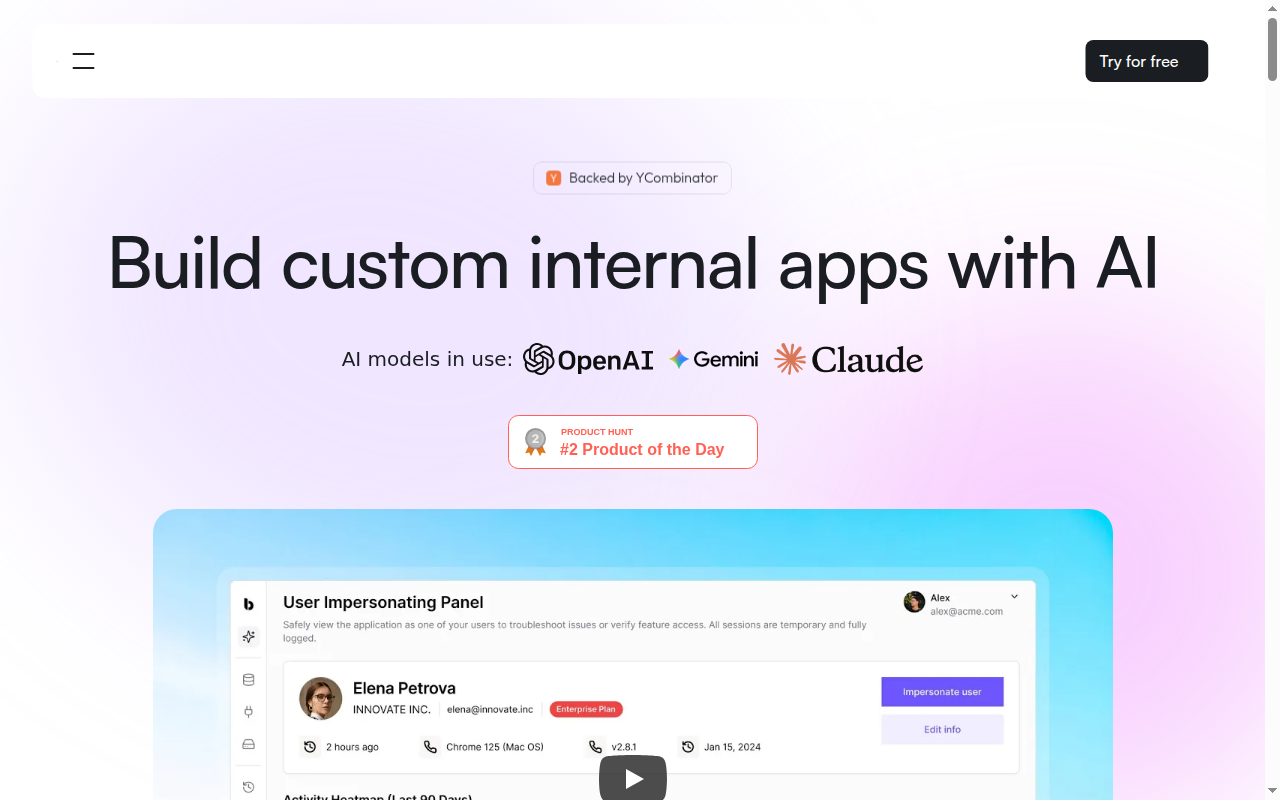
Build0 is a credible Lovable alternative if your real goal is not a polished public SaaS MVP, but a secure internal app that connects to business systems fast. Lovable is usually easier to pitch for customer-facing prototypes, design-heavy landing flows, and broad “build me an app” experiments. Build0 wins when the project lives behind the company firewall, needs connectors, permissions, execution limits, and tighter operational controls from day one. If you want a consumer-grade marketing app with strong visual identity and broad frontend flexibility, Lovable is still the safer first stop.
The practical difference is that Build0 is opinionated around internal operations. It talks about builders, viewers, connectors, executions, a built-in database, RBAC, and white-glove setup rather than pure vibe-coded web product polish. That makes it more relevant for operations teams, customer success, finance, support, and product-led teams that need workflow tools quickly without hiring a small internal platform team.
Build0 vs. Lovable: Quick Comparison
| Dimension | Build0 | Lovable |
|---|---|---|
| Primary approach | AI internal app builder for team workflows | General AI web app builder for broad product prototyping |
| No-code support | High for structured business apps | High for fast prompt-led prototypes |
| Learning curve | Moderate if you need connectors and governance | Lower for first-pass product mockups |
| Typical output | Internal tools, dashboards, CRM-like apps, workflow apps | Public-facing web apps, SaaS MVPs, landing-plus-product concepts |
| AI builder style | Prompt to full-stack app with execution and data limits | Prompt to polished app flow with rapid UI iteration |
| Visual editing | Visual editor listed as coming soon on pricing | Strong prompt-driven visual iteration |
| Database model | Built-in database with quota by plan | Usually external services or separate setup depending on stack |
| Authentication / permissions | RBAC appears in Team plan and up | Depends more on generated stack and manual integration choices |
| Connectors | Connector limits are core to plan design | Integrations depend more on generated code and manual setup |
| Deploy path | Managed app environment | Hosted project experience with code iteration |
| Custom domain | Available on paid plans | Supported, often simpler for public apps |
| Code portability | Not prominently positioned as the main selling point | Typically stronger when you want a product-like codebase to continue elsewhere |
| Team controls | Builders, viewers, version history, support tiers | Collaboration exists, but governance is less central to the story |
| Best fit | Internal operations software | Startup MVPs and user-facing prototypes |
What Build0 Actually Does Better Than Lovable
The biggest reason to pick Build0 over Lovable is scope control. Build0 does not pretend to be a universal answer for every software idea. Its positioning is narrower, and that is a strength. If your team needs an approval tool, a finance workflow app, a support operations dashboard, a light CRM, or an internal admin surface connected to outside services, Build0 is already speaking your language.
That matters because internal tools usually fail for boring reasons, not flashy reasons. They fail when permissions are messy, when data models are not constrained, when execution costs are invisible, or when the app cannot connect to the systems your team already uses. Build0 surfaces builders, viewers, connectors, executions, and database sizes directly in the plan model. That makes planning easier for operations teams than a generic “just prompt your app into existence” story.
Build0 also gives a clearer procurement story for a manager who has to justify the purchase. Free, Team, Growth, Scale, and Enterprise are framed around how many builders, viewers, apps, connectors, and executions you need. Lovable is easier to explain to a founder chasing product velocity. Build0 is easier to explain to someone buying a controlled internal tool platform.
Where Lovable Still Wins
Lovable is the better option if the thing you are building needs to feel like a finished consumer or startup product very quickly. Its reputation is stronger around rapid frontend iteration, broad MVP experimentation, and the kind of “describe the product and keep refining it” loop that non-technical founders love. If your first success metric is user perception, presentation, or demo quality, Lovable is usually easier to recommend.
Lovable also tends to be a cleaner fit when the app idea starts vague and product-led. Build0 is more opinionated around business process software, which is great once the use case is clear, but can feel narrower if you are still searching for the shape of the product itself.
How Build0 Fits a Real Beginner or Non-Technical Buyer
For a non-technical beginner, Build0 is easiest when the app is structured and operational. A founder who wants “a ticket triage tool connected to Slack and email” or “a partner onboarding dashboard with steps, statuses, and approvals” is more likely to benefit than a founder who wants “the next breakout consumer product with delightful UX.” That is because structured workflow problems are easier to constrain, and Build0 is designed around constrained business workflows.
The flip side is that beginners who expect magic-level creative product invention may feel boxed in faster. Build0 is likely to get you to a useful internal outcome sooner, but not necessarily to the most differentiated public-facing app. That makes it a stronger Lovable alternative for operators than for indie makers chasing a broad-market launch.
Pricing and Cost Predictability
Build0’s pricing is one of its strongest differentiators because it exposes the levers that actually drive cost. The free plan includes one builder, 1,500 AI build credits per month, two apps, two connectors per app, 2,000 executions, and a 0.25 GB built-in database. Team moves to $35 per month with two builders, ten viewers, five apps, ten thousand AI build credits, three connectors per app, and one gigabyte of database capacity.
Growth is priced at $75 per month and increases builders, viewers, apps, connectors, executions, and support. Scale moves to $149 per month and adds larger quotas plus visual editor access listed as coming soon. Enterprise is custom. Compared with Lovable, this is a more operational pricing model. You are not only paying for AI generation; you are paying for controlled app capacity, team access, connectors, and runtime usage.
That is good news if you hate surprise bills and you know your workflow shape. It is less ideal if you just want the loosest possible experimentation surface with minimal structural thinking. Build0’s pricing makes tradeoffs explicit, which helps buyers estimate long-term value but also exposes how quickly an internal platform can become a line item once multiple teams join in.
Limitations You Should Take Seriously
- Build0 is not the best Lovable replacement for design-first public apps. Its strongest story is internal operations, not high-polish product marketing surfaces.
- Cost predictability is better than in many builder tools, but connector limits, execution limits, and database quotas can become the real scaling pressure once usage spreads across teams.
- Lovable is still better when the comparison is purely about frontend impression and broad-market MVP presentation. Build0’s comparative weakness is that it feels more operational than aspirational.
- The pricing page mentions a visual editor as “coming soon” at higher tiers, which means some buyers may be paying partly for platform direction rather than only mature present-day functionality.
- Code ownership and long-term portability are not positioned as aggressively as they are in some Lovable-adjacent competitors, so teams with strict exit-strategy requirements should verify how far they can move or extend projects.
Lock-In, Portability, and Workflow Risk
The lock-in question with Build0 is different from the lock-in question with Lovable. Lovable buyers usually worry about whether the generated product can keep evolving outside the builder. Build0 buyers should worry about whether the operating model itself becomes sticky: connectors, permissions, execution quotas, and internal processes can all become coupled to the platform once teams rely on them daily.
That is not automatically bad. Operational coupling is often worth it when the tool saves real labor every week. But it means you should evaluate Build0 as infrastructure for process software, not just as a one-time AI builder. If the app will become business-critical, ask how exports, migrations, governance, and environment control work before your usage expands.
When Build0 Is the Better Lovable Alternative
Choose Build0 over Lovable when your app is mainly for employees, not end users; when the value comes from workflow automation, not marketing polish; when you need connector planning and team roles early; and when you want a clearer operational buying model. It is especially compelling for support operations, finance workflows, internal admin surfaces, customer success tooling, and any team that has a backlog of “we need a small app for this” requests.
When You Should Stay With Lovable
Stay with Lovable if the app is customer-facing, branding matters more than workflow constraints, you need to iterate visually in a founder-friendly loop, or the project is still too undefined to be framed as an internal business application. Lovable remains the better fit for broad SaaS idea validation, faster design-led demos, and public launch experiments where the first impression matters more than governance.
FAQ
Is Build0 a good Lovable alternative?
Yes, for internal tools. Build0 is a stronger choice when your real need is secure internal business software rather than a design-led public MVP.
Can a non-technical team use Build0?
Yes, with structure. Teams with a clear workflow problem will likely have a better time than founders exploring an open-ended product idea.
Does Build0 look cheaper than Lovable?
It depends on usage. Build0 is clearer about limits, but connectors, executions, and database capacity become the real cost story as the app grows.
What is the biggest drawback?
Its narrowness. Build0 is excellent when you want internal app discipline, but that same focus makes it less exciting for public product prototyping.
When should I avoid Build0?
Avoid it when you mostly care about consumer-facing polish. Lovable is a better default when the app must feel like a startup product before it behaves like an internal system.