
CodeRabbit
AI-powered code review tool that analyzes pull requests and provides contextual feedback
CodeRabbit - Lovable alternative
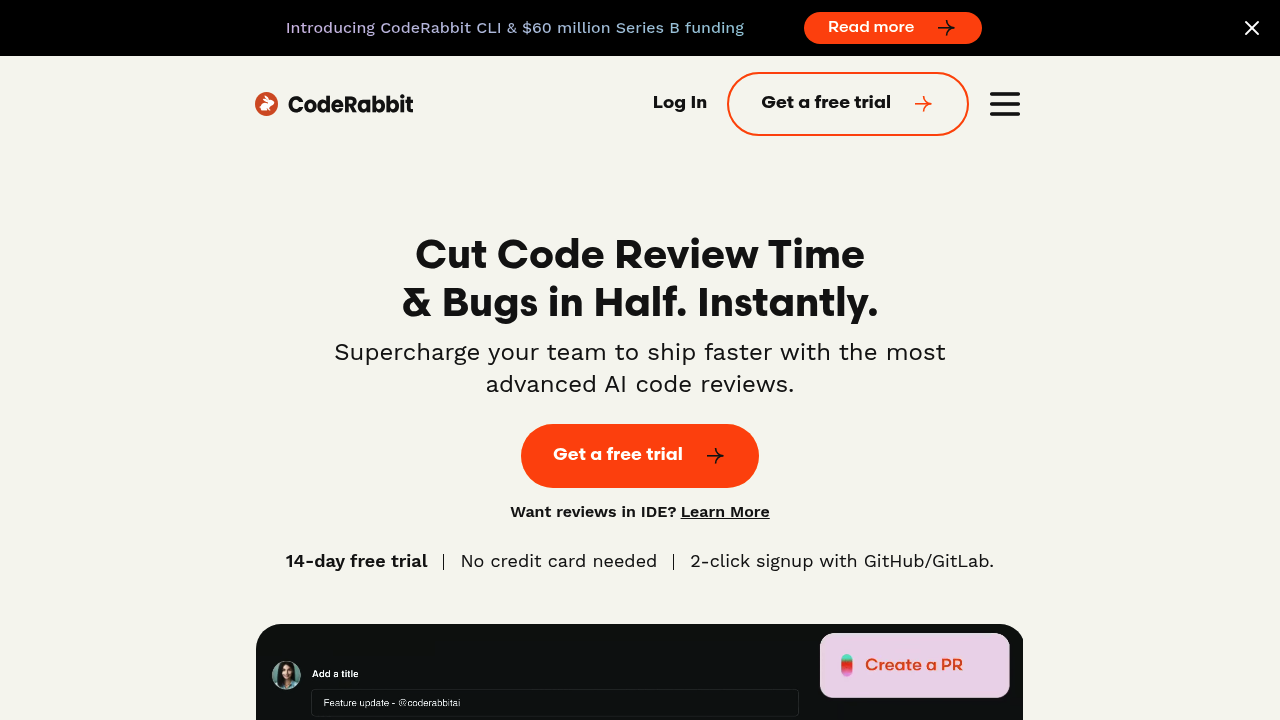
CodeRabbit delivers context-aware feedback on pull requests within minutes, reducing manual code review time and effort. The platform runs static analyzers, linters, and security tools combined with AI reasoning models. Solo developers might prefer it because it learns from user input and adapts to individual code style preferences over time. Unlike Lovable, which generates full applications from prompts, this Lovable alternative focuses exclusively on reviewing existing code changes.
Strengths
- Automatically runs popular static analyzers, linters, and security tools combined with advanced reasoning models for deeper code understanding.
- Integrates with GitHub, GitHub Enterprise, GitLab, Azure DevOps, and Bitbucket Cloud in just a few clicks.
- Learns team code style and review preferences through natural-language conversations in pull request comments.
- Free VS Code extension reviews every commit in the IDE and fixes bugs directly in Visual Studio Code, Cursor, and Windsurf.
- Maintains strong privacy with zero retention of analyzed code after queries complete and no use of customer data for training LLMs.
- Pro tier features available at no charge for public repositories.
Weaknesses
- Does not generate applications or build new software features from scratch.
- Hourly usage limits apply to each developer on paid tiers.
- Requires existing codebase and pull request workflow to provide value.
- Free tier only includes pull request summarization without full review capabilities.
Best for
Teams and solo developers who maintain existing codebases through pull request workflows and need automated, context-aware review feedback.
Pricing plans
- Free — $0/month — Unlimited public and private repositories, PR summarization, reviews in IDE. 14-day Pro trial included.
- Lite — $12/month billed annually or $15/month per developer — Unlimited pull request reviews, customizable learnings, real-time web query, code graph analysis, reviews in IDE.
- Pro — $24/month billed annually or $30/month per developer — Everything in Lite plus linters and SAST tools support, Jira and Linear integration, agentic chat, product analytics dashboards, customizable reports, docstrings generation, higher IDE rate limits.
- Enterprise — Custom pricing — Everything in Pro plus self-hosting option, multi-org support, higher limits, SLA support, onboarding support, dedicated CSM, AWS/GCP marketplace payment, VPN tunneling support.
Tech details
- Type: AI-powered code review automation platform
- IDEs: VS Code and all forks such as Cursor and Windsurf
- Key features: Static analysis, linters, security tools, code graph analysis, autogenerated release notes, pull request summaries, sequence diagrams, Linear and Jira issue validation
- Privacy / hosting: SaaS or self-hosted (Enterprise). All LLM queries exist in-memory only with zero retention after completion. SOC 2 and GDPR compliant.
- Models / context window: Uses latest foundational LLMs for code reviews with built-in intelligence that enhances reviews with additional context around code changes. Specific models and context window size not disclosed.
When to choose this over Lovable
- You maintain existing code through pull requests rather than building new applications from scratch.
- Your workflow requires automated security scanning and linter integration across multiple repositories.
- You need a tool that learns your specific code style preferences and adapts reviews accordingly.
When Lovable may be a better fit
- You want to generate full-stack web applications from natural language descriptions.
- Your goal is rapid prototyping or building new products rather than reviewing existing code.
- You prefer a conversational interface that builds software rather than analyzes pull requests.
Conclusion
CodeRabbit serves developers who need automated, intelligent code review on existing projects. It complements manual reviews by catching issues that human reviewers often miss and learns from team feedback. The platform integrates seamlessly with standard Git workflows and offers strong privacy guarantees. While Lovable focuses on generating new applications, CodeRabbit optimizes the code quality and review process for established codebases.
Sources
- Official site: https://www.coderabbit.ai
- Docs: https://docs.coderabbit.ai
- Pricing: https://www.coderabbit.ai/pricing
FAQ
What is the main difference between CodeRabbit and Lovable?
CodeRabbit reviews and analyzes existing code changes in pull requests. Lovable generates full-stack web applications from conversational prompts. CodeRabbit optimizes code quality; Lovable builds software from scratch.
Does CodeRabbit work with my IDE?
Yes, CodeRabbit offers a free VS Code extension that works with Visual Studio Code, Cursor, and Windsurf. The extension reviews commits locally before you push changes.
Is CodeRabbit free for open source projects?
Yes, Pro tier features are free forever for unlimited public repositories. Rate limits may apply to free public repository usage.
What programming languages does CodeRabbit support?
CodeRabbit works with any language supported by standard linters and static analyzers. It applies dozens of open-source, industry-standard code analyzers to every commit.
How does CodeRabbit protect my code?
All LLM queries exist in-memory only with zero retention after each query completes. CodeRabbit doesn't use customer code to train models or share data with third parties. The platform maintains SOC 2 and GDPR compliance.
Can I use CodeRabbit without a team?
Yes. Solo developers can use CodeRabbit on personal repositories. The tool learns individual code style preferences through natural-language feedback in pull request comments.