
Codiga
Real-time static code analysis platform integrated directly into developer workflows.
Codiga - Lovable alternative
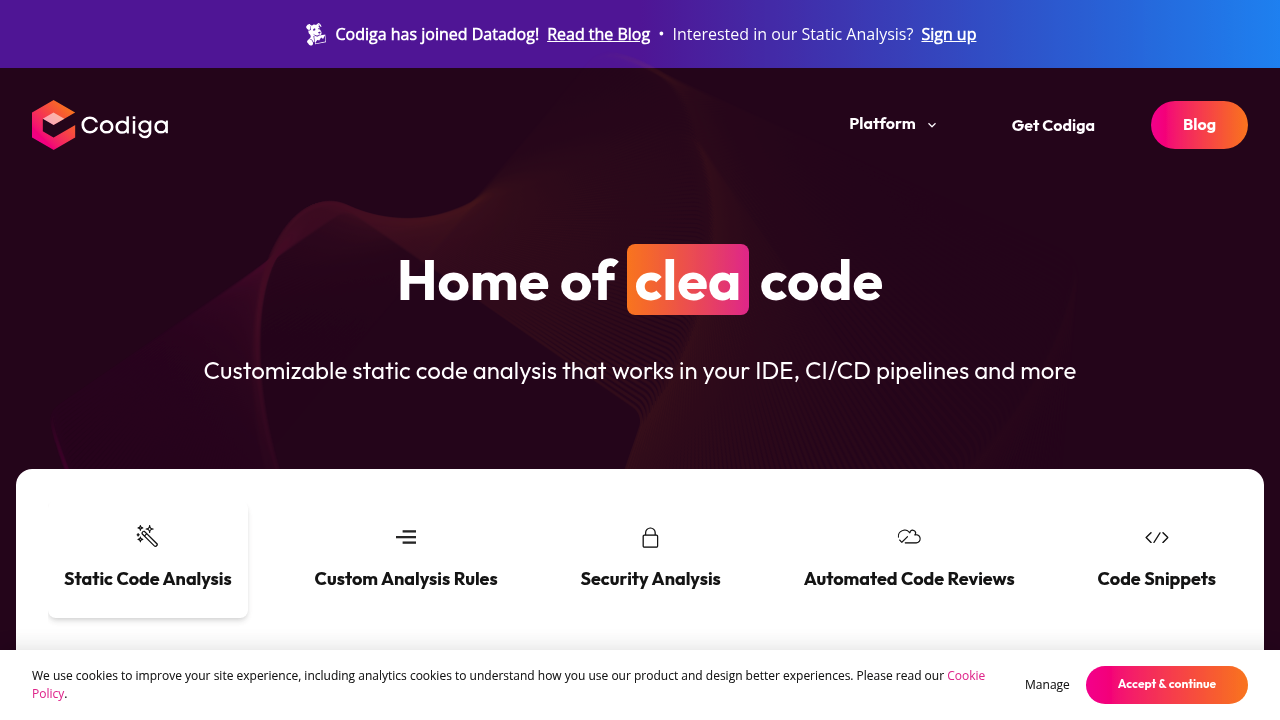
Codiga is a customizable static code analysis tool that works in IDEs, CI/CD pipelines, and version control systems. The platform uses AI-powered analysis to enhance code quality and improve developer productivity. It provides automated code reviews, security fixes, and detects vulnerabilities in real-time across more than 12 programming languages. Solo developers might prefer this Lovable alternative for its focus on code quality enforcement and security analysis rather than application generation.
Strengths
- Analyzes code instantly in VS Code, JetBrains, and VisualStudio with real-time feedback directly in the IDE
- Supports OWASP Top 10, MITRE CWE, and SANS/CWE Top 25 security standards with automated vulnerability fixes
- Provides over 2,000 analysis rules across 12+ programming languages with framework-specific detection
- Allows developers to create custom static code analysis rules from the browser in under 5 minutes
- Detects leaked credentials, SSH keys, and API tokens before code reaches production
- Integrates seamlessly with GitHub, GitLab, Bitbucket, CircleCI, Travis-CI, and GitHub Actions
Weaknesses
- Focuses on code analysis and quality enforcement, not full application generation or scaffolding
- Market mindshare decreased from 0.4% to 0.3% between 2024 and July 2025
- Team version limited to 1 user per month at the base tier
- Requires existing code infrastructure; does not generate applications from natural language prompts
- No built-in deployment or hosting capabilities
Best for
Developers who need rigorous code quality enforcement, security scanning, and technical debt reduction across existing codebases.
Pricing plans
- Free — $0/month — Unknown limits
- Team — $14/month — Limited to 1 user per month
- Custom — Contact for pricing — Unknown limits
- Startup program offers 20% discount for 12 months on all features
Tech details
- Type: Static code analysis platform with IDE plugins and CI/CD integration
- IDEs: VS Code, JetBrains, VisualStudio
- Key features: Real-time code analysis, automated security fixes, custom rule creation, code snippet sharing, infrastructure code analysis for Terraform and Docker
- Privacy / hosting: Cloud-based SaaS platform. Analysis occurs in real-time within IDE and during CI/CD pipeline execution. Data retention policies unknown.
- Models / context window: AI-powered analysis engine. Analysis engine updated daily with new rules. Specific models and context window size not disclosed.
- Supported languages: JavaScript, TypeScript, Python, Java, Scala, Ruby, PHP, Apex, Docker and 12+ total languages
When to choose this over Lovable
- You need comprehensive security analysis covering OWASP Top 10 and CWE standards with automated fixes
- Your workflow requires real-time code quality feedback integrated directly into VS Code, JetBrains, or VisualStudio
- You want to enforce custom coding standards and share rules across development teams
When Lovable may be a better fit
- You need to generate full-stack web applications from natural language descriptions rather than analyze existing code
- Your goal is rapid prototyping and MVP development without writing code manually
- You prefer an all-in-one platform with built-in deployment and hosting capabilities
Conclusion
Codiga specializes in customizable static code analysis with real-time feedback across development environments. The platform excels at security vulnerability detection and technical debt reduction for existing codebases. With support for over 2,000 rules and 12+ languages, it provides comprehensive code quality monitoring. Unlike Lovable's application generation approach, Codiga focuses on analyzing and improving code that developers write themselves.
Sources
- Official site: https://www.codiga.io/
- Docs: https://docs.lovable.dev/ (Lovable documentation for comparison)
- Pricing: https://www.codiga.io/ (Contact for detailed pricing)
FAQ
What is Codiga used for?
Codiga provides customizable static code analysis that detects security vulnerabilities, code violations, duplicates, and complex functions. It works within developer IDEs and CI/CD pipelines to provide real-time feedback. The platform helps teams enforce coding standards and reduce technical debt.
How does Codiga differ from Lovable?
Lovable generates full-stack applications from plain English prompts and produces real code for frontends, backends, and databases. Codiga analyzes existing code for quality and security issues. Lovable focuses on application creation; Codiga focuses on code improvement and vulnerability detection.
Which programming languages does Codiga support?
Codiga supports more than 12 programming languages with over 2,000 analysis rules. Confirmed languages include JavaScript, TypeScript, Python, Java, Scala, Ruby, PHP, Apex, and Docker. The platform also analyzes infrastructure code written in Terraform.
Can I create custom analysis rules in Codiga?
Developers can create custom static code analysis rules from their browser in under 5 minutes. Rules can be shared publicly on the Codiga Hub or kept private within teams. This allows organizations to enforce company-specific coding standards.
Does Codiga work with Git platforms?
Codiga integrates with GitHub, GitLab, and Bitbucket. The platform performs automated code reviews on pull requests and supports multi-branch analysis. Onboarding takes approximately one minute with no credit card required for initial setup.
What security standards does Codiga support?
Codiga covers OWASP Top 10, MITRE CWE, and SANS/CWE Top 25 security standards. The platform detects Common Weakness Enumeration issues and leaked credentials in source code. Automated security fixes can be applied directly within the IDE.