Draftbit
Contact
Draftbit
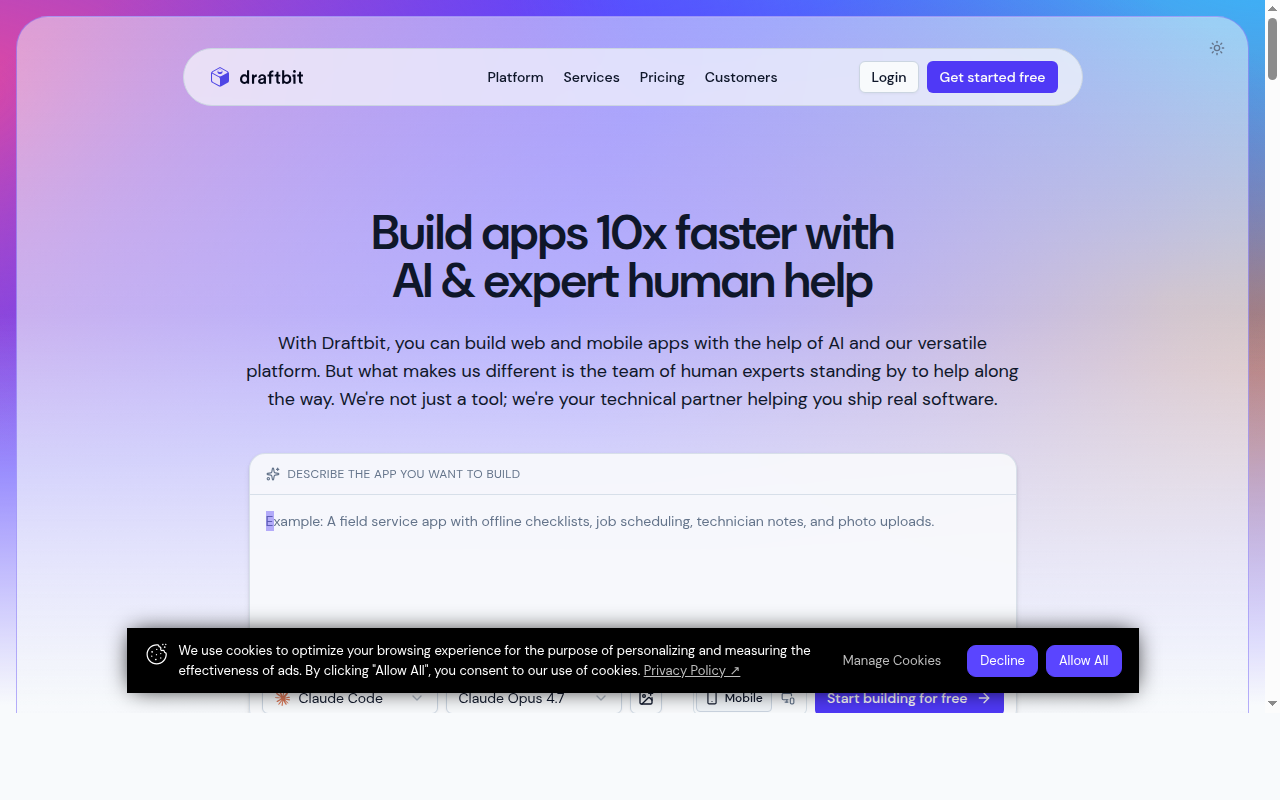
Draftbit is an AI-assisted visual app builder for web, iOS, and Android — with multiple AI agents (Claude, GPT, Gemini), full code export, GitHub integration, and an optional human expert support layer.
Draftbit as a Lovable Alternative: Comparison & Decision Guide (2026)
Draftbit is an AI-assisted visual app builder that targets both web and native mobile (iOS and Android) app development — with full code access, GitHub export, and a human expert support layer that sets it apart from most no-code platforms. As a Lovable alternative, Draftbit is a strong choice for founders who want the speed of AI-assisted building combined with real code ownership and the option to have actual human engineers involved when needed. Complete beginners will find Draftbit slightly more technical than Lovable, but accessible — especially given the $20/month starting price.
Unlike Lovable's fully conversational approach, Draftbit combines AI agents (Claude, GPT, and others), a visual editor with full code access, and one-click publishing for web, iOS, and Android. The result is a platform that covers a wider output range than Lovable, at a price point designed for individual builders and small teams.
If you need native mobile app publishing alongside a web app, or want to own your full source code on an accessible budget, Draftbit is worth a close look. If you want the absolute fastest path to a working web app with zero configuration, Lovable's prompt-first flow remains easier for pure beginners.
Draftbit vs. Lovable: Quick Comparison
| Decision area | Draftbit | Lovable |
|---|---|---|
| Primary approach | AI agents + visual editor with full code access | Conversational AI app generator (prompt-to-app) |
| No-code support | Yes — visual editing and AI agents require no coding; code editing is optional | Yes — prompt-driven, no coding required |
| Learning curve | Low to Moderate — visual editor is intuitive; more options than Lovable's single chat flow | Low — single chat interface, minimal setup |
| Output stack | Web (React 19, Vite 6, Tailwind v4) + native iOS + native Android | React + Supabase (web app only) |
| AI capability | Claude Code, OpenAI Codex, GPT, Gemini — multiple agents, run in parallel | Claude (single AI model in conversational flow) |
| Visual editing | Full pixel-perfect visual editor on infinite canvas with undo/redo history | Limited visual editing post-generation |
| Figma import | Not publicly documented | Not supported natively |
| Templates / starter projects | Available; AI generates initial structure from prompt | General starter templates available |
| Deployment | One-click publishing to web (draftbit.dev), iOS App Store, Google Play | Managed hosting (Supabase-based) |
| Custom domain | Yes (Standard plan and above) | Yes |
| Database | Connect via integrations (backends, APIs, MCP); no built-in DB specified | Supabase (built-in) |
| Authentication | Via integrations; not built-in by default | Built-in via Supabase Auth |
| Mobile support | Yes — native iOS and Android app publishing on Standard+ | No native mobile; responsive web only |
| Git/GitHub workflow | Yes — full GitHub export on Pro+ plans; zip export on Standard+ | GitHub sync available |
| Code export / portability | Full source code export to GitHub or zip on Standard+; no lock-in | Partial code export |
| Collaboration | Team plan (10 seats, live collaboration); Enterprise for larger orgs | Team collaboration available |
| Error handling / debugging | AI agents fix issues; live preview with side-by-side comparison | AI-assisted error fixing in chat |
| Support quality / onboarding | Human experts available for hire; priority support on Pro+; team training on Team plan | In-app AI guidance, community |
| Pricing model | Credit-based subscription; Free, Standard ($20/mo), Pro ($40/mo), Team ($200/mo) | Credit-based subscription from ~$25/mo |
| Free plan | Yes — 10,000 credits/month, 3 projects, web publishing only (draftbit.dev) | Yes (limited credits) |
| Paid plans | Standard $20/mo, Pro $40/mo, Team $200/mo, Enterprise custom | From $25/mo |
What Draftbit Does Differently
Multiple AI Agents in Parallel — Including Claude Code and OpenAI Codex
Draftbit lets you run Claude Code, OpenAI Codex, Gemini, and other AI agents simultaneously within the same project, using separate threads for different features. This is a more flexible AI workflow than Lovable's single conversational agent — you can delegate a UI task to one agent while another handles backend integration. On Pro plans, multiple agents can run concurrently, speeding up complex builds significantly.
Native iOS and Android Publishing at $20/Month
Draftbit publishes native iOS and Android apps from the same platform, starting at the Standard plan ($20/month). This is a meaningful price-to-capability advantage: AppMaster charges $195/month for native mobile, while Draftbit includes it at $20/month. For solo founders who need mobile app publishing without an enterprise budget, Draftbit is one of the most cost-effective options in this category.
Full Code Export with No Lock-In
Draftbit explicitly states "no lock-in, ever" — you can export your full source code to GitHub or download as a zip on Standard plans and above. The web app stack uses modern open standards: React 19, Vite 6, Tailwind v4, React Router v7, and shadcn/ui. This means your exported code is maintainable by any React developer, not a proprietary format. Compared to Lovable's partial export, Draftbit offers significantly stronger portability guarantees.
Known Limitations
- No built-in database: Unlike Lovable's integrated Supabase backend, Draftbit requires you to connect an external backend or database via integrations or MCP. For complete beginners who want everything in one place, this is an extra setup step that Lovable eliminates.
- Credit consumption requires monitoring: Draftbit uses a credit system — 10,000/month free, 25,000 on Standard, 50,000 on Pro. Complex AI agent builds consume credits faster, and overages require plan upgrades. Cost predictability at higher usage levels requires attention.
- iOS and Android publishing not on free plan: The free plan only publishes to the draftbit.dev subdomain. Native iOS/Android publishing and custom domains require the Standard plan ($20/month). For testing mobile publishing, you must be a paid user.
- GitHub export requires Pro plan: Full GitHub repository integration (not just zip export) is available on Pro ($40/month) and above. Standard users can export code as a zip file but cannot sync changes directly to a GitHub repo without the Pro plan.
- Human expert support adds cost: While Draftbit's positioning as "not just a tool, but a partner" is compelling, expert support and app store submission assistance are add-on services — not included in the base plan price. Teams expecting guided onboarding should budget accordingly.
Who Should Choose Draftbit Over Lovable?
- Founders who need to publish native iOS and Android apps without paying enterprise pricing — Draftbit delivers this at $20/month, which Lovable cannot do at any price point.
- Developers and technical builders who want to use multiple AI models (Claude, GPT, Gemini) in the same project and switch models based on the task.
- Teams that want full code ownership with export to GitHub and the ability to hand off to a React developer — without being locked into a proprietary runtime or partial export.
- Founders who want human expert involvement available when they get stuck — Draftbit's expert hiring service is a meaningful differentiator for people who know they'll need hands-on help.
When Lovable Is Still the Better Choice
- You want a fully integrated backend (database + auth) set up automatically without any configuration — Lovable's built-in Supabase integration eliminates this step entirely, while Draftbit requires connecting an external backend.
- You're building a web-only app and want the fastest, most guided prompt-to-app experience without managing AI model selection or credit allocation.
- You prefer a single, opinionated AI workflow over a multi-agent, multi-model setup — Lovable's single chat interface is simpler if you're not looking for granular control over which AI model handles which task.
- Your free tier experience matters — Lovable's free plan produces more complete web app output faster than Draftbit's free tier, which only publishes to a draftbit.dev subdomain without mobile publishing.
Pricing Comparison & Cost at Scale
Plan overview
- Free: Up to 10,000 credits/month, 3 projects, 1 integration, limited AI models, web publishing only (draftbit.dev).
- Standard ($20/mo): 25,000 credits, unlimited projects and integrations, all AI agents and models, full code editing and export (zip), iOS + Android + web publishing, custom domains, no Draftbit branding.
- Pro ($40/mo): 50,000 credits, parallel agents, GitHub export, custom MCP servers, advanced agent configuration, iOS/Android simulators, app store submission assistance, priority support.
- Team ($200/mo): 250,000 credits, 10 editor seats, live collaboration, team training sessions, dedicated account manager.
- Enterprise (custom): Custom credits, unlimited seats, SSO/SAML, dedicated infrastructure, private/self-hosting options.
Prices are subject to change. Yearly billing saves 20%. Check draftbit.com/pricing for the latest details.
| Scenario | Draftbit | Lovable | Notes |
|---|---|---|---|
| Solo founder prototyping | Free (10k credits/mo, web only) | Free (limited credits) | Both usable at free tier for early exploration |
| Solo founder shipping web + mobile | $20/mo (Standard) | Not possible (web only) | Draftbit is the clear winner for mobile needs at this price |
| Full GitHub workflow | $40/mo (Pro) | GitHub sync available on paid plans | Similar price point; Draftbit Pro vs Lovable paid tiers |
| Small team (5–10 people) | $200/mo (Team, 10 seats) | ~$25–50/mo per seat | Draftbit Team plan may be cheaper per seat for larger teams |
| Credit cost risk | Complex AI agent builds can consume credits quickly | Credit overages possible at scale | Both platforms have credit-based cost uncertainty |
How Draftbit Compares to Other Options
- vs. AppMaster: AppMaster generates real Go backend code and native mobile apps but starts at $195/month. Draftbit delivers native mobile at $20/month with full code export. AppMaster is more enterprise-focused; Draftbit is better value for individual founders.
- vs. WeWeb: WeWeb is web-only with Vue.js export, better for complex data-driven web apps with existing backends. Draftbit adds native mobile and multi-model AI agents for a similar or lower price point.
- vs. FlutterFlow: FlutterFlow uses Flutter for cross-platform mobile + web. Draftbit uses React/native stacks. Both offer code export; the choice often comes down to preferred tech stack and ecosystem.
FAQ
Is Draftbit free?
Yes. Draftbit's free plan includes up to 10,000 credits per month, 3 projects, and web publishing to a draftbit.dev subdomain. Native iOS/Android publishing and custom domains require the $20/month Standard plan.
Do I need to know how to code?
No — Draftbit is designed for non-technical builders. AI agents and the visual editor handle app creation without requiring code. Code access and editing are available for those who want it, but entirely optional.
Is Draftbit good for beginners?
Yes, with a small caveat. Beginners can build with AI agents and the visual editor from day one. Connecting an external database or backend adds a step that tools like Lovable (with built-in Supabase) handle automatically. If you don't need a database, Draftbit is very accessible. If you do, expect a short setup session.
Can Draftbit replace Lovable?
For founders who need native mobile apps, full code export, and multi-model AI agents, Draftbit offers more capabilities than Lovable at a comparable price. For those who only need a web app with an integrated backend set up instantly, Lovable's simpler flow remains faster to get started.
Can I publish my app to the App Store with Draftbit?
Yes. Standard plans and above support one-click publishing to iOS App Store and Google Play. Pro plans also include App Store submission assistance, which helps non-technical founders navigate the Apple and Google submission processes.
Can I export my code from Draftbit?
Yes — full source code export is available on Standard plans as a zip download, and on Pro plans via GitHub repository sync. Draftbit explicitly guarantees no lock-in, and the exported web app uses standard open-source frameworks (React 19, Tailwind v4, shadcn/ui).