
Dreamflow
Contact
Dreamflow
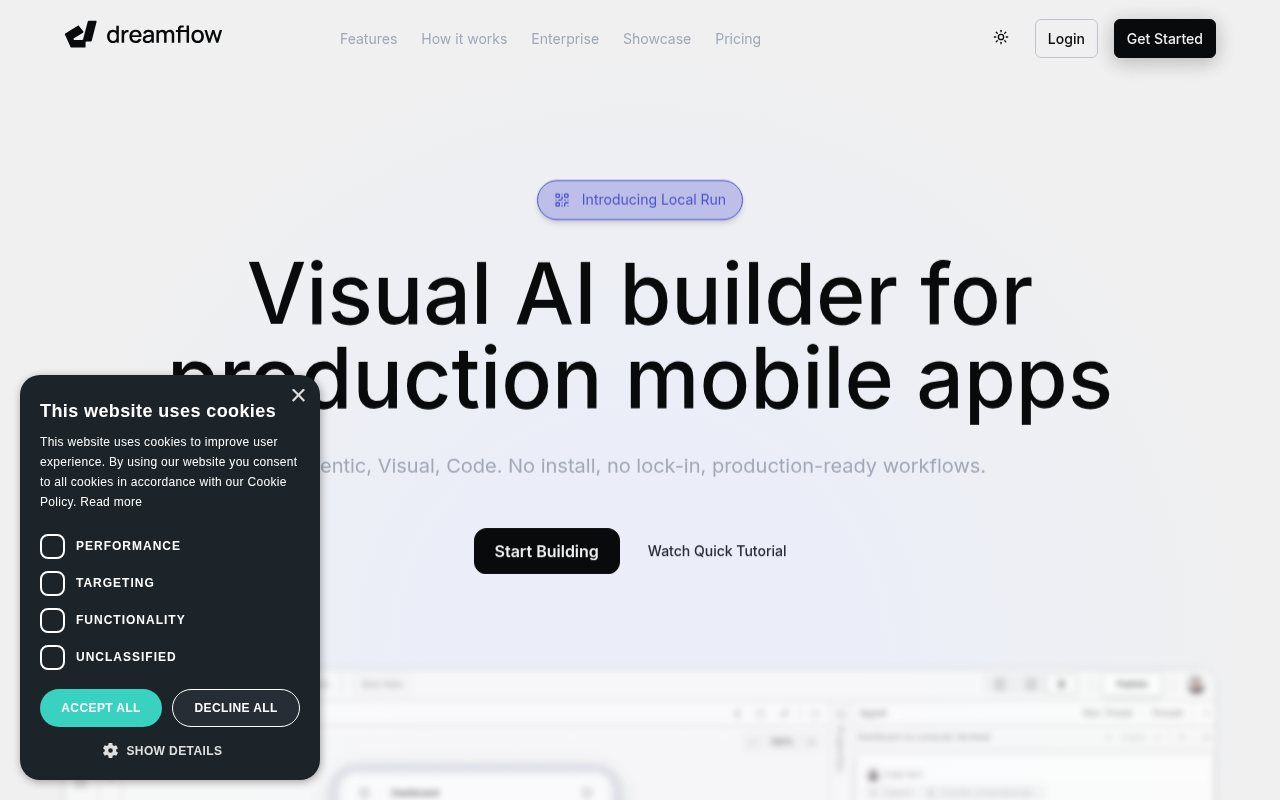
Visual AI builder from the FlutterFlow team that combines prompting, visual canvas, code editing, and cross-platform deployment for web and mobile app creation.
Dreamflow as a Lovable Alternative: Comparison & Decision Guide (2026)
Dreamflow is a legitimate Lovable alternative for builders who want AI generation plus a visual canvas and code access in one flow, especially when the project may span web and mobile, but it is not the cleanest choice if the only goal is a simple web MVP for non-technical users. For builders comparing it directly with Lovable, the real question is not whether it can generate an app from prompts. The real question is whether its workflow matches the kind of app you need to own after day one.
Dreamflow is best for founders, designers, product teams, and builders who want one workflow that mixes prompts, visual editing, code access, and cross-platform deployment across web and mobile. If your project needs a closer match to a startup-style product builder with broad product flexibility, Lovable usually stays easier to justify.
Dreamflow vs. Lovable: Quick Comparison
| Dimension | Dreamflow | Lovable |
|---|---|---|
| Primary approach | responsive web apps and cross-platform mobile products that benefit from visual editing, code export, and iterative AI scaffolding | Prompt-first web app builder for startup-style products and MVPs |
| No-code support | Strong for first drafts, but Dreamflow expects users to engage with visual and code surfaces more actively than HeyBoss or pure no-code website builders do | Strong for prompt-driven product creation, but still closer to product-building than business-software administration |
| Learning curve | Slightly steeper than Lovable for non-technical web-only users because Dreamflow adds visual-canvas and code-level choices that reward more product-building confidence | Usually low for first drafts, then rises as product complexity and prompt precision grow |
| Output stack | Flutter-based app generation with tri-surface editing across agent prompts, visual canvas, and code, plus deployment to Web, iOS, and Android | Web app output with a stronger product-MVP orientation |
| AI capability | Context-aware AI generation with iterative edits that stay synced across prompt, visual, and code surfaces | Prompt-to-app generation with iterative edits |
| Visual editing | A core differentiator; Dreamflow explicitly sells the combination of AI generation, visual canvas, and code sync | Yes |
| Figma import | Not publicly documented on the reviewed public pages | Not publicly emphasized as the core differentiator |
| Templates / starter projects | Not heavily template-marketed; the stronger story is tri-surface app creation rather than a giant template catalog | Templates and starter projects are part of the broader Lovable workflow |
| Deployment | One-click deployment for web on the free tier, with App Store and Play Store deployment on paid plans | Hosted web deployment for generated apps |
| Custom domain | Not publicly documented on the reviewed public pages | Supported for public product launches |
| Database | Firebase and Supabase integrations are highlighted as built-in backend options | Managed database path for generated apps |
| Authentication | Not exhaustively documented on the homepage, but full app workflows and backend integrations imply production-ready auth patterns | Auth support for generated apps |
| Mobile support | Very strong; Dreamflow is explicitly cross-platform and mobile-aware while still supporting web deployment | Mostly web-first |
| Git/GitHub workflow | Version control and Git are part of the Pro tier according to the public pricing section | Closer to code ownership than classic no-code tools |
| Code export / portability | Stronger than many visual builders because full code export is part of the paid workflow, but still tied to the Flutter ecosystem | A major buyer expectation in the Lovable category |
| Collaboration | Better than Lovable for teams that want designers, prompt users, and code-oriented builders to work in one synced environment | Useful for startup teams, but not primarily an enterprise workflow suite |
| Error handling / debugging | Potentially stronger than Lovable once the app grows, because code and visual views both exist, but the broader surface area can also overwhelm simpler projects | Product iteration is smoother than deep enterprise workflow debugging |
| Support quality | The team behind FlutterFlow, public docs, showcase material, and explicit pricing all point to a product with meaningful launch maturity | Documentation and community-driven onboarding |
| Pricing model | Dreamflow's pricing is refreshingly explicit for a newer AI builder, with clear Free, Hobby, Pro, and Enterprise levels instead of vague usage-only messaging.; The main cost decision is not only subscription price but whether your team actually needs the cross-platform and code-aware workflow. If not, paying for that extra power can be unnecessary compared with Lovable.; For builders who genuinely want one tool to span prototype, visual refinement, code export, and mobile or web deployment, the paid tiers can be easier to justify than stacking multiple products. | Builder-style plans and credit logic |
| Free plan | Free plan at $0 per month with 10 starter credits and web deployment | Usually suitable for prototyping and evaluation |
| Paid plans | Hobby starts at $20 per month with full code export and mobile deployment; Pro is $90 per month with Git and premium-model access; Enterprise is custom | Paid tiers unlock more serious product work |
What Dreamflow Does Differently
It combines prompt, visual, and code editing in one loop
Lovable is simpler because it keeps the workflow more prompt-first and product-centric. Dreamflow is more flexible when the team wants to move between AI generation, visual adjustments, and direct code control without switching tools.
It is stronger for cross-platform ambition
Dreamflow can deploy to Web, iOS, and Android, which makes it more attractive when the project is not purely a web MVP. Lovable is usually the cleaner choice when the product is web-only and the team wants less surface-area complexity.
It offers a more balanced designer-developer bridge
The visual canvas matters. Teams that want a builder where product, design, and code perspectives stay connected may find Dreamflow more collaborative than Lovable, even if it also asks more from the user.
Known Limitations
- It is less obvious than Lovable for completely non-technical founders who only want the fastest path to one web app.
- The Flutter and cross-platform orientation can be overkill for teams that do not care about mobile or code-level control.
- Public pricing is clear, but the jump from $20 Hobby to $90 Pro is meaningful once version control and heavier production workflow become necessary.
- Its broader workflow can feel more complex than Lovable when the project is a small web MVP rather than a cross-platform product.
Who Should Choose Dreamflow Over Lovable
Dreamflow makes more sense when the app is tightly shaped by its native strengths instead of by generic vibe-coding hype. In practice, that means you should choose it when its platform model directly reduces the hardest part of your workflow, not simply because it can also turn prompts into a UI.
- Choose Dreamflow when the app may need to ship on web and mobile, not only on the web.
- Choose it when your team wants AI generation plus a real visual canvas and code surface in one synced workflow.
- Choose it when designers and developers both need to touch the product without abandoning the AI-builder loop.
- Choose it when code export and backend integrations matter, but you still want a highly visual creation process.
When Lovable Is Better
This is the section many alternative pages weaken, but it matters here because Lovable is still one of the clearer product-first builders in the category. If your use case leans toward a standalone product, faster aesthetic experimentation, or a cleaner mental model for startup MVP work, Lovable can be the more sensible default.
- Stay with Lovable when you only need a web MVP and want the simplest product-builder experience.
- Stay with Lovable when the buyer is strongly non-technical and likely to feel slowed down by extra visual and code complexity.
- Stay with Lovable when mobile deployment is irrelevant and the cross-platform story adds more noise than value.
- Stay with Lovable when product speed and clarity are more important than tri-surface flexibility.
Pricing and Cost Predictability
Dreamflow is not only about subscription price. It is about the shape of the bill once the app becomes useful, the number of people who touch it, and the platform rules that control ongoing iteration. That matters because the cheapest-looking AI builder can become the most expensive one if the limits map badly to the way your team actually works.
- Dreamflow's pricing is refreshingly explicit for a newer AI builder, with clear Free, Hobby, Pro, and Enterprise levels instead of vague usage-only messaging.
- The main cost decision is not only subscription price but whether your team actually needs the cross-platform and code-aware workflow. If not, paying for that extra power can be unnecessary compared with Lovable.
- For builders who genuinely want one tool to span prototype, visual refinement, code export, and mobile or web deployment, the paid tiers can be easier to justify than stacking multiple products.
Prices are subject to change. Check the official pricing page before making a production choice.
Decision Matrix
This comparison is easiest when you stop asking which tool is generally better and start asking which tool is better for the exact kind of app you are trying to ship. The following quick calls capture the practical split between Dreamflow and Lovable.
- Need cross-platform web plus mobile app output: Dreamflow
- Need the simplest prompt-first web MVP flow: Lovable
- Need visual canvas plus code export in one builder: Dreamflow
- Need less workflow complexity for a solo web product experiment: Lovable
Lock-In, Ownership, and Long-Term Risk
Dreamflow is less locked-in than a classic no-code platform because paid plans include code export and the product is honest about visual plus code workflows. That reduces the risk of getting trapped in a black box when the project grows up.
The remaining lock-in comes from the ecosystem choice: Dreamflow is anchored to Flutter-style output and its own tri-surface workflow. Teams should confirm that this stack is a fit before treating it as their primary long-term builder.
Workflow Fit for Teams
Compared with Lovable, Dreamflow fits teams that do not want to choose between AI generation, visual editing, and code access. It is most compelling when the app's life will move across those three surfaces repeatedly.
It is less ideal when the only requirement is to ship one web-first MVP quickly and the team gains little from the extra flexibility.
What Builders Are Saying
External coverage tends to praise Dreamflow for combining AI speed, visual control, and code-level access in a way that feels more production-aware than many demo-first AI builders. The common caution is complexity: it shines more when the team actually needs that extra breadth.
Final Verdict
Dreamflow is a legitimate Lovable alternative for builders who want AI generation plus a visual canvas and code access in one flow, especially when the project may span web and mobile, but it is not the cleanest choice if the only goal is a simple web MVP for non-technical users.
The best way to test the fit is to rebuild one small but real workflow or product slice in both tools. If Dreamflow solves the long-term operational problem more honestly than Lovable does, it deserves the switch. If it only looks impressive in the first ten minutes, Lovable is probably still the stronger default.
Sources
- https://dreamflow.app
- https://dreamflow.app/#pricing
- https://docs.dreamflow.com/
- https://nubiapage.com/ai-login-app-pricing/
- https://upstackstudio.com/blog/dreamflow-review/
FAQ
Is Dreamflow a good Lovable alternative?
Yes, especially for cross-platform builders. It is a strong Lovable alternative when you want web plus mobile output and a workflow that combines prompts, visual editing, and code.
Does Dreamflow have a free plan?
Yes. Dreamflow lists a free plan with 10 starter credits and web deployment.
Who should choose Dreamflow over Lovable?
Teams that want visual canvas plus code access, or teams that may deploy to mobile as well as web.
What is the biggest tradeoff?
Complexity. Dreamflow offers more surfaces and power than Lovable, but that can slow down builders who only need a simple web MVP.