
Emergent
Contact
Emergent
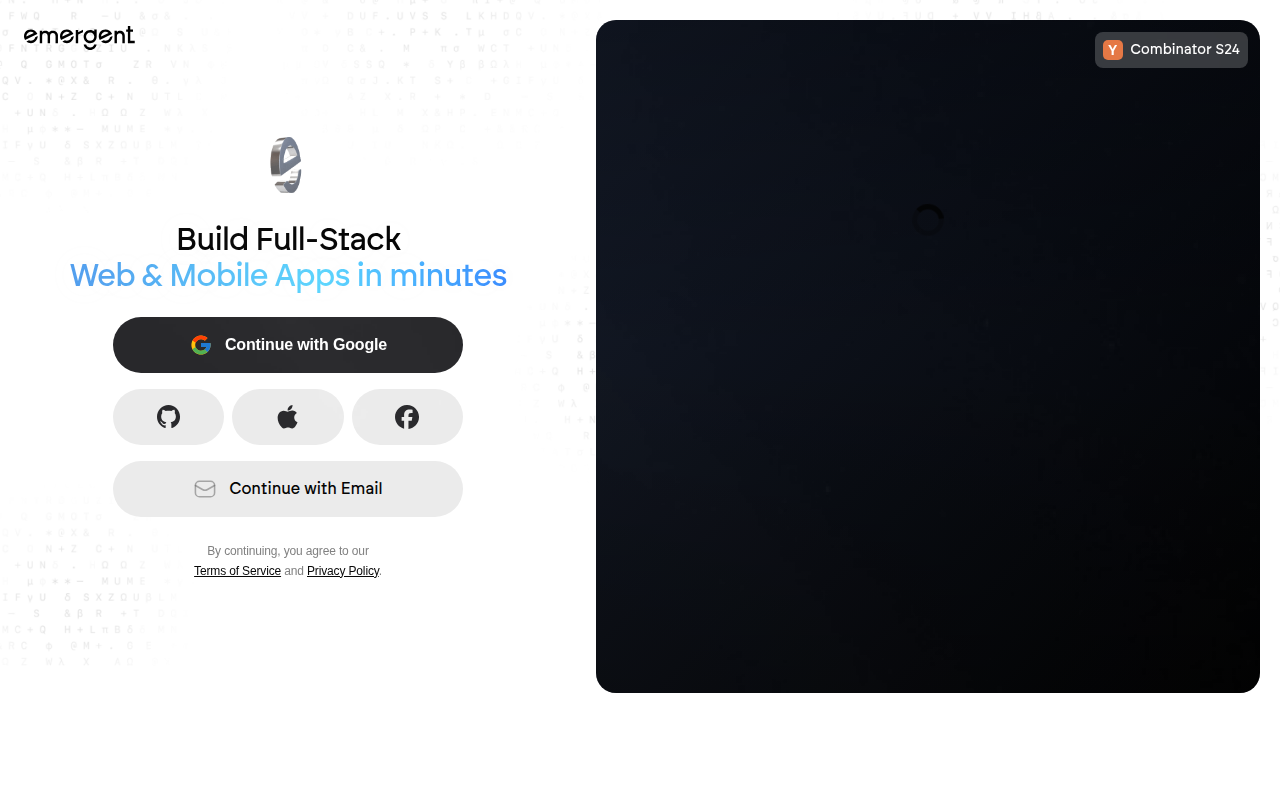
YC S24-backed AI app builder for web and native mobile apps with 3M+ users. Supports GPT, Claude, and Gemini with a 1M context window on Pro, plus custom AI agent creation.
Emergent as a Lovable Alternative: Comparison & Decision Guide (2026)
Emergent (emergent.sh) is a YC S24-backed AI app builder for web and native mobile apps, with over 3 million users worldwide. It is a credible Lovable alternative for builders who need both web and mobile outputs from a single AI platform — something Lovable does not offer natively. The main trade-off is that Emergent uses a credit-based pricing model where complex app generations consume more credits than simple ones, making monthly costs harder to predict. Beginners who want a simple, fixed-fee experience may find Lovable's pricing structure easier to plan around.
Compared to Lovable, Emergent's main edge is native mobile app generation and the availability of GPT, Claude, and Gemini with a 1M context window on the Pro plan. Its free tier (10 credits/month) is quite limited — a serious build will consume them quickly. If you are experimenting or on a tight budget, the free tier is more of a trial than a sustainable workflow.
Emergent is not the right choice if you need rich drag-and-drop visual editing, a large template library, or if cost predictability matters more than model choice.
Emergent vs. Lovable: Quick Comparison
| Decision area | Emergent | Lovable |
|---|---|---|
| Primary approach | AI-native app builder for web and native mobile apps | AI front-end + Supabase integration app builder |
| No-code support | Yes — build web and mobile apps through conversation, no code required | Yes — strong no-code workflow, very beginner-friendly |
| Learning curve | Low for web apps; low-to-moderate for mobile app generation | Low — widely considered beginner-friendly |
| Output stack | Web apps and native mobile apps; custom AI agents | React front-end + Supabase backend |
| AI capability / builder style | Multi-model: GPT, Claude, Gemini (1M context on Pro) | AI-generated React; strong at UI iteration |
| Visual editing | Primarily conversational/prompt-driven | Inline visual editor; click-to-edit elements |
| Figma import | Not publicly documented | Yes — Figma to app conversion supported |
| Templates / starter projects | Not prominently featured in public docs | Growing library of app and project templates |
| Deployment | Private project hosting on Standard+ | Instant deploy via Lovable subdomain or custom domain |
| Custom domain | Not publicly documented at Standard tier; check pricing page | Available on paid plans |
| Database | Not publicly documented as standalone feature | Supabase integration |
| Authentication | Not publicly documented as standalone feature | Via Supabase Auth |
| Mobile support | Yes — native mobile app generation is a core feature | Responsive web only; native mobile not publicly documented |
| Git/GitHub workflow | GitHub integration on Standard+ plans | GitHub sync on paid plans |
| Code export / portability | Not publicly documented | Code accessible; export possible |
| Collaboration | Team plan ($300/mo, 1250 shared credits) | Collaboration supported on team plans |
| Support quality / onboarding help | Priority support on Pro; SOC 2 Type I certified | Strong onboarding; active community |
| Pricing model | Credit-based (complexity affects credits consumed) | Credit-based |
| Free plan | Yes — 10 credits/month (very limited) | Yes — limited credits/month |
| Paid plans | Standard $20/mo (100 credits), Pro $200/mo (750 credits), Team $300/mo | Multiple tiers; credit packs available |
What Emergent Does Differently
Native mobile app generation
Emergent generates both web and native mobile apps from the same conversational workflow. Lovable is a web-only builder — if you want a mobile app, you need a separate tool or a separate workflow. For founders who want to ship a web app and a mobile app from a single prompt-based process, Emergent removes a major workflow gap. This is the single most important differentiator for this platform in the Lovable alternative context.
Access to frontier models with 1M context window
The Emergent Pro plan ($200/mo) provides access to GPT, Claude, and Gemini with a 1 million token context window and "ultra thinking" mode. For large, complex apps with many interconnected features, a larger context window means the AI can hold more of your app's structure in memory while generating new features — reducing broken references and inconsistent code. Lovable's model selection and context limits are not publicly documented in comparable detail.
Custom AI agents as app output
On Emergent Pro, you can create custom AI agents as part of your app — not just build an app that calls an API, but define AI agents with custom system prompts and capabilities. For teams building internal tools with AI automation built in, this extends Emergent beyond a pure app builder into a workflow automation layer. This is an adjacent capability that Lovable does not offer.
YC-backed with SOC 2 Type I certification
Emergent is Y Combinator S24-backed and holds SOC 2 Type I certification. For teams building apps that handle user data and need to demonstrate security compliance to customers or stakeholders, SOC 2 certification is a meaningful trust signal. This is relevant for professional teams and agencies, not just solo experimenters.
Known Limitations
- Pricing risk from credit-based billing: Credits are consumed based on generation complexity. A complex multi-feature app build can consume 10 credits quickly, and on the Standard plan (100 credits/month at $20/mo), it is easy to exhaust your allowance mid-month. Extra credits can be purchased, but costs can compound unpredictably compared to flat-rate alternatives.
- Free tier is extremely limited: 10 credits/month means you can complete a handful of simple generations. For serious prototyping, the free plan is a trial, not a working plan. Lovable's free tier, while also limited, offers more room for exploration.
- Visual editing is minimal vs Lovable: Emergent is a conversational builder. It does not provide Lovable's inline click-to-edit or drag-and-drop visual interface. Non-technical users who want to tweak layouts visually without re-prompting will find this limiting.
- Backend/database specifics not publicly documented: Unlike Blink.new, Emergent does not prominently document what database, auth, or storage is provisioned by default. For builders who need to understand the backend infrastructure, this creates uncertainty when planning a production app.
- Pro plan is expensive vs Lovable alternatives: At $200/mo, the Emergent Pro plan is significantly higher than most AI builder competitors. The 750 credit allowance may still be consumed quickly for complex projects, making this a substantial budget commitment without clear usage-to-credit conversion documentation.
Who Should Choose Emergent Over Lovable?
- Founders who need both web and mobile app from one tool — Emergent's native mobile app generation is the single strongest reason to choose it over Lovable for multi-platform products.
- Teams with SOC 2 compliance requirements — Emergent's SOC 2 Type I certification is relevant for B2B apps that need to demonstrate data security posture to customers or enterprise clients.
- Builders who need access to multiple frontier AI models — If model quality, context window size, and "ultra thinking" mode are important for generating complex logic, Emergent's Pro plan offers more model choice than most competitors.
- Agencies building custom AI agents as part of deliverables — Emergent Pro's custom agent creation capability makes it suited for agencies that need to deliver AI-powered internal tools or automation workflows as part of a project.
When Lovable Is Still the Better Choice
- You need visual editing tools — Lovable's inline click-to-edit and drag-and-drop UI is significantly more developed. For design-first builders, Lovable's visual layer reduces re-prompting friction.
- You need a larger template library — Lovable has a more established set of starter templates and community clones. Emergent's template offering is not prominently documented.
- Predictable monthly cost matters — Lovable's plans are also credit-based, but Lovable has more established community guidance on what each plan buys you. Emergent's credit consumption per task is less clearly documented.
- Budget is limited — If you need the Standard tier for serious builds, both Emergent Standard ($20/mo, 100 credits) and Lovable are comparable in entry price. But Emergent's Pro jump to $200/mo has no mid-tier equivalent, while Lovable offers more intermediate tiers.
Pricing Comparison & Cost at Scale
Emergent plan overview
- Free — $0/mo: 10 credits/month, all core platform features, web and mobile builds, access to advanced models.
- Standard — $20/mo (annual, save $36): 100 credits/month, private project hosting, GitHub integration, fork tasks, extra credits purchasable.
- Pro — $200/mo (annual, save $396): 750 credits/month, 1M context window, ultra thinking, custom AI agents, high-performance computing, priority support.
- Team — $300/mo: 1,250 shared credits, team collaboration.
- Enterprise — custom: Custom credits and SLA.
Prices are subject to change. Verify at https://emergent.sh/pricing before subscribing. Annual billing gives significant discounts; monthly billing is higher.
| Scenario | Emergent | Lovable | Notes |
|---|---|---|---|
| Solo builder, just exploring | $0/mo (10 credits) | Limited free credits | Both free tiers are minimal for serious work |
| Active builder, moderate use | $20/mo (100 credits) | ~$20-25/mo | Comparable entry price; credit consumption rates differ |
| Power user needing all models + mobile | $200/mo (750 credits) | Lower-cost tiers available | Emergent Pro is significantly more expensive; justified only if mobile or 1M context needed |
| Small team (3-5 builders) | $300/mo Team (1250 shared credits) | Per-seat team pricing | Shared credit pool means one heavy user can consume team allowance |
Credit risk note: Both Emergent and Lovable use credit-based billing. Emergent's free documentation of credit-to-task conversion is limited. Before committing to Standard or Pro, test your typical workflow on the free tier to estimate monthly credit burn rate.
How Emergent Compares to Other Options
- vs. Blink.new: Blink offers a more transparent backend stack (Postgres, auth included) and flat-rate pricing. Emergent's advantage is native mobile app generation and multi-model access. For web-only apps with backend needs, Blink is more cost-predictable.
- vs. FlutterFlow: FlutterFlow is purpose-built for Flutter-based mobile and web apps with a visual designer. Emergent generates apps conversationally. FlutterFlow gives more design control; Emergent is faster for non-technical builders who want to describe rather than design.
- vs. Adalo: Adalo is a visual no-code app builder for simple mobile and web apps. Emergent uses AI generation rather than drag-and-drop. Adalo is more predictable for simple data-driven apps; Emergent is better for AI-heavy or complex apps.
FAQ
Is Emergent free to use?
Yes — there is a free plan with 10 credits/month and access to core features. However, 10 credits is enough for very simple builds only. For serious prototyping, the Standard plan ($20/mo) is the realistic starting point.
Do I need to know how to code?
No — Emergent is a conversational AI builder. You describe what you want to build, and the AI generates and deploys the app. No coding is required from the user at any plan level.
Is Emergent good for beginners?
Partially. Emergent is accessible via conversation, but its credit model and lack of visual editing tools mean beginners may find it harder to iterate quickly on design. Lovable's visual editor and larger community make it more forgiving for first-time app builders. Emergent is better for beginners who specifically need mobile app output.
Can Emergent replace Lovable?
For web-and-mobile use cases, yes — Emergent does what Lovable does for web, plus adds mobile. For pure web apps with a focus on UI design iteration, Lovable's visual tools make it harder to replace. The decision largely hinges on whether you need mobile output and how important visual editing is.
How does Emergent's credit system work?
Credits are consumed per generation. Simple tasks (a small UI update) use fewer credits; complex tasks (building a multi-feature app from scratch) use more. The exact credit cost per task is not publicly documented with a fixed conversion rate, which makes monthly budgeting harder to forecast without testing your own workflow first.
Does Emergent build native mobile apps?
Yes — native mobile app generation for web and mobile is a core Emergent feature, available from the Standard plan. This is the primary reason to choose Emergent over most AI app builder competitors, which are web-only.