Flatlogic
Contact
Flatlogic
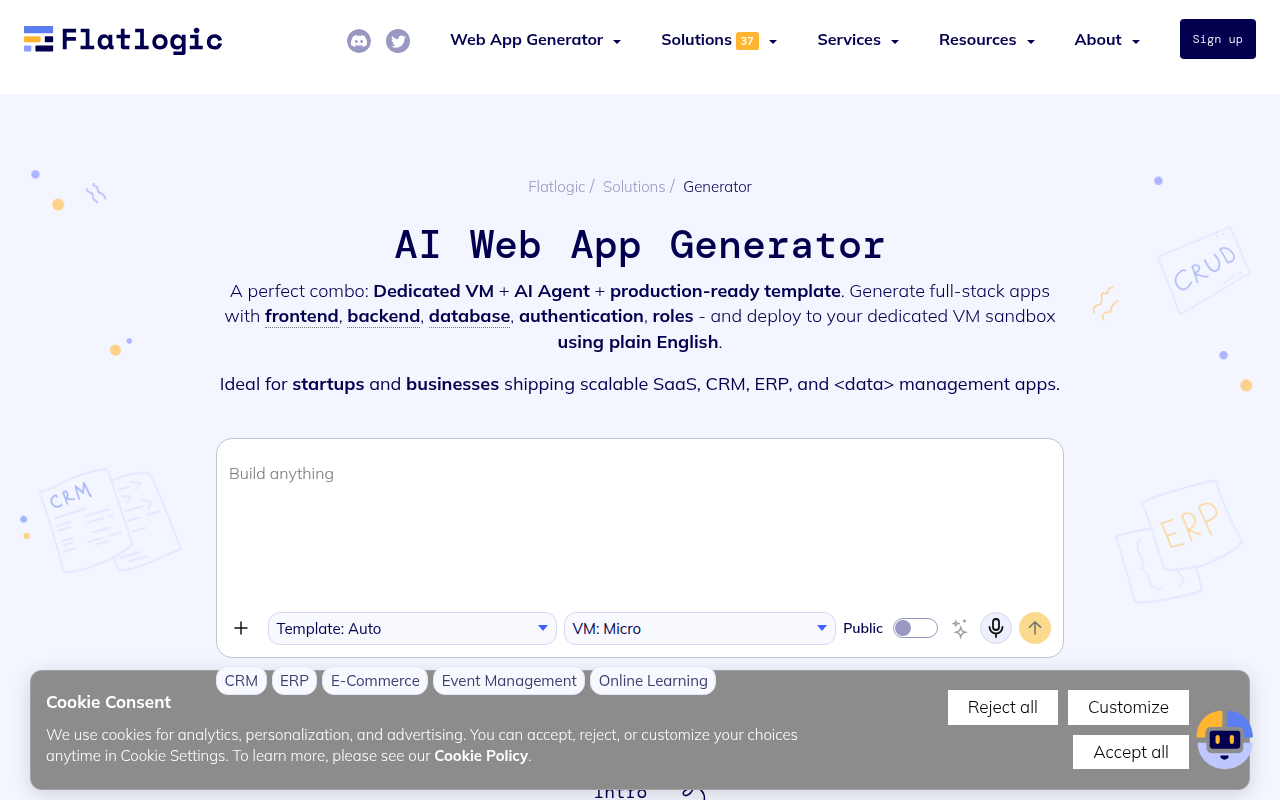
AI web application generator for startups and SMBs that produces full-stack business apps with frontend, backend, database, roles, and hosted VM deployment from plain-English prompts.
Flatlogic as a Lovable Alternative: Comparison & Decision Guide (2026)
Flatlogic is a credible Lovable alternative for founders and small teams that want AI-generated business software with stronger full-stack structure, clearer source-code ownership paths, and VM-based deployment instead of a lighter prompt-first product builder. For builders comparing it directly with Lovable, the real question is not whether it can generate an app from prompts. The real question is whether its workflow matches the kind of app you need to own after day one.
Flatlogic is best for startups, SMBs, agencies, internal-tool builders, and operators who want AI-generated SaaS, CRM, ERP, or dashboard apps with a more explicit backend, database, and deployment story. If your project needs a closer match to a startup-style product builder with broad product flexibility, Lovable usually stays easier to justify.
Flatlogic vs. Lovable: Quick Comparison
| Dimension | Flatlogic | Lovable |
|---|---|---|
| Primary approach | full-stack business web apps such as SaaS back offices, internal tools, CRMs, ERPs, and data-heavy operational dashboards | Prompt-first web app builder for startup-style products and MVPs |
| No-code support | Moderate to strong; Flatlogic starts from AI prompts and templates, but it expects users to think more in software structure and app architecture than in pure no-code marketing language | Strong for prompt-driven product creation, but still closer to product-building than business-software administration |
| Learning curve | Higher than Lovable for total beginners because VM hosting, credits, templates, and app structure are more visible parts of the workflow | Usually low for first drafts, then rises as product complexity and prompt precision grow |
| Output stack | Production-oriented full-stack web apps with React or PHP-based stacks, relational data, authentication, roles, and a dedicated VM sandbox | Web app output with a stronger product-MVP orientation |
| AI capability | Prompt-to-app generation plus iterative AI modifications on top of a production-ready template and hosted development environment | Prompt-to-app generation with iterative edits |
| Visual editing | Limited compared with visual-first builders; the value comes more from generated software structure than from a design-canvas workflow | Yes |
| Figma import | Not publicly documented | Not publicly emphasized as the core differentiator |
| Templates / starter projects | Template-led generation for SaaS, CRM, ERP, event management, AI workspaces, WordPress, and other business-app starting points | Templates and starter projects are part of the broader Lovable workflow |
| Deployment | Dedicated VM deployment and hosted development or stable environments are part of the core offer, not an afterthought | Hosted web deployment for generated apps |
| Custom domain | Supported through deployed app environments and source-code ownership workflows | Supported for public product launches |
| Database | Relational database support is first-class, with PostgreSQL, MySQL, and backend models built into the generated app structure | Managed database path for generated apps |
| Authentication | Authentication, roles, and access control are explicitly included in the product story and generated output | Auth support for generated apps |
| Mobile support | Responsive web apps, but not a mobile-first native builder story | Mostly web-first |
| Git/GitHub workflow | Supported through push-to-GitHub and source-code download or ownership flows | Closer to code ownership than classic no-code tools |
| Code export / portability | Stronger than many no-code competitors because the platform emphasizes source-code ownership and generated app control, though template licenses and paid-plan rules still matter | A major buyer expectation in the Lovable category |
| Collaboration | Built for SMB and startup teams that need collaborators inside a shared app workflow rather than solo prompt experimentation only | Useful for startup teams, but not primarily an enterprise workflow suite |
| Error handling / debugging | Stronger than Lovable for structured backend-heavy business apps because the generated result exposes more app architecture, but weaker for ultra-fast first-draft UX iteration | Product iteration is smoother than deep enterprise workflow debugging |
| Support quality | The product exposes pricing, example apps, deployment options, documentation-like product copy, and a clear enterprise upgrade path | Documentation and community-driven onboarding |
| Pricing model | Flatlogic separates cost into plan price, AI credits, hosting, and template licenses, which makes it more transparent for serious software work but less emotionally simple than Lovable's cleaner consumer-style builder plans.; The entry Pro plan at $20 per month is attractive for teams that already know they need real backend structure, but the total bill can rise once you add paid templates and always-on hosting.; For teams building internal tools or data-heavy SaaS admin layers, that complexity can still be more predictable than choosing a prettier builder that hides infrastructure tradeoffs until later. | Builder-style plans and credit logic |
| Free plan | Free plan with 5 credits per month and up to 3 public apps, aimed at testing and prototypes | Usually suitable for prototyping and evaluation |
| Paid plans | Pro starts at $20 per month with 25 credits, private apps, paid templates, and stable environments; Enterprise is custom-priced | Paid tiers unlock more serious product work |
What Flatlogic Does Differently
It starts from software structure, not demo-friendly prompt magic
Flatlogic immediately foregrounds stacks, databases, roles, and hosted environments. That makes it less magical than Lovable in the first five minutes, but often more honest about what production business apps actually need after the screenshot moment passes.
It treats deployment and source control as part of the product
Lovable is better when the buyer mostly wants a fast product-shaped web app. Flatlogic is stronger when the buyer wants generated software that can be hosted, iterated, and moved closer to a normal engineering workflow.
It is better suited to admin, workflow, and operations-heavy apps
The examples, templates, and pricing logic all suggest a platform optimized for CRMs, dashboards, portals, and internal business systems. That is a closer match than Lovable when the project is more operations software than brand-forward startup product.
Known Limitations
- It is less beginner-friendly than Lovable because the product exposes infrastructure and software-delivery decisions earlier in the workflow.
- The template-plus-credits-plus-hosting model is more cognitively demanding than simpler AI app builders for non-technical founders who only want a polished first release.
- Visual editing is not the main strength, so teams that care deeply about UI experimentation may feel more friction than in Lovable.
- Paid template licenses and hosting add-ons mean the total production cost can exceed the attractive $20 headline plan faster than some buyers expect.
Who Should Choose Flatlogic Over Lovable
Flatlogic makes more sense when the app is tightly shaped by its native strengths instead of by generic vibe-coding hype. In practice, that means you should choose it when its platform model directly reduces the hardest part of your workflow, not simply because it can also turn prompts into a UI.
- Choose Flatlogic when the app is an internal tool, SaaS back office, CRM, ERP, or dashboard that truly benefits from explicit backend structure.
- Choose it when source-code ownership and GitHub continuity matter more than the easiest first prototype experience.
- Choose it when your team can tolerate a more technical setup in exchange for a clearer route from generated prototype to maintainable software.
- Choose it when deployment, data modeling, and roles are core needs rather than secondary details.
When Lovable Is Better
This is the section many alternative pages weaken, but it matters here because Lovable is still one of the clearer product-first builders in the category. If your use case leans toward a standalone product, faster aesthetic experimentation, or a cleaner mental model for startup MVP work, Lovable can be the more sensible default.
- Stay with Lovable when speed to a polished product mockup or MVP matters more than backend explicitness.
- Stay with Lovable when the primary user is a non-technical founder who wants the lowest-friction path from prompt to visible web app.
- Stay with Lovable when UI experimentation and product feel outweigh admin workflows, roles, and managed VM deployment.
- Stay with Lovable when you do not want to think about templates, credits, and hosting as separate moving parts.
Pricing and Cost Predictability
Flatlogic is not only about subscription price. It is about the shape of the bill once the app becomes useful, the number of people who touch it, and the platform rules that control ongoing iteration. That matters because the cheapest-looking AI builder can become the most expensive one if the limits map badly to the way your team actually works.
- Flatlogic separates cost into plan price, AI credits, hosting, and template licenses, which makes it more transparent for serious software work but less emotionally simple than Lovable's cleaner consumer-style builder plans.
- The entry Pro plan at $20 per month is attractive for teams that already know they need real backend structure, but the total bill can rise once you add paid templates and always-on hosting.
- For teams building internal tools or data-heavy SaaS admin layers, that complexity can still be more predictable than choosing a prettier builder that hides infrastructure tradeoffs until later.
Prices are subject to change. Check the official pricing page before making a production choice.
Decision Matrix
This comparison is easiest when you stop asking which tool is generally better and start asking which tool is better for the exact kind of app you are trying to ship. The following quick calls capture the practical split between Flatlogic and Lovable.
- Need a structured CRM, ERP, dashboard, or internal SaaS app: Flatlogic
- Need the fastest prompt-first product MVP flow: Lovable
- Need a clearer route to GitHub and source-code ownership: Flatlogic
- Need simpler first-run UX for a non-technical founder: Lovable
Lock-In, Ownership, and Long-Term Risk
Flatlogic is less lock-in-heavy than classic no-code platforms because it explicitly talks about source-code ownership, GitHub, and downloadable software. That lowers the strategic risk if you expect the app to become a normal engineering asset later.
The tradeoff is that you pay with more workflow complexity now. You still depend on the platform's template and hosted-environment model during creation, so portability is better than in many alternatives, but not frictionless.
Workflow Fit for Teams
Compared with Lovable, Flatlogic fits teams that are already thinking about business logic, data models, hosting, and admin workflows before launch. It feels closer to AI-assisted software production than to vibe-coded product storytelling.
It is less ideal for solo founders who mainly want the smoothest path to a beautiful first release and only later plan to worry about backend or ownership details.
What Builders Are Saying
External writeups describe Flatlogic as stronger for full-stack business software than for casual prompt experimentation. The upside is structure, code ownership, and deployment honesty; the downside is a steeper learning curve and a more layered cost model.
- https://uibakery.io/blog/ai-app-generator-tools
- https://www.noupe.com/magazine/business-online/no-code-ai-app-builders.html
Final Verdict
Flatlogic is a credible Lovable alternative for founders and small teams that want AI-generated business software with stronger full-stack structure, clearer source-code ownership paths, and VM-based deployment instead of a lighter prompt-first product builder.
The best way to test the fit is to rebuild one small but real workflow or product slice in both tools. If Flatlogic solves the long-term operational problem more honestly than Lovable does, it deserves the switch. If it only looks impressive in the first ten minutes, Lovable is probably still the stronger default.
Sources
- https://flatlogic.com/generator
- https://flatlogic.com/pricing
- https://flatlogic.com/generator
- https://uibakery.io/blog/ai-app-generator-tools
- https://www.noupe.com/magazine/business-online/no-code-ai-app-builders.html
FAQ
Is Flatlogic a good Lovable alternative?
Yes, especially for structured business apps. It is a stronger Lovable alternative when the project needs real backend structure, roles, databases, and a clearer path to owned code.
Does Flatlogic have a free plan?
Yes. Flatlogic's pricing page shows a free plan with 5 monthly credits and up to 3 public apps.
Who should choose Flatlogic over Lovable?
Teams building internal tools, CRMs, ERPs, or SaaS back offices. It is best when software structure matters more than the smoothest no-code onboarding.
What is the biggest tradeoff?
Complexity. Flatlogic is more transparent about infrastructure and ownership, but that also makes it less beginner-friendly than Lovable.