
Frontly
Contact
Frontly
AI no-code app builder for portals, dashboards, and custom business software.
Frontly as a Lovable Alternative: No-Code Business App Builder (2026)
Frontly is a practical Lovable alternative if your goal is to turn a prompt into a client portal, internal dashboard, or lightweight business app without touching code. Lovable is usually stronger when the project starts as a broad product idea and you want to iterate toward a polished public-facing SaaS experience quickly. Frontly is better when the buyer already knows the workflow they want to automate and values no-code editing more than code ownership.
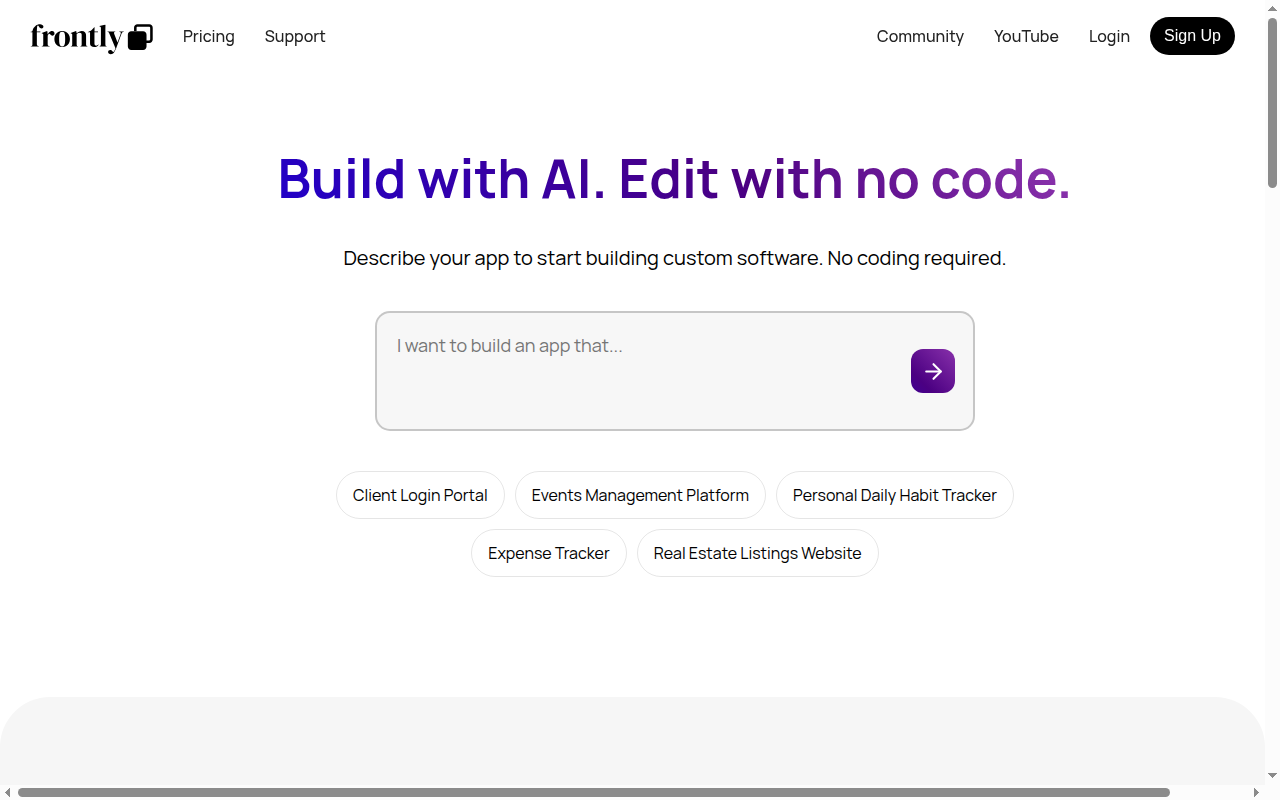
The homepage is unusually direct about the target outcome: custom software, no coding required, and app examples like client login portals, events management, habit tracking, expense tracking, and real estate listings. That makes Frontly feel less like an open-ended coding copilot and more like an AI-assisted no-code builder for repeatable business use cases.
If you need deep stack control, a developer-grade backend story, or a clear export path into your own engineering workflow, Frontly is the wrong first choice. It fits founders, operators, and small teams that want software outcomes quickly, not teams that already know they will hand the codebase to engineers in the next sprint.
Frontly vs. Lovable: Quick Comparison
| Decision area | Frontly | Lovable |
|---|---|---|
| Primary approach | AI no-code builder for custom business apps | AI app builder with stronger public-product momentum |
| No-code support | High; the product is positioned around building without code | High for prototyping, but often paired with code-oriented workflows |
| Learning curve | Low to moderate for structured apps | Low for first-pass generation, then higher once complexity grows |
| Typical output | Client portals, internal tools, CRUD-style business apps | Broader SaaS MVPs, landing-plus-product ideas, startup experiments |
| AI builder style | Prompt to app, then visual no-code editing | Prompt to app with more code-adjacent expectations |
| Visual editing | Core part of the product story | Strong iteration loop, but not framed as a classic no-code editor |
| Templates / starter ideas | Homepage showcases concrete business-app examples | Broader experimentation and concept-driven creation |
| Users included | Homepage lists unlimited users on public plans | User limits depend on project architecture and pricing model |
| Operational limits | Monthly operations and AI credits are explicit | Cost pressure can show up later through usage or external services |
| Branding control | Custom branded apps start on paid plans | Branding flexibility depends more on how the generated app is extended |
| API access | Publicly listed on the Professional plan | Possible, but often tied to the generated stack and follow-up work |
| Code portability | Not publicly documented as a major selling point | Usually a bigger part of the buying conversation |
| Best fit | Operators and founders shipping software for a known workflow | Founders validating a broader product concept |
| Worst fit | Teams that already need a handoff-ready codebase | Teams that want a mostly visual no-code builder |
What Frontly Does Differently
It is more opinionated about business software
Frontly is not trying to be the universal answer for every kind of software project. The examples on the homepage lean into portals, trackers, directories, and process-heavy apps rather than consumer-grade product fantasies.
That matters because a lot of people searching for a Lovable competitor are not actually building the next breakout SaaS company. They need an app that helps clients log in, staff update records, or a small team manage a workflow without waiting on engineering.
The pricing model exposes practical operating limits early
Frontly surfaces monthly operations and AI credits on the homepage, which gives buyers a more grounded way to estimate scale than a vague promise of unlimited AI generation. The free Starter plan includes 1,000 monthly operations and 250 AI credits, while Basic and Professional raise those caps to 10,000 and 50,000 monthly operations respectively.
That is useful if you are buying software for a real team, because it forces you to think about live usage rather than only the initial generation moment. Lovable often wins the imagination stage; Frontly is easier to reason about once you are mapping an actual recurring business process.
No-code editing is the main story, not a side feature
Frontly leads with "Build with AI. Edit with no code," which is a clear signal about who the product is for. The product promise is not that you will become a developer by accident; it is that you can get software outcomes through prompts and then keep refining them in a no-code environment.
That makes Frontly more approachable for non-technical teams than many code-first builders that start friendly but quietly assume you will tolerate a much more technical workflow later.
Known Limitations
- Frontly does not publicly emphasize code export, self-hosting, or a developer handoff path, so teams with a strict portability requirement should treat lock-in as a serious due-diligence question.
- The pricing model is clearer than many builder tools, but monthly operations and AI credits create a second layer of scaling cost that buyers need to forecast before multiple workflows go live.
- Lovable is usually a better fit when the goal is a public-facing startup MVP with a strong product story, more custom frontend ambition, or a smoother path into code-first iteration.
- Custom branded apps are gated behind paid tiers, which means the cheapest path is good for proving value but less ideal if white-label presentation matters early.
- Core technical details such as database architecture, export depth, and advanced integration constraints are not fully documented on the homepage, so enterprise buyers will need a deeper technical review before standardizing on it.
Who Should Choose Frontly Over Lovable?
- Choose Frontly if you are a founder or operator who already knows the workflow and mainly needs software delivered without hiring developers first.
- Choose it if the app is essentially a portal, tracker, dashboard, or other business system where clean structure matters more than product theatrics.
- Choose it if your users are internal staff, clients, or a controlled audience rather than a broad public SaaS market.
- Choose it if visual editing and non-technical maintenance matter more to you than code ownership.
When Lovable Is Still the Better Choice
- Stay with Lovable if the project is a public-facing SaaS concept where the first impression, demo quality, and product narrative matter more than back-office workflow structure.
- Stay with Lovable if you want a builder that sits closer to a code-adjacent startup workflow and you expect engineers to extend the result quickly.
- Stay with Lovable if you are still exploring what the product should be, not just implementing a known business process.
- Stay with Lovable if long-term portability and developer handoff are already top-of-mind on day one.
Pricing Comparison and Cost at Scale
Frontly is refreshingly concrete about public pricing. Starter is free and includes unlimited apps, unlimited users, 1,000 monthly operations, 250 AI credits, and community support. Basic is listed at $30 per month with unlimited apps, unlimited users, 10,000 monthly operations, 1,000 AI credits, team support, and one custom branded app.
Professional is listed at $100 per month with 50,000 monthly operations, 5,000 AI credits, priority support, API access, and three custom branded apps. Enterprise is custom. Prices are subject to change, but the key takeaway is that Frontly prices around a blend of generation capacity, runtime activity, branding, and support rather than only charging for a prompt box.
That pricing is easier to budget for than a fuzzy usage story, but it also means you need to think about scale earlier. If several workflows go live and real people use them every day, operations and credit limits become a buyer risk, not just a technical detail.
How This Tool Compares to Other Options
If Frontly feels too constrained, Bubble and Softr are the most obvious adjacent options in this directory for no-code business software. If it feels not code-centric enough, Lovable or Replit usually make more sense for teams that expect a faster handoff into developer-led expansion.
FAQ
Is Frontly good for beginners?
Yes, mostly. Frontly is one of the more approachable options here because it leads with no-code editing and concrete business-app examples. It is still easiest when the workflow is already clear.
Do I need to know how to code to use Frontly?
No, not by default. The public product positioning is explicitly no-code. The bigger question is not coding skill, but whether you can define the workflow and data you want the app to support.
Is Frontly free?
Yes, to start. The Starter plan is publicly listed as free, with usage caps around monthly operations and AI credits.
Can Frontly replace Lovable?
Partially. It can replace Lovable for many portal, dashboard, and internal-tool use cases. It is a weaker substitute when the project needs a more code-centric or public-product-oriented path.
What is Frontly's biggest trade-off?
Portability clarity. Frontly looks strong for no-code delivery, but public information does not make code export or self-hosting a central promise, so exit risk should be evaluated early.