
Jotform AI App Builder
Contact
Jotform AI App Builder
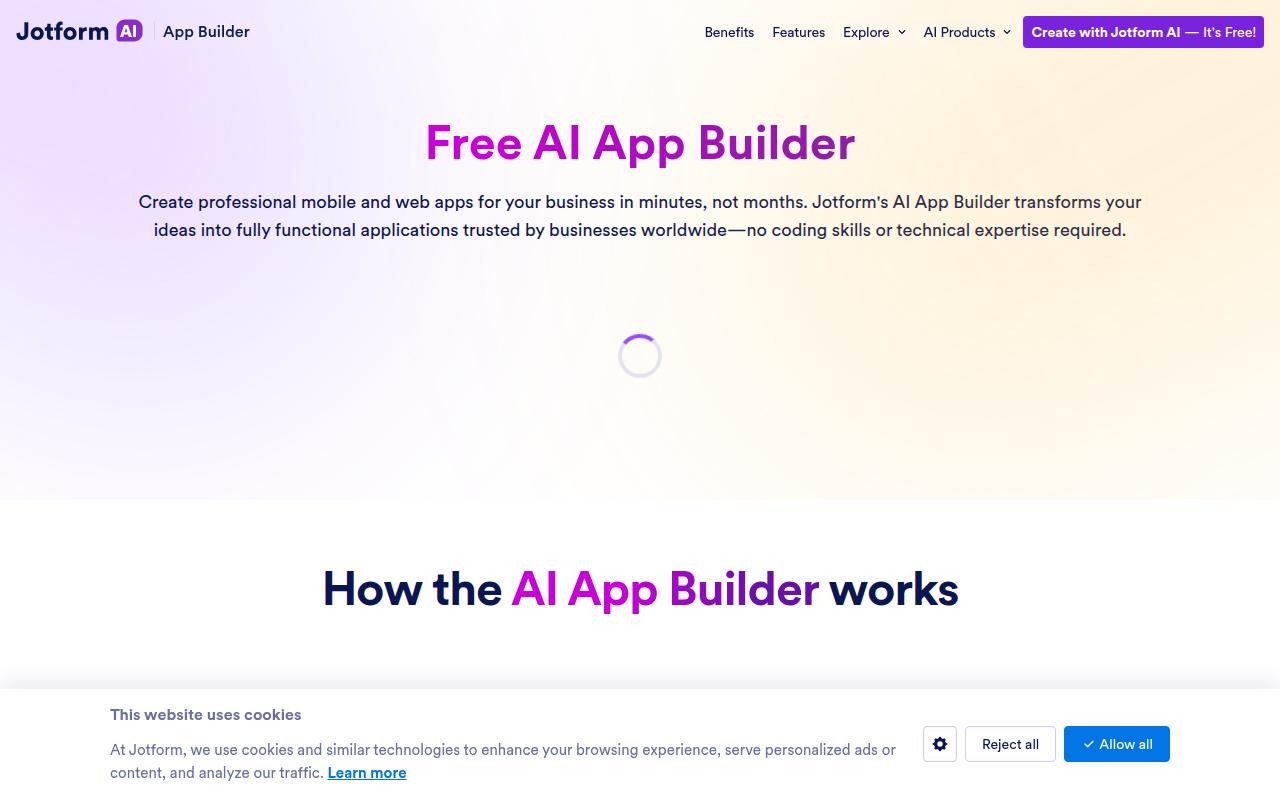
Prompt-based business app builder that turns text, voice, files, or URLs into apps with forms, workflows, AI agents, and field-ready portals.
Jotform AI App Builder as a Lovable Alternative: Comparison & Decision Guide (2026)
Jotform AI App Builder is a credible Lovable alternative for business teams that care more about forms, approvals, portals, and workflow speed than about owning production code. For builders comparing it directly with Lovable, the real question is not whether it can generate an app from prompts. The real question is whether its workflow matches the kind of app you need to own after day one.
Jotform AI App Builder is best for operations teams, service businesses, internal request flows, client intake portals, field teams, and non-technical departments that already think in forms, approvals, and business workflows. If your project needs a closer match to a startup-style product builder with broad product flexibility, Lovable usually stays easier to justify.
Jotform AI App Builder vs. Lovable: Quick Comparison
| Dimension | Jotform AI App Builder | Lovable |
|---|---|---|
| Primary approach | business apps, intake flows, approval workflows, service portals, field operations, and internal tools that turn forms into structured app experiences | Prompt-first web app builder for startup-style products and MVPs |
| No-code support | Very strong; text, voice, file, or URL prompts generate the app, then the result can be refined with drag-and-drop editing | Strong for prompt-driven product creation, but still closer to product-building than business-software administration |
| Learning curve | Lower than Lovable for non-technical teams because the workflow stays close to forms and business processes instead of product-building abstractions | Usually low for first drafts, then rises as product complexity and prompt precision grow |
| Output stack | Managed no-code app layer inside Jotform with forms, pages, widgets, workflows, analytics, and app distribution | Web app output with a stronger product-MVP orientation |
| AI capability | Text-to-app, voice-to-app, file-to-app, built-in AI Copilot, AI agents inside apps, and assisted edits after generation | Prompt-to-app generation with iterative edits |
| Visual editing | Yes; drag-and-drop editing, widgets, and workflow adjustments are central to the product | Yes |
| Figma import | Not publicly documented | Not publicly emphasized as the core differentiator |
| Templates / starter projects | Thousands of templates plus AI-generated starting points for business apps and portals | Templates and starter projects are part of the broader Lovable workflow |
| Deployment | Hosted web and mobile-friendly app deployment inside Jotform with branded app experiences | Hosted web deployment for generated apps |
| Custom domain | Available on higher plans according to Jotform pricing and app-platform positioning | Supported for public product launches |
| Database | Workflow and submission-centric data layer anchored in Jotform forms, approvals, and app structures | Managed database path for generated apps |
| Authentication | Role-based access and account-controlled access for business workflows and portals | Auth support for generated apps |
| Mobile support | Strong for field teams and mobile usage, including offline support highlighted in external reviews | Mostly web-first |
| Git/GitHub workflow | Not publicly documented | Closer to code ownership than classic no-code tools |
| Code export / portability | Source-code export is not part of the public story, so long-term ownership stays closer to the platform than to a repo | A major buyer expectation in the Lovable category |
| Collaboration | Strong for business teams because approvals, forms, signatures, payments, agents, and analytics already live inside the same ecosystem | Useful for startup teams, but not primarily an enterprise workflow suite |
| Error handling / debugging | Workflow and business-rule refinement are easier than code debugging, but software-engineering style inspection is not the core experience | Product iteration is smoother than deep enterprise workflow debugging |
| Support quality | Large documentation footprint, templates, launch content, and established Jotform support channels | Documentation and community-driven onboarding |
| Pricing model | The entry price is friendly for teams that already need forms, approvals, or portal workflows, because the app builder sits on top of a mature business-workflow platform instead of being a greenfield product tool only.; Pricing is less predictable than Lovable for heavy operational usage because forms, submissions, automation intensity, and business-app scale can matter as much as the headline plan price.; The economic upside is that one subscription can replace a patchwork of forms, portals, signatures, and workflow tools for smaller service businesses and internal teams. | Builder-style plans and credit logic |
| Free plan | Free plan available; external reviews cite paid entry around $34 to $39 per month depending on billing and plan mix | Usually suitable for prototyping and evaluation |
| Paid plans | Paid plans start around $34 to $39 per month in current public coverage, with higher tiers unlocking more business capacity | Paid tiers unlock more serious product work |
What Jotform AI App Builder Does Differently
It starts from business operations, not startup product design
Lovable is strongest when the team wants a product-looking web app and a builder that feels close to modern software creation. Jotform AI App Builder is stronger when the real job is collecting information, routing approvals, giving clients or staff a structured portal, and getting the process live quickly.
Its AI generation is tied to forms, workflows, and business primitives
That makes the first draft much more useful for service delivery, intake, field work, and approval-heavy apps. It also means the generated result can feel less flexible than Lovable when the user wants a bespoke product experience rather than a workflow-centered application.
The platform reduces operational setup more than engineering friction
Jotform gives you ready-made paths for signatures, payments, widgets, analytics, and business logic. Lovable reduces product engineering friction better, but Jotform reduces business-process assembly faster for non-technical operators.
Known Limitations
- It is weaker than Lovable for founders who need a code-oriented path, developer handoff, or a product that can leave the platform early.
- The generated apps are strongest for workflows and portals, not for highly original SaaS UX where branding and front-end freedom are strategic.
- Public pricing is easy enough to start with, but long-term cost predictability depends on broader Jotform usage patterns rather than only one simple app-builder credit model.
- If your team wants GitHub continuity, custom architecture choices, or product engineering workflows, Jotform is a worse fit than Lovable.
Who Should Choose Jotform AI App Builder Over Lovable
Jotform AI App Builder makes more sense when the app is tightly shaped by its native strengths instead of by generic vibe-coding hype. In practice, that means you should choose it when its platform model directly reduces the hardest part of your workflow, not simply because it can also turn prompts into a UI.
- Choose Jotform AI App Builder when the app is really a client portal, intake app, field workflow, or approval process rather than a startup product.
- Choose it when the people maintaining the app after launch are operators or service teams, not engineers.
- Choose it when built-in forms, signatures, payments, workflows, and agents remove more pain than code ownership would.
- Choose it when speed to a usable business workflow matters more than long-term repo portability.
When Lovable Is Better
This is the section many alternative pages weaken, but it matters here because Lovable is still one of the clearer product-first builders in the category. If your use case leans toward a standalone product, faster aesthetic experimentation, or a cleaner mental model for startup MVP work, Lovable can be the more sensible default.
- Stay with Lovable when the project needs a more product-like web app, more front-end freedom, or a clearer path to source-code ownership.
- Stay with Lovable when engineering handoff and future custom development are part of the plan from day one.
- Stay with Lovable when the app is a standalone startup product first and a workflow tool second.
- Stay with Lovable when your team wants product experimentation more than a workflow-heavy business suite.
Pricing and Cost Predictability
Jotform AI App Builder is not only about subscription price. It is about the shape of the bill once the app becomes useful, the number of people who touch it, and the platform rules that control ongoing iteration. That matters because the cheapest-looking AI builder can become the most expensive one if the limits map badly to the way your team actually works.
- The entry price is friendly for teams that already need forms, approvals, or portal workflows, because the app builder sits on top of a mature business-workflow platform instead of being a greenfield product tool only.
- Pricing is less predictable than Lovable for heavy operational usage because forms, submissions, automation intensity, and business-app scale can matter as much as the headline plan price.
- The economic upside is that one subscription can replace a patchwork of forms, portals, signatures, and workflow tools for smaller service businesses and internal teams.
Prices are subject to change. Check the official pricing page before making a production choice.
Decision Matrix
This comparison is easiest when you stop asking which tool is generally better and start asking which tool is better for the exact kind of app you are trying to ship. The following quick calls capture the practical split between Jotform AI App Builder and Lovable.
- Need a client portal, intake app, or approval workflow fast: Jotform AI App Builder
- Need a product-style MVP with stronger code ownership expectations: Lovable
- Need forms, signatures, and business process automation built in: Jotform AI App Builder
- Need broader freedom for startup UX and custom product behavior: Lovable
Lock-In, Ownership, and Long-Term Risk
Jotform AI App Builder is attractive because it replaces a lot of business-tool glue at once, but that convenience increases platform dependence. Your workflows, data collection, app behavior, and surrounding business logic are all most valuable when they stay inside the Jotform ecosystem.
That is often a fair trade for service businesses and internal operations teams. It is a worse trade for product teams that expect the app to become a long-lived engineering asset with its own architecture and repo lifecycle.
Workflow Fit for Teams
Compared with Lovable, Jotform feels more grounded in operations than in product creation. It suits teams that define success as getting a workflow live, reducing admin work, and making staff or client interactions more structured.
It is less ideal when the team wants a flexible software foundation that can evolve into a distinct product with deeper engineering ownership over time.
What Builders Are Saying
External coverage consistently frames Jotform AI App Builder as one of the easiest paths from prompt to useful business app, especially for forms, approvals, portals, and workflow automation. The most common caution is that it does not solve the same code-ownership or custom-product problem that Lovable targets.
- https://www.noupe.com/magazine/business-online/no-code-ai-app-builders.html
- https://vibecoding.app/tools/jotform-ai
- https://mk0r.com/t/jotform-ai-app-builder
Final Verdict
Jotform AI App Builder is a credible Lovable alternative for business teams that care more about forms, approvals, portals, and workflow speed than about owning production code.
The best way to test the fit is to rebuild one small but real workflow or product slice in both tools. If Jotform AI App Builder solves the long-term operational problem more honestly than Lovable does, it deserves the switch. If it only looks impressive in the first ten minutes, Lovable is probably still the stronger default.
Sources
- https://www.jotform.com/ai/app-generator/
- https://www.jotform.com/pricing/
- https://www.jotform.com/ai/introducing-jotform-ai-app-builder/
- https://www.noupe.com/magazine/business-online/no-code-ai-app-builders.html
- https://vibecoding.app/tools/jotform-ai
- https://mk0r.com/t/jotform-ai-app-builder
FAQ
Is Jotform AI App Builder a good Lovable alternative?
Yes, for workflow-heavy apps. It is a stronger Lovable alternative when the app is about forms, approvals, portals, and business operations instead of a code-minded startup MVP.
Does Jotform AI App Builder have a free plan?
Yes. Public pricing coverage and Jotform's own product messaging both present a free entry path.
Who should choose Jotform over Lovable?
Business teams and service operators. It is especially compelling when the app must wrap around intake, approvals, payments, signatures, or field workflows.
What is the biggest tradeoff?
Platform dependence. You get speed and business tooling, but not the same path to code ownership or engineering handoff.