
Meku
Contact
Meku
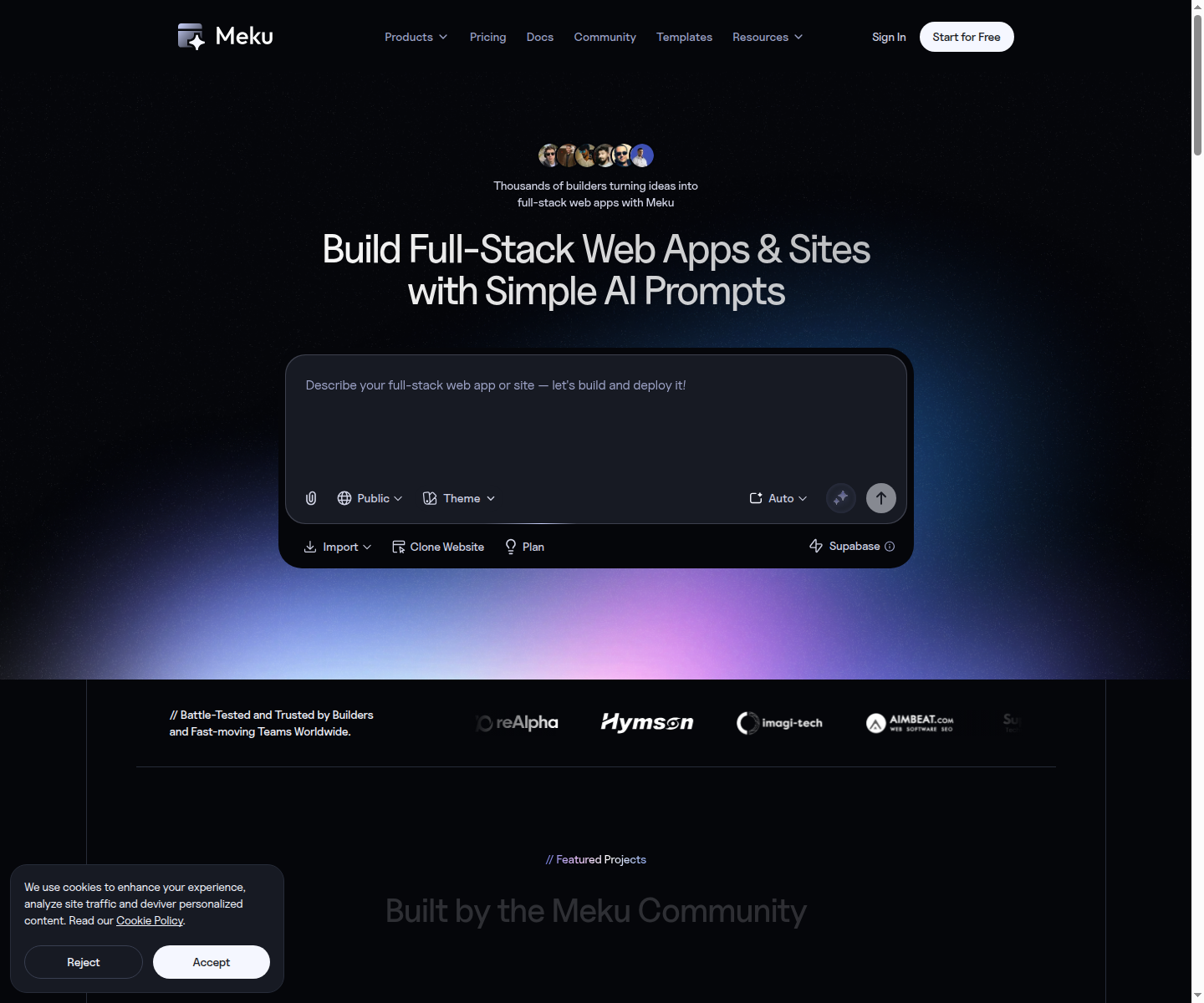
AI web app and site builder for developers who want deployable React output, exports, and stronger code ownership than a beginner-first builder.
Meku as a Lovable Alternative: Comparison & Decision Guide (2026)
Meku is a strong Lovable alternative for builders who want prompt speed but care more about code ownership, GitHub workflows, and deployable React output than pure beginner simplicity.
Compared with Lovable, Meku gives you a more developer-oriented path through React, Tailwind, export options, and GitHub sync, but it asks for more technical confidence and a higher tolerance for AI-credit management.
It is not the best fit for absolute beginners who want the lightest possible onboarding, the most guided visual experience, or a platform that hides most engineering choices.
Meku vs. Lovable: Quick Comparison
| Decision area | Meku | Lovable |
|---|---|---|
| Primary approach | AI web app and website builder with code-first output | Prompt-first app builder with a more guided beginner loop |
| No-code support | Usable without writing code for simple builds, but clearly favors technical users | More approachable for no-coders and first-time builders |
| Learning curve | Moderate because you eventually think about code structure and exports | Lower for early prototypes and first experiments |
| Output stack | React + Tailwind projects | Managed Lovable stack with generated app output |
| AI workflow | Prompt, refine, remix, and iterate with code-aware context | Prompt, preview, and visually refine generated apps |
| Visual editing | Available, but less central than code ownership | Core part of the product experience |
| Figma support | Figma import support on paid plans | Design-oriented workflow, but Figma specifics are less central than prompt-to-app speed |
| Templates | Community and premium templates, plus prebuilt modules | Template support exists, but the main value is quick greenfield generation |
| Deployment | One-click deploy plus custom domains and SSL | Managed deployment path inside Lovable ecosystem |
| Git workflow | Push, pull, and sync with GitHub on paid plans | GitHub sync exists, but repo-native ownership is not its main appeal |
| Portability | Export projects, download files, self-host | You can move out, but the export path is less central to the story |
| Database path | Supabase connection documented | Managed backend path is easier for beginners |
| Authentication | Possible through integrations, but exact provider list is still narrower in public messaging | Lovable keeps more of the managed setup feel |
| Mobile support | Not publicly positioned as a dedicated mobile builder | Not Lovable's core differentiator either |
| Support quality | Email support plus community resources | Lovable feels easier to start with before you need support |
| Pricing model | Credits and plan tiers | Credits-based pricing |
| Free plan | Free plan with credit and project limits | Free usage path depends on current Lovable offer |
| Paid plans | Pro from $19/mo on annual view, richer collaboration and export features | Paid access depends on Lovable credits and tiers |
What Meku Does Differently
Code ownership is a first-class selling point
Meku repeatedly frames exportability, offline files, GitHub sync, and self-hosting as core reasons to choose it. That matters if your biggest fear with Lovable is being stuck in a platform workflow once an MVP starts to grow.
The default output stack is narrow and opinionated
React and Tailwind are easier to reason about than a vague full-stack promise. For a team that wants a familiar frontend stack and cleaner handoff into a real repo, this makes Meku easier to evaluate than builders that market 'magic' without saying what you actually receive.
The product aims at launch ownership, not only prototype delight
Marketing and docs lean heavily on deployable projects, custom domains, GitHub sync, and prebuilt modules. That puts Meku closer to a 'generate and keep building' workflow than a disposable concept generator.
It offers a more explicit bridge from prompting into developer operations
Supabase integration, project export, and template remixing make Meku more practical when your next step after generation is maintenance. Lovable is still more elegant for the first blank-canvas moment, but Meku is easier to justify when shipping pressure starts.
Known Limitations
- Pricing predictability is weaker than a flat subscription tool because credits, project counts, and plan gates can change how much iteration feels safe in a given month.
- Lovable is still stronger for true beginners because its product story is simpler: type a prompt, get a working app, and keep polishing without thinking much about repo ownership.
- Meku's biggest advantage, code ownership, also creates its biggest friction because exported React projects still need someone to maintain structure, dependencies, and production decisions afterward.
- Public positioning is strong on React + Tailwind, but broader backend depth, advanced auth patterns, and enterprise governance are less clearly documented than in larger platforms.
- The product depends heavily on its own AI-credit loop, so fast experimentation can become expensive if a team iterates carelessly or keeps rerolling whole screens.
- If your team mainly wants visual polish and collaborative ideation, a design-first workflow can feel more intuitive than Meku's more technical posture.
Who Should Choose Meku Over Lovable?
- Choose Meku over Lovable if you already know your next step after generation is a real codebase and you do not want to re-platform the project later.
- Choose Meku if React + Tailwind is an acceptable target stack and you value explicit export paths more than maximum beginner friendliness.
- Choose Meku if GitHub sync, self-hosting potential, or downloadable project files matter in the buying decision.
- Choose Meku if your team includes at least one technical owner who can turn a generated app into a maintained product after the AI does the first 70 percent.
When Lovable Is Still the Better Choice
- Stay with Lovable if you are a first-time no-code builder who needs the smoothest path from idea to visible prototype with the fewest engineering concepts exposed.
- Stay with Lovable if the project is still in idea-validation mode and you care more about fast visual iteration than about code portability this week.
- Stay with Lovable if nobody on the team wants to own a React codebase after the initial generation phase.
- Stay with Lovable if your biggest requirement is confidence and simplicity for non-technical stakeholders rather than long-term stack control.
Pricing and Cost Predictability
Pricing is one of the main decision points when people compare Lovable alternatives, because the tool can feel cheap during the first demo and expensive once iteration becomes the real job. That makes the price model more important than the headline monthly fee.
Meku publicly markets a free tier with limits and a Pro plan shown at $19/month on annual pricing in the current public page snapshot, alongside features such as more active projects, team workspaces, custom domains, export, Figma import, GitHub sync, and Supabase support. Prices are subject to change, but the public story is clear enough to classify Meku as a paid builder with a usable free entry point.
The harder question is not the sticker price but how much iteration discipline your team has. A builder that exposes credits, project caps, and plan gates can still be worth it if exportability saves you from a later rebuild, but it will feel worse than Lovable if you mainly want to bounce through many rough prototypes without caring about long-term ownership.
In short, both tools can beat Lovable on total value when their differentiators matter, but both can also lose badly on perceived value if you use them for work that Lovable already does simply and well.
Meku for Teams, Workflows, and Long-Term Ownership
Cost-at-scale view
Meku looks attractive when you expect to keep and extend the generated code, because exportability reduces the chance of a later full rebuild. If you only need a few fast prototypes each month, Lovable's simpler experience may still create better total value despite weaker ownership optics.
Lock-in assessment
Meku's lock-in risk is lower than Lovable's because the product openly emphasizes export, GitHub sync, and self-hosting paths. That does not remove all dependency risk, but it gives buyers a more believable exit story before they commit serious product work.
Workflow-fit analysis
Meku is best when one person can wear both builder and technical-owner hats. Teams with only non-technical operators may still prefer Lovable because the ongoing maintenance burden lands later and more softly.
A useful buying question is this: what happens after the first exciting prompt? Lovable wins when the next step is still exploration. These alternatives win only when the next step is ownership, coordination, or a broader product workflow that Lovable does not center as strongly.
How Meku Compares to Other Options in Directory 2930
Meku sits closer to tools like Bolt, Dyad, and Hostinger Horizons than to pure design-first products. It competes best when the buyer wants a deployable app path with more code control than a black-box no-code platform usually offers.
Compared with Bubble, Softr, or WeWeb, Meku is more code-forward and less operationally abstracted. Compared with Lovable, it is less beginner-safe but more convincing for teams that already assume the generated project will need repo-level life after day one.
FAQ
Can Meku replace Lovable completely?
Sometimes, but mainly for builders who want more ownership over the generated app and can tolerate a slightly more technical workflow.
Is Meku better for no-coders?
Not really. Meku is usable without code for simple generation, yet Lovable remains the friendlier choice for no-coders who want fewer technical decisions.
What stack does Meku generate?
React and Tailwind, according to Meku's public docs and product messaging.
Does Meku support exports and GitHub sync?
Yes. Export projects and GitHub push/pull/sync are part of Meku's public paid-plan story.
When should you skip Meku?
Skip it when you need the easiest possible onboarding, the least pricing anxiety around credits, or a product that hides repo concerns longer.
Sources and Proof Links
- Official site: https://meku.dev/
- Official pricing: https://meku.dev/pricing
- Official docs: https://meku.dev/docs
- Community/review: https://www.producthunt.com/products/meku
- Community/discussion: https://www.reddit.com/r/vibecoding/comments/1pc3uln/avoid_mekudev_at_all_costs/