
NxCode
Contact
NxCode
AI app builder for founders and non-technical creators that turns plain-English ideas into production-ready software with planning, code generation, testing, and deployment.
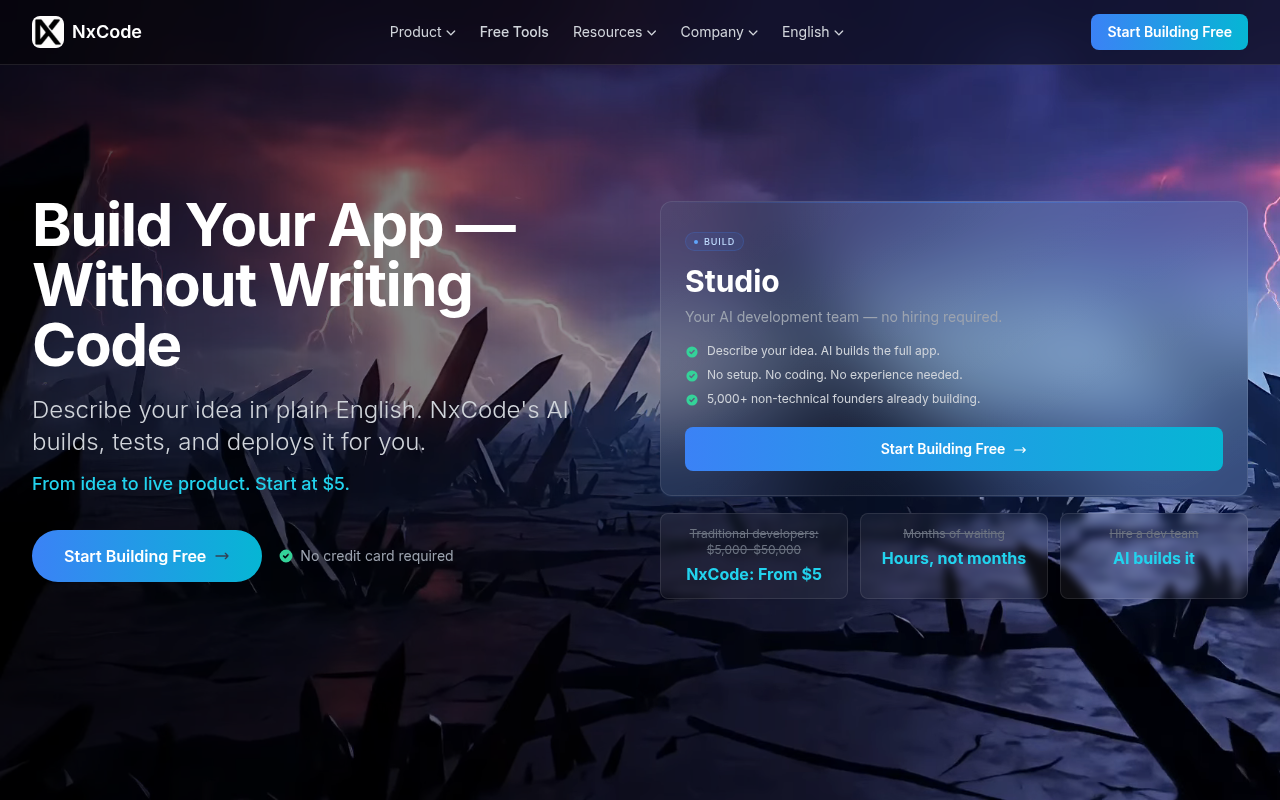
NxCode as a Lovable Alternative: Comparison & Decision Guide (2026)
NxCode is a credible Lovable alternative for builders who want a more structured no-code path to production-ready apps, especially when price sensitivity matters more than front-end polish freedom. The central question is not whether NxCode can generate an app with AI. The real question is whether its default workflow is a better fit than Lovable for the kind of product or business software you need to own after launch.
NxCode is best for solo founders, bootstrappers, small product teams, non-technical creators, and operators who want AI to plan and build a full app instead of only sketching a UI. That matters because buyers looking for a Lovable alternative often assume every AI app builder solves the same problem. In practice, these platforms split into very different camps: product-first builders, workflow-first no-code suites, mobile-native generators, and credit-driven AI software studios. NxCode only becomes a smart switch if its strengths line up with the shape of your app, the skill profile of the people maintaining it, and the type of risk you can tolerate after the first draft goes live.
The safest way to read this page is as a decision aid, not as marketing copy. Instead of asking whether NxCode is generally better than Lovable, ask whether it removes the most painful part of your own workflow. If it shortens the path to the app you actually need, the tradeoffs can be worth it. If its strongest differentiators do not matter in your case, Lovable usually remains the simpler default.
NxCode vs. Lovable: Quick Comparison
| Dimension | NxCode | Lovable |
|---|---|---|
| Primary approach | startup MVPs, SaaS dashboards, internal tools, landing pages with working product logic, and creator-built apps that need a cheap path from idea to deployed software | Prompt-first web app builder for startup-style products and MVPs |
| No-code support | Strong; the public positioning is explicitly about building apps without coding and letting AI agents handle planning and implementation | Strong for prompt-driven product creation, but still closer to product-building than business-software administration |
| Learning curve | Lower than Lovable for price-sensitive beginners who want a guided build system, but still requires product judgment once the app grows beyond the first generated version | Usually low for first drafts, then rises as product complexity and prompt precision grow |
| Output stack | Web-based AI app generator with planning and build agents, real code execution, Docker-backed testing, and hosted deployment flow | Web app output with a stronger product-MVP orientation |
| AI capability | Two named AI agents plan and build the project, break ideas into tasks, generate code, run tests, and iterate toward a production-ready result | Prompt-to-app generation with iterative edits |
| Visual editing | Partially; the product is more builder-workflow driven than drag-and-drop canvas driven, so iteration happens through AI guidance and generated app updates rather than classic visual editing alone | Yes |
| Figma import | Not publicly documented | Not publicly emphasized as the core differentiator |
| Templates / starter projects | Quick-start prompts, reusable creator templates, and marketplace-oriented publishing are publicly emphasized more than a large classic template gallery | Templates and starter projects are part of the broader Lovable workflow |
| Deployment | Hosted deployment with a one-click go-live story is part of the public homepage and pricing narrative | Hosted web deployment for generated apps |
| Custom domain | Not publicly documented in the accessible official pricing copy | Supported for public product launches |
| Database | Database setup is part of the build flow, but the exact managed database stack is not publicly documented in accessible marketing copy | Managed database path for generated apps |
| Authentication | Not publicly documented in detail, though the platform positions itself as capable of shipping real SaaS-style applications | Auth support for generated apps |
| Mobile support | Web-first; mobile app publishing is not the core public story | Mostly web-first |
| Git/GitHub workflow | Not publicly documented | Closer to code ownership than classic no-code tools |
| Code export / portability | Project export is listed on the Pro plan, but a repo-first Git workflow is not the main buyer story in the accessible public copy | A major buyer expectation in the Lovable category |
| Collaboration | Better suited to small creator teams than large enterprise governance; the public story leans toward founders and individual makers rather than formal multi-seat admin workflows | Useful for startup teams, but not primarily an enterprise workflow suite |
| Error handling / debugging | Stronger than many vibe builders because NxCode emphasizes automatic testing, Docker execution, and self-correction instead of stopping at a front-end mockup | Product iteration is smoother than deep enterprise workflow debugging |
| Support quality | Documentation, tutorials, API reference, community pages, and structured pricing copy indicate a reasonably mature onboarding surface for a newer platform | Documentation and community-driven onboarding |
| Pricing model | NxCode is one of the cheapest Lovable-adjacent builders in this directory niche because the entry plan starts at $5 per month instead of the more common $20-plus monthly threshold.; The low headline price is attractive, but cost predictability still depends on credits and usage intensity rather than a flat unlimited-builder model.; For early founders, that trade can be reasonable because you get a much lower experimentation cost than Lovable while still keeping a production-minded build path. | Builder-style plans and credit logic |
| Free plan | Free entry path with no credit card required according to the official pricing page | Usually suitable for prototyping and evaluation |
| Paid plans | Official pricing starts at $5/month for Lite with 200 credits and $20/month for Pro with 1,500 credits | Paid tiers unlock more serious product work |
What NxCode Does Differently
It frames the build as an AI-managed software workflow, not just a prompt-to-UI toy
NxCode publicly leans on two agents, acceptance criteria, Docker testing, and deployment, so the product story feels more like an automated software team than a quick interface generator.
Its price floor is much lower than many Lovable-style builders
A $5 Lite plan makes NxCode easier to justify for solo founders who are still validating whether AI app builders belong in their workflow at all.
It leans into creator monetization and templates
The marketplace and revenue-share story make NxCode feel more like a creator platform, whereas Lovable is more tightly associated with direct product building and iteration.
Known Limitations
This is the part many alternatives pages soften, but it matters more than the headline feature list. AI app builders are easy to overrate during the first hour because the first generated result feels impressive. The harder question is what happens after the first build, when pricing, lock-in, maintenance, and workflow edge cases start to matter. These are the main limitations to keep in mind before treating NxCode as a straight Lovable replacement.
- The public story promises production-ready software, but the overall brand maturity and buyer confidence are still lower than more established app-builder names in this directory.
- Front-end freedom and brand-led product polish are less clearly differentiated than in Lovable's product-first positioning.
- Pricing is cheap to start but still credit-based, so heavy iteration can become less predictable than the sticker price suggests.
- GitHub continuity, enterprise governance, and long-term engineering handoff are not as clearly documented as they are in stronger code-first competitors.
Who Should Choose NxCode Over Lovable
NxCode makes the most sense when its native strengths solve a real business or product constraint instead of simply looking novel in a demo. In practical terms, that means the tool should reduce the hardest part of your delivery process more effectively than Lovable does. If the strongest reason to switch is only curiosity, you usually end up with migration overhead and no durable gain.
- Choose NxCode when budget matters and you want a real AI app builder instead of another visual no-code suite with weak AI bolted on.
- Choose it when you want AI to plan, build, test, and deploy in one flow without paying Lovable-level pricing from day one.
- Choose it when your app is web-first and the main goal is shipping a working MVP, not polishing a standout product surface immediately.
- Choose it when you value structured agent workflow more than design-first experimentation.
Another useful test is to imagine who owns the app three months after launch. If the future owner is a product-minded founder iterating on a web MVP, Lovable often stays easier to justify. If the future owner is an operator, a mobile-first team, or a business systems manager, NxCode can become the more practical choice because its workflow may match their real maintenance job more closely.
When Lovable Is Better
Lovable remains one of the clearer product-first builders in this category. That means it often wins when the app needs to feel like a modern startup product, when the team wants to iterate quickly on a public-facing experience, or when the buyer is trying to preserve a cleaner path toward long-term product evolution. If any of the following points describe your project more accurately, staying with Lovable is usually the smarter move.
- Stay with Lovable when front-end polish, faster product ideation, and a cleaner product-builder identity matter more than getting the cheapest possible AI build path.
- Stay with Lovable when your team already trusts its workflow and does not want to learn another credits-driven system.
- Stay with Lovable when you need a more recognizable ecosystem and stronger confidence in community mindshare today.
- Stay with Lovable when product aesthetics and rapid UI iteration are more strategic than marketplace publishing or low-cost experimentation.
Pricing and Cost Predictability
Pricing is one of the easiest places to make a bad decision with AI app builders because the visible monthly number rarely tells the full story. The real bill depends on how the tool meters usage, how many people need access, how often you iterate, and how expensive the app becomes after it starts doing useful work in production. That makes cost predictability just as important as the official plan page.
- NxCode is one of the cheapest Lovable-adjacent builders in this directory niche because the entry plan starts at $5 per month instead of the more common $20-plus monthly threshold.
- The low headline price is attractive, but cost predictability still depends on credits and usage intensity rather than a flat unlimited-builder model.
- For early founders, that trade can be reasonable because you get a much lower experimentation cost than Lovable while still keeping a production-minded build path.
Official pricing starts at $5/month for Lite with 200 credits and $20/month for Pro with 1,500 credits
Prices are subject to change. Check the official pricing page before making a production choice.
Decision Matrix
The easiest way to choose between AI app builders is to stop asking which one is generally best and start asking which one is best for the exact app you are trying to ship. The shortcuts below capture the practical split between NxCode and Lovable for the most common buying scenarios.
- Need the lowest-cost entry into AI app building with a production-minded workflow: NxCode
- Need a more product-first and design-conscious builder for startup MVP iteration: Lovable
- Need AI agents to plan, test, and deploy as part of the story: NxCode
- Need stronger buyer familiarity and a cleaner mainstream vibe-coding brand: Lovable
Lock-In, Ownership, and Long-Term Risk
NxCode reduces traditional lock-in risk somewhat by emphasizing project export, but the workflow itself still depends on staying inside its agent, credit, and deployment model long enough to get real value from the platform.
That makes it safer than a fully sealed business-app suite, but not as clearly portable as tools whose public story starts with GitHub and code ownership.
That long-term ownership question matters because switching costs often appear later than buyers expect. The first build can feel cheap and fast, while the real dependency grows quietly through templates, automations, hosted data, publishing workflows, or team habits. A good Lovable alternative should not only impress in the first session; it should also make sense as the app becomes a maintained asset.
Workflow Fit for Teams
Compared with Lovable, NxCode feels more operationally structured and more budget-aware. It is a better fit for founders who want AI to behave like a tiny product team with explicit planning, testing, and deployment steps.
It is a weaker fit for teams who want the app builder to feel like a product-design accelerator first and an automated software pipeline second.
In other words, team fit matters just as much as feature fit. A builder that looks strong on paper can still be the wrong choice if the people maintaining it think in a completely different way than the platform expects. That is why workflow alignment is often the hidden difference between a tool that actually ships value and one that becomes another abandoned experiment.
What Builders Are Saying
External writeups frame NxCode as one of the more affordable AI app builders and one of the few newer entrants trying to make the build process feel structured rather than magical. The praise centers on low entry price and production-minded workflow; the caution is that it remains a younger platform with less proven ecosystem depth than Lovable.
- https://www.lindy.ai/blog/ai-app-builder
- https://findtoolz.com/tool/nxcode-ai-app-builder-structured-generation/
Final Verdict
NxCode is a credible Lovable alternative for builders who want a more structured no-code path to production-ready apps, especially when price sensitivity matters more than front-end polish freedom.
The best next step is to rebuild one small but real workflow, screen, or user path in both tools. If NxCode solves the long-term operational or product problem more honestly than Lovable does, it deserves serious consideration. If it only looks impressive during the first few prompts, Lovable is probably still the stronger default for your use case.
Sources
- https://www.nxcode.io/
- https://www.nxcode.io/pricing
- https://www.nxcode.io/product/features
- https://www.lindy.ai/blog/ai-app-builder
- https://findtoolz.com/tool/nxcode-ai-app-builder-structured-generation/
FAQ
Is NxCode a good Lovable alternative?
Yes, for cost-conscious builders. It is especially credible if you want an AI-managed workflow and lower entry pricing more than a highly polished product-builder brand.
Does NxCode have a free plan?
Yes. The official pricing page says you can start free without a credit card.
Who should choose NxCode over Lovable?
Founders and solo builders on a tighter budget. It fits best when shipping a working app cheaply matters more than premium product polish.
What is the biggest caution?
Platform maturity. NxCode's workflow is promising, but its ecosystem and long-term trust are not as battle-tested as more established alternatives.