
Qodo
AI-powered code quality platform focused on testing and code review workflows
Qodo - Lovable alternative
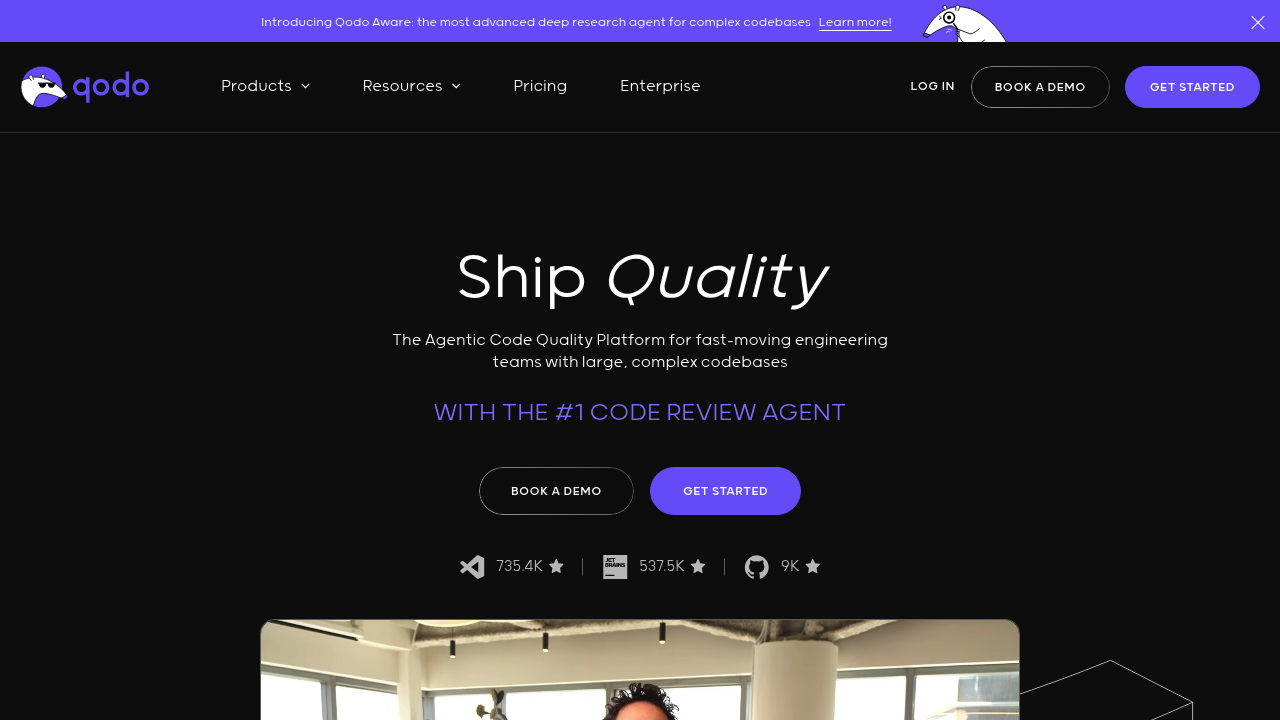
Qodo is a quality-first AI coding platform that generates tests, automates code reviews, and provides context-aware code assistance directly in IDEs. The platform analyzes code behavior to generate test suites with happy paths, edge cases, and rare scenarios while maintaining project-specific frameworks and style. Solo developers may prefer Qodo as a Lovable alternative when building code that requires rigorous testing and quality assurance. Unlike full-stack app builders, Qodo integrates into existing development workflows through IDE plugins and pull request automation.
Strengths
- Specialized testing domain prompting with parallelized and chained multiple prompts to create meaningful test variations.
- Autonomous coding agent that makes decisions, asks questions, uses tools, and executes multi-step tasks from single prompts.
- Harmonious integration between IDE plugin and pull request analysis agent for continuous code quality throughout development.
- Supports leading models including GPT-4.1, 4o, Claude 4 Sonnet, Claude 4 Opus, Gemini 2.5 Pro, and Grok 4.
- SOC2 Type II certification with 2-way encryption, secrets obfuscation, and TLS/SSL secure payment processing.
- Open-source PR-Agent tool available for self-hosting with customization options alongside enterprise version.
Weaknesses
- Credit system limits usage with 250 credits monthly for free tier and 2,500 for Teams tier.
- Premium models consume higher credits per request (Claude Opus uses 5 credits, Grok 4 uses 4 credits).
- Advanced features like SOC2 compliance and static code analysis require paid Team or Enterprise plans.
- No option to purchase additional credits mid-cycle when monthly allocation exhausted (feature in development).
Best for
Developers who prioritize code quality and testing over rapid prototyping. Teams needing automated PR reviews and test generation integrated with existing repositories and workflows.
Pricing plans
- Developer — $0/month — 250 credits per month, 75 PRs/month limit for Qodo Merge, community support via Discord and GitHub
- Teams — $30/user/month (billed $38) — 2,500 credits per month, unlimited PRs, automated PR descriptions, ticket compliance, standard private support, SSO additional cost
- Enterprise — $45/user/month (annual only) — Full platform access, enterprise dashboard and analytics, multi-repo awareness, enterprise SSO, priority support, SaaS and on-prem deployment options
Tech details
- Type: IDE plugin with AI coding agent and pull request automation platform
- IDEs: Visual Studio Code and JetBrains IDEs with support for GitHub, GitLab, and other git providers.
- Key features: Autonomous agentic coding, iterative test generation with edge cases, context-aware RAG with quality filtering, custom best practices enforcement, multi-step problem solving, git-diff comparison, Model Context Protocol (MCP) integration for custom tools.
- Privacy / hosting: SOC2 Type II certified, paid subscriber data stored 48 hours for troubleshooting only, not used for AI training, opt-out available for free tier, SaaS single/multi-tenant and on-prem deployments for Enterprise. Self-hosted option available through open-source PR-Agent.
- Models / context window: GPT-4.1, GPT-4o, Claude 4 Sonnet, Claude 4 Opus, Gemini 2.5 Pro, Grok 4. Full repository indexing with tagging to focus retrieval on relevant files. Context window sizes vary by selected model.
When to choose this over Lovable
- You need specialized test generation with edge case detection and behavior analysis rather than full-stack application scaffolding.
- You work with existing codebases and require pull request automation, code review workflows, and integration with version control systems.
- You want to maintain custom organizational best practices across development, review, and testing workflows with quality guardrails.
When Lovable may be a better fit
- You need to build complete full-stack web applications from natural language descriptions without existing code infrastructure.
- Your priority is rapid prototyping and deployment of functional web apps rather than rigorous testing and code quality workflows.
- You prefer a no-code approach focused on application creation rather than IDE-based development tools for professional coders.
Conclusion
Qodo delivers comprehensive AI-powered code quality tools that analyze behavior, generate tests, and automate reviews while integrating seamlessly with IDEs and git providers. The platform supports multiple leading AI models with enterprise-grade security through SOC2 Type II certification and flexible deployment options. Solo developers benefit from free access to core features, while teams gain collaboration tools and enhanced privacy controls. The platform's specialization in testing-domain prompting and code integrity distinguishes it from general-purpose code generation tools.
Sources
- Official site: https://www.qodo.ai/
- Docs: https://docs.qodo.ai/
- Pricing: https://www.qodo.ai/pricing/
FAQ
What is the difference between Qodo Gen and Qodo Merge?
Qodo Gen is an IDE plugin that assists developers as they write code, while Qodo Merge provides analysis and feedback on pull requests in version control systems. The two tools work together to ensure code quality throughout the development lifecycle.
How does Qodo's credit system work?
Most LLM model requests cost 1 credit per network request, with premium models costing more: Claude Opus costs 5 credits per request and Grok 4 costs 4 credits per request. Credits reset every 30 days from the first message sent in Qodo Gen, not on a calendar schedule.
Does Qodo use my code to train AI models?
Paid subscriber data is stored for 48 hours for troubleshooting only and is not used to train AI models. Free-tier users can opt-out of data usage for model enhancement by adjusting account settings at app.qodo.ai.
Can I self-host Qodo?
Yes, Qodo offers PR-Agent as a free, open-source tool that can be run locally, on CI/CD, or self-hosted. Enterprise customers also have access to on-prem and air-gapped deployment options with proprietary Qodo models.
What programming languages does Qodo support?
Qodo supports practically every programming language through its VSCode and JetBrains IDE integrations. The platform focuses on language-agnostic testing and code quality rather than language-specific features.
How is Qodo different from general code completion tools?
Unlike general-purpose code completion tools, Qodo focuses on code integrity by generating tests that reveal code behavior, finding edge cases and suspicious behaviors, and making code more robust through specialized testing-domain prompting. The platform uses context-aware RAG with quality filtering to ensure relevant, high-quality context rather than indiscriminate retrieval.