
Replit
Contact
Replit
Cloud-based AI app builder and coding platform where users build, run, and deploy full-stack web and mobile applications entirely in the browser using AI agents, with real-time collaboration and Parallel Agents for faster complex builds.
Replit: A Lovable Alternative for builders who want an agent plus a real cloud development environment (2026)
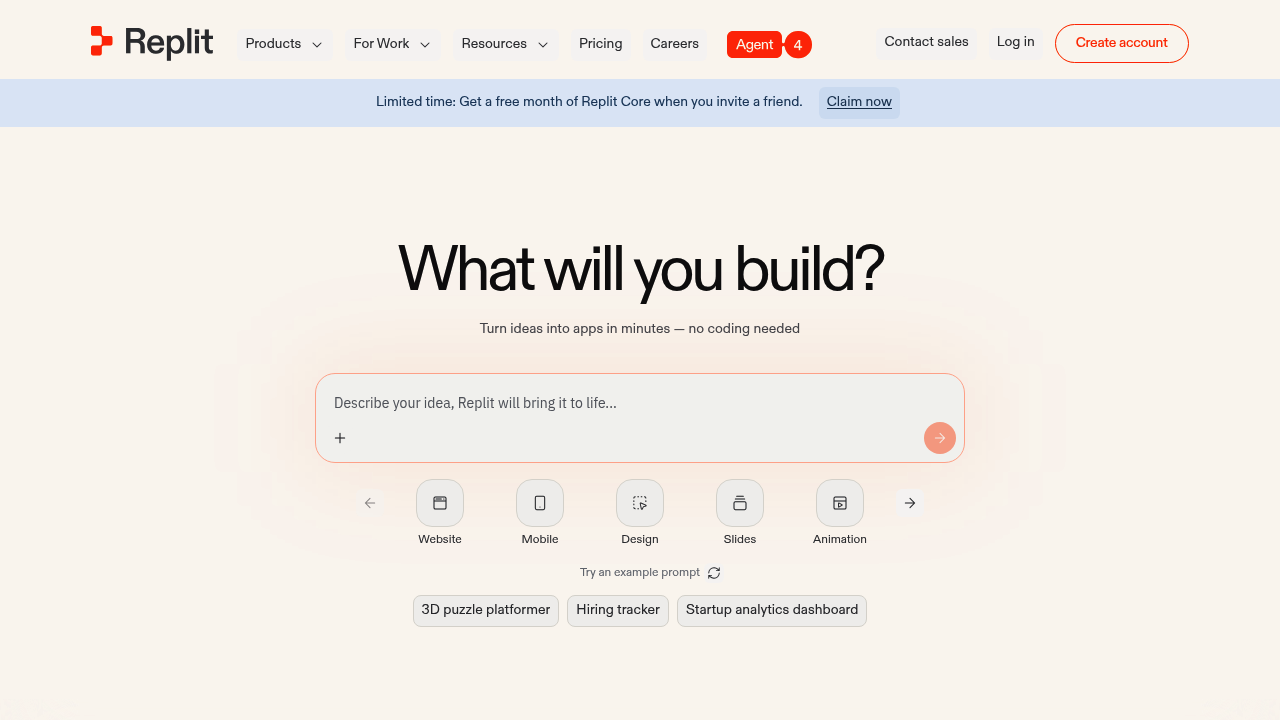
Replit is a AI app builder / cloud development platform developed by Replit. As a Lovable alternative, it is strongest when the project needs more stack freedom, built-in cloud execution, and a real multi-person development workspace.
Replit has moved beyond being just a browser IDE. The current product positions itself as a place to build apps and sites with AI, run Parallel Agents, work on an Infinite Canvas, and publish through multiple deployment models.
That gives Replit a very different feel from Lovable. Lovable is better as a focused prompt-to-web-app tool, while Replit is closer to an AI-assisted software workspace where the builder, runtime, deployment layer, and team collaboration all live together.
Replit vs. Lovable: Quick Comparison
| Decision area | Replit | Lovable |
|---|---|---|
| Primary approach | Agent-assisted cloud development environment for apps, sites, and broader software projects | Prompt-first AI app builder with visual edits and fast iteration |
| Output stack | Multi-language and full-stack; not limited to a single front-end framework | React + TypeScript with a Supabase-first workflow |
| AI builder style | Parallel Agents, multiple artifacts, and selectable Agent modes | Single conversational builder focused on fast product scaffolding |
| Visual editing | Infinite Canvas for design exploration and visual tweaking | Prompt edits plus visual tweaking inside the builder |
| Figma import | Not publicly documented in the sources reviewed here | Supported via Builder.io Figma integration |
| Deployment path | Built-in deployments including autoscale, reserved VM, scheduled, and static | Deploy externally after export or GitHub sync |
| Data layer | Bring your own architecture; no single required database path | Supabase is the default path for app data |
| Authentication | Implement with your chosen stack; no single default auth path is highlighted | Supabase Auth is the default route for auth flows |
| Native mobile output | Yes; official homepage claims mobile and web apps can be created in one project context | No documented native mobile runtime; strongest for web apps |
| Git workflow | GitHub import is officially documented | GitHub sync is supported |
| Code portability | High, because you are working in a real code workspace rather than a closed visual runtime | High: generated React code can be taken out of the platform |
| Collaboration | Core supports up to 5 collaborators; Pro supports up to 15 builders | Team collaboration is built in with shared projects |
| Debugging style | Agent assistance plus a real runtime, which is powerful but also exposes more engineering complexity | Paste errors and ask the builder to repair the app |
| Pricing model | Subscription plus credits and usage-based deployment costs | Credit-based plans with a free daily allowance |
| Entry pricing | Starter free; Core $20/month | Free plan with daily credits; Starter $20/mo |
| Scale pricing | Pro $100/month; Enterprise custom | Launch $50/mo; Scale $100/mo |
What Replit Does Differently
More than a builder
Replit is not just trying to generate the first version of an app. It gives you a live development environment, cloud execution, deployment models, and team collaboration in the same product, which makes it much broader than Lovable.
Real runtime control
Replit lets teams choose deployment types such as autoscale, reserved VMs, scheduled deployments, and static hosting. That flexibility is useful when an MVP grows into a production service, but it also means the user has more infrastructure choices to manage.
Collaboration-first workspace
Recent pricing updates made collaboration a central part of paid plans. Even Core now supports up to five collaborators, and Pro supports larger builder groups with pooled credits and workspace-level controls.
Broader output scope
Replit markets the agent as able to produce web apps, mobile apps, slides, and other artifacts. That broader ambition makes it interesting for builders who want one workspace for experiments that go beyond a classic SaaS front end.
Known Limitations
- Replit can cost more than it first appears because both AI usage and deployment usage matter. A founder comparing headline subscription prices alone can underestimate the total cost of shipping and operating a real app there.
- Because it exposes a real code and runtime environment, it naturally surfaces more debugging work than Lovable. That is a strength for developers, but it is more overhead for people who want the platform to make most technical choices for them.
- The broader the platform gets, the easier it becomes to spend time on engineering choices rather than product validation. Lovable is more opinionated and therefore often faster for getting a focused web MVP in front of users.
- Visual polish is not the core reason to choose Replit. It can absolutely produce polished interfaces, but tools like Lovable, v0, Framer, and Webflow often feel more specialized for fast UI shaping.
- The jump from Core to Pro is significant. Teams that outgrow a casual usage pattern may quickly end up in a much higher monthly spend than they expected.
Who Should Choose Replit Over Lovable?
- Choose Replit when you want the builder and the runtime in the same product.
- Choose it when the project may outgrow a simple front-end generator and need custom backend logic, services, or infrastructure decisions.
- Choose it when collaboration between multiple builders matters early in the lifecycle.
- Choose it when GitHub import, publishing, and AI-assisted debugging should happen in one shared workspace.
When Lovable Is Still the Better Choice
- Stay with Lovable if the goal is a fast React-style MVP rather than a general software workspace.
- Stay with Lovable if the team is non-technical and wants fewer infrastructure and runtime choices.
- Stay with Lovable if Supabase-first scaffolding is a better match than a bring-your-own-architecture model.
- Stay with Lovable if you want a cleaner prompt-to-product flow with less deployment cost complexity.
Pricing Comparison & Cost at Scale
Plan overview
- Starter — free with daily Agent credits and free credits for AI integrations.
- Core — $20/month with better collaboration, lower cost than before, and up to 5 collaborators.
- Pro — $100/month with stronger Agent modes, larger credit options, priority support, and up to 15 builders.
- Enterprise — custom pricing for larger organizations and advanced controls.
Prices are subject to change. Check the official pricing pages for the latest details.
Approximate cost profile vs. Lovable
| Scenario | Replit | Lovable | Notes |
|---|---|---|---|
| Casual experimenting | $0/month | $0/month | Both are easy to try, but Replit’s free tier is best when you want a real workspace, not just a prompt-to-MVP loop. |
| Solo builder shipping an MVP | $20/month plus deployment usage | $20/month | Lovable is easier to forecast; Replit is worth the extra complexity if the app needs more custom engineering. |
| Small team with shared workspaces | $100/month Pro or higher | $50 to $100/month | Replit’s team value is strong, but it can outprice Lovable once deployment and heavy agent usage are included. |
How This Tool Compares to Other Options in Directory Lovable-alternatives.com
- Versus v0, Replit offers more stack freedom and runtime choices, while v0 feels cleaner for Next.js and Vercel-native delivery.
- Versus Bubble, Replit gives much stronger code ownership, but Bubble is easier for non-technical builders managing data and workflows visually.
- Versus Framer and Webflow, Replit is far better for product logic and engineering-heavy apps than for marketing-site specialization.
FAQ
Is Replit free?
Yes. Replit has a free Starter tier with daily Agent credits, which is enough to evaluate the workflow before moving to Core or Pro.
Can Replit replace Lovable?
Yes, but mostly for builders who want more control and a fuller development environment. For the fastest prompt-to-web-app path, Lovable still stays simpler.
Does Replit support GitHub?
Yes. Official docs describe importing public and private GitHub repositories into Replit, where the app can then be run, tested, and published.
Why does Replit cost more at scale?
Because the total cost is not just the subscription. Deployment, usage, and heavier agent modes can add to the monthly bill once an app becomes active.
Who should avoid it?
A founder who wants the platform to make most technical decisions automatically will usually move faster in Lovable or Bubble than in Replit.