
Retool
Contact
Retool
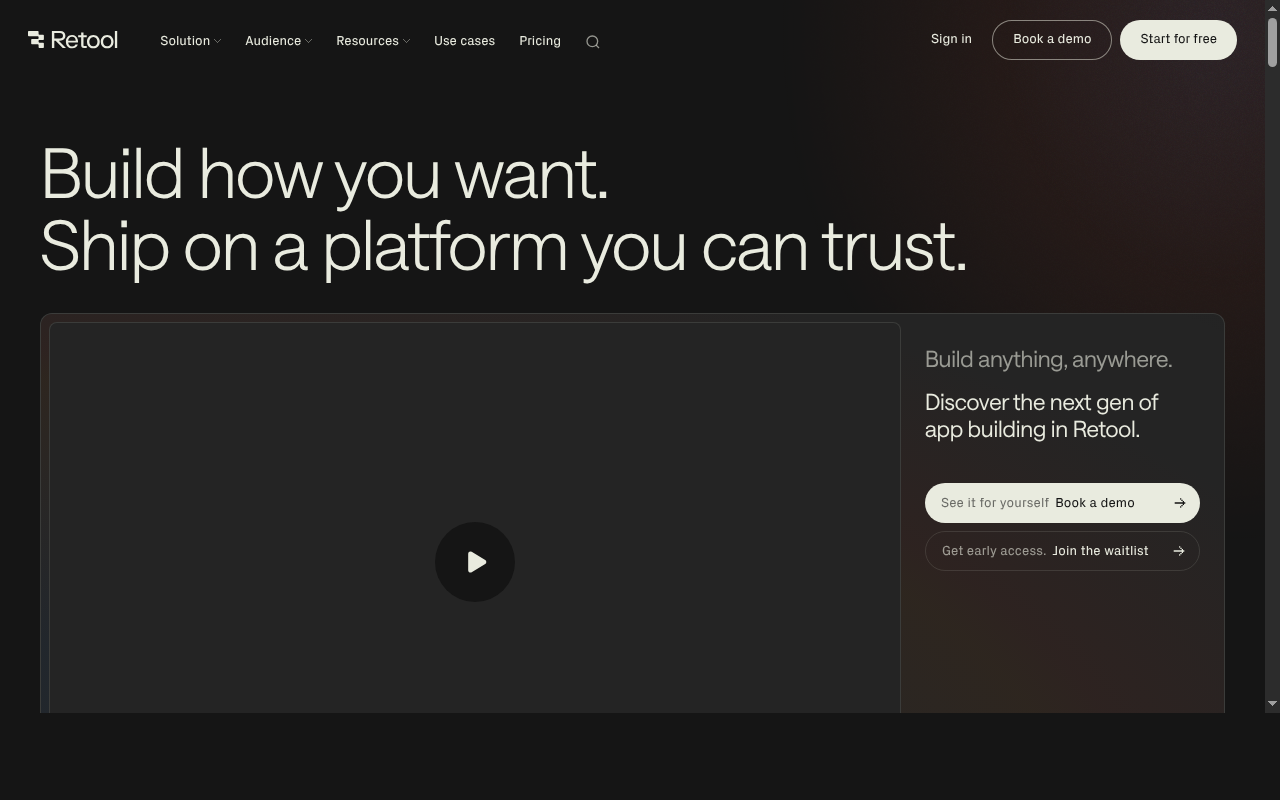
Build internal tools, dashboards, and admin panels with Retool's visual drag-and-drop builder and 100+ data connectors. AI agents, mobile apps, and enterprise governance included.
Retool as a Lovable Alternative: Comparison & Decision Guide (2026)
If you need a production-grade internal tool builder with deep database connectivity, AI agents, and enterprise-level governance, Retool is the strongest choice over Lovable. Lovable excels at generating polished consumer-facing apps quickly through AI prompts, but Retool is built for teams that need robust internal dashboards, admin panels, and CRUD interfaces connected to real data sources. Do not choose Retool if you want to ship a consumer mobile app or need pixel-perfect branding without engineering involvement — Lovable's AI-first approach wins there.
Retool vs. Lovable: Feature Comparison
| Feature | Retool | Lovable |
|---|---|---|
| Primary approach | Visual drag-and-drop + AI agents for internal tools | AI prompt-to-app for consumer and startup apps |
| No-code support | Yes, with extensive component library | Yes, primary interface is natural language |
| Learning curve | Moderate — requires understanding of data sources | Low — describe and build in minutes |
| Output stack | Web apps, mobile apps, workflows, AI agents | React + Supabase web apps |
| Visual editing | Full drag-and-drop canvas | AI-driven with visual tweaks |
| Figma import | Not supported | Not supported natively |
| Templates | 50+ pre-built templates for internal tools | Limited templates, AI-generated |
| Deployment | Cloud or self-hosted | Cloud only |
| Custom domain | Yes (Business and Enterprise) | Yes |
| Database | Retool DB + 100+ connectors (Postgres, MySQL, MongoDB, etc.) | Supabase (built-in) |
| Authentication | Built-in auth + SSO/SAML (Enterprise) | Supabase auth built-in |
| Mobile support | Yes — native mobile apps with offline mode (Business+) | Web-responsive only |
| Git/GitHub | Version history; Git sync on Enterprise | GitHub sync available |
| Code export | Not available (vendor lock-in) | Code accessible via GitHub |
| Collaboration | Multi-user, role-based permissions | Basic collaboration |
| Pricing model | Per-builder + per-user | Per-seat subscription |
| Free plan | Yes — up to 5 builders, 500 workflow runs/month | Yes — limited projects |
| Paid plans | Team: €9/builder/mo + €5/user/mo; Business: €46/builder/mo + €14/user/mo; Enterprise: custom | Starts ~$20/month |
What Retool Does Differently
Retool's differentiation stems from three core strengths that Lovable simply does not address:
- 100+ native data integrations: Retool connects directly to Postgres, MySQL, MongoDB, Snowflake, REST APIs, GraphQL, and S3 out of the box. No custom connector code required.
- AI Agents with observability: Retool's built-in Agent framework allows you to build, evaluate, and tune LLM-powered workflows inside the same platform you use for building UIs — a rare combination.
- Enterprise governance: Audit logs, granular RBAC, SSO/SAML, self-hosted deployment on your own infrastructure, and VPN/IP allowlisting are available on Business and Enterprise tiers.
- Mobile apps with offline mode: Unlike Lovable which outputs web-responsive apps, Retool Mobile generates native iOS and Android apps with offline capability and biometric authentication.
Known Limitations
- Pricing complexity: Retool charges separately for builders, internal users, and external users — costs can escalate quickly for teams with many end users. Enterprise pricing is custom and typically high.
- Weakest vs. Lovable — visual polish: Retool's default UI is functional but not beautiful. Consumer-facing apps look generic compared to Lovable's AI-crafted designs.
- No code export: Unlike Lovable which gives you GitHub access, Retool does not export source code. You are locked into the Retool platform.
- Steep learning for non-technical users: While Retool is technically no-code, its data model, query editor, and component bindings require at least junior developer understanding to be productive.
Who Should Choose Retool Over Lovable?
- Teams building internal dashboards, admin panels, or operational tools that connect to existing databases
- Engineering-led organizations that want enterprise-grade security, RBAC, and self-hosting
- Companies that need AI agents embedded in their internal tooling stack
- Operations, data, and support teams that need rapid CRUD interfaces over live data
- Organizations already on AWS/GCP/Azure that want to self-host their internal tool platform
When Lovable Is Still the Better Choice
- You're building a consumer-facing web app or startup MVP that needs strong design
- Your team has no engineers and wants pure natural-language app creation
- You need code ownership via GitHub without vendor lock-in
- You're prototyping quickly and want a shareable URL in minutes
- Your app is web-only and you don't need deep database connector diversity
Pricing Comparison & Cost at Scale
Retool's pricing is layered and can get complex fast. The Free plan covers up to 5 builders with 500 workflow runs/month. The Team plan costs €9/builder/month + €5/internal user/month, billed annually. The Business plan costs €46/builder/month + €14/internal user/month. External user pricing starts at free (0–50), then €7.33/month for 51–250 users. Enterprise pricing is custom.
For comparison, Lovable starts around $20/month per seat with simpler, more predictable pricing. At scale with 50 internal users, Retool's Team plan could cost $250–$500/month depending on builder count, while Lovable scales linearly per seat. Retool becomes cost-efficient for large teams once the per-user costs are normalized across a high-usage internal team.
How This Tool Compares to Other Options
Retool vs. Superblocks: Superblocks targets similar internal tool use cases but positions itself as more AI-native with its Clark AI agent. Superblocks starts at $100/AI Builder/month — significantly more expensive than Retool's entry tier. Retool has more mature templates and a larger community.
Retool vs. Microsoft Power Apps: Power Apps is deeper in the Microsoft 365 ecosystem and is stronger for enterprise SharePoint/Teams integration. Retool is more developer-friendly and supports a wider range of non-Microsoft databases. Power Apps is better if you're all-in on Microsoft; Retool is better for mixed or cloud-native stacks.
Retool vs. Thunkable: Thunkable is purpose-built for no-code native mobile apps, while Retool treats mobile as one output channel. If your primary deliverable is a mobile app (not an internal web dashboard), Thunkable is the better choice.
Frequently Asked Questions
Is Retool really no-code?
Partially — Retool requires basic SQL or API knowledge to connect real data sources. The UI building is visual and no-code, but data logic often needs technical input.
Can I self-host Retool?
Yes — Retool Cloud is the default, but self-hosting on AWS, GCP, Azure, or on-premise is available on Business and Enterprise plans.
Does Retool have a free plan?
Yes — up to 5 builders, unlimited web apps, and 500 workflow runs per month at no cost.
Is Retool better than Lovable for internal tools?
Yes — for internal tools, Retool's data connector library, RBAC, and workflow engine far exceed what Lovable offers.
Can I build mobile apps with Retool?
Yes — Retool Mobile produces native iOS and Android apps, including offline mode on Business and Enterprise plans.
Does Retool lock me into their platform?
Largely yes — Retool does not export source code. Unlike Lovable which provides GitHub access, Retool apps live on the platform.
What databases does Retool support?
100+ integrations including Postgres, MySQL, MongoDB, Snowflake, BigQuery, REST, GraphQL, S3, Airtable, and many more.