
Solid
Contact
Solid
AI full-stack web app builder focused on enterprise apps, real code, and maintainable foundations.
Solid as a Lovable Alternative: Enterprise AI Web App Builder (2026)
Solid is a credible Lovable alternative when you want AI to generate software that looks and behaves like a real developer-built codebase, not just a fast prototype. Lovable is often easier for first-time builders, founders, and teams chasing quick visual momentum on a public web product. Solid is stronger when the buyer already knows the app needs deeper backend control, more serious security posture, and a path that engineers will not immediately want to rewrite.
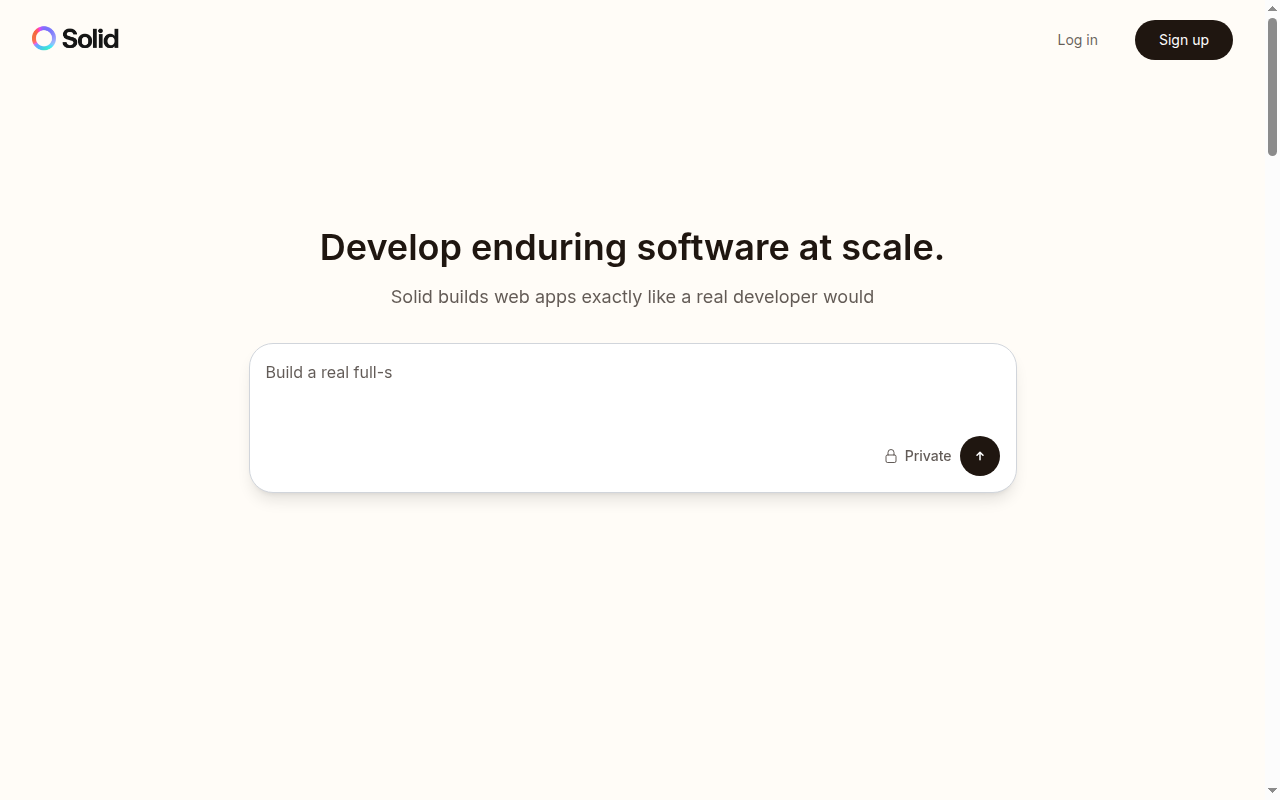
The public site is unusually explicit about this position. It says Solid builds web apps exactly like a real developer would, promises enterprise apps in seven days, and backs that story with claims around GDPR and SOC 2 alignment, encryption, access control, audit logs, and regional data hosting. The comparison page goes further by arguing for a real Node.js backend, Prisma, React, TypeScript, and the freedom to use any Postgres database.
That makes Solid a better alternative to Lovable for enterprises, serious internal products, and teams that hate the idea of a throwaway build. The flip side is that it is simply not the gentlest option here for a total beginner who wants a quick, playful, public-facing MVP.
Solid vs. Lovable: Quick Comparison
| Decision area | Solid | Lovable |
|---|---|---|
| Primary approach | AI builder for real full-stack web apps | AI builder with stronger broad-market MVP accessibility |
| No-code support | Partial; entire teams can describe apps, but the story is still developer-shaped | Higher for non-technical experimentation |
| Learning curve | Moderate to high once real software concerns matter | Lower at the start, then higher as you scale complexity |
| Typical output | Enterprise apps, internal tools, operational software | Public-facing web apps, prototypes, startup concepts |
| Backend model | Real Node.js backend with Prisma is publicly emphasized | Backend choices often depend on generated stack and external services |
| Frontend stack | React and TypeScript are publicly emphasized | Frontend path depends on generated output and workflow choices |
| Database model | Any Postgres database is part of the pitch | Often tied to easier managed-service defaults or later manual choices |
| Deployment | Local, one-click deployed, or self-hosted is claimed on the comparison page | Deployment varies by project and surrounding stack |
| Security posture | GDPR / SOC 2 alignment, encryption, audit logs, regional hosting | Security is part of the story, but less central to the initial pitch |
| Advanced logic | Explicitly pitched as a strength | Possible, but complexity often pushes you into more manual work |
| Visual editing | Not publicly documented as a core promise | Visual refinement is a stronger part of Lovable's appeal |
| Pricing transparency | Public self-serve pricing is not documented | Usually easier for individuals to understand upfront |
| Best fit | Engineering-shaped teams, enterprise buyers, serious internal software | Founders, small teams, and fast-moving product experiments |
| Worst fit | Total beginners who want the easiest first build | Teams that already know they need real-code foundations |
What Solid Does Differently
It makes real-code control the centerpiece of the purchase
Solid's public comparison content does not politely hint at developer depth; it makes it the core sales argument. The product says the result is a real Node.js backend with Prisma and a React plus TypeScript frontend, and that buyers can use any Postgres database rather than being trapped in a hidden abstraction.
That changes the buying conversation completely. Instead of asking whether the AI can make a nice-looking first version, teams ask whether the resulting software can survive custom workflows, integrations, performance work, and a future engineering handoff.
It is positioned for enterprise trust, not only creation speed
The homepage highlights GDPR and SOC 2 alignment, end-to-end encryption, audit logs, access control, and regional data hosting. Those are not decorative details; they signal that Solid wants to win buyers who would otherwise distrust the entire AI app builder category.
If your stakeholders include security reviewers, compliance-minded operators, or enterprise procurement, that positioning can matter more than another round of faster prompt-based UI generation.
It solves the rewrite anxiety better than most builders
A common fear with AI builders is that the first version looks impressive but becomes disposable the second real requirements appear. Solid directly attacks that fear by arguing against mockup-like foundations and promising software developers can keep extending.
Lovable can still be the better first move for a quick public MVP. But when the app is expected to grow into a serious internal system, the promise of a handoff-ready codebase becomes much more valuable than the shortest time to demo.
Known Limitations
- Solid is less beginner-friendly than Lovable because its strongest value appears when you actually care about backend architecture, databases, and future maintainability.
- Public pricing is not documented, which makes budgeting and low-risk experimentation harder for solo builders or small teams comparing tools on cost.
- Visual editing, Figma support, and no-code maintenance are not emphasized publicly, so non-technical teams should assume a steeper path than with more no-code-oriented alternatives.
- The tone of the product is enterprise and serious by design, which is helpful for trust but can feel heavy if your real goal is playful MVP exploration.
- Several workflow details that matter to buyers, such as GitHub integration depth or beginner onboarding, are not clearly documented in public materials and should be validated directly before rollout.
Who Should Choose Solid Over Lovable?
- Choose Solid if the app will become real business software rather than only a prototype.
- Choose it if your future engineering team would rather inherit a real stack than reverse-engineer a platform abstraction.
- Choose it if security posture, regional hosting, and auditability already matter in the selection process.
- Choose it if you expect the project to need complex workflows, custom endpoints, or deeper backend behavior early.
When Lovable Is Still the Better Choice
- Stay with Lovable if you are a beginner who wants the fastest path from idea to a convincing web product demo.
- Stay with Lovable if the app is mainly a public-facing experiment where frontend perception matters more than backend depth.
- Stay with Lovable if you want a gentler experience for non-technical iteration and do not yet know whether the idea deserves a serious full-stack foundation.
- Stay with Lovable if public self-serve pricing and lightweight experimentation matter more than enterprise-grade positioning.
Pricing Comparison and Cost at Scale
Solid's biggest commercial weakness in a head-to-head comparison is pricing transparency. The public site invites buyers to contact sales and describes the product in enterprise terms, but it does not publish a simple self-serve plan grid that individual builders can compare line by line.
That does not make the product weak; it makes the buying motion different. Solid is clearly optimized for teams that are already thinking in terms of business value, trust, and software backlog reduction rather than simply asking what the cheapest way is to try an AI app builder.
The risk is obvious: without public pricing, early buyers cannot easily model cost before a sales conversation. For enterprises that may be acceptable. For indie founders and small teams, it is a meaningful friction point compared with tools that let you start cheap and learn later.
How This Tool Compares to Other Options
If Solid feels too enterprise-heavy, Lovable and Bolt are the more approachable fast-start options. If it feels not governed enough for your no-code team, Buzzy is a better platform-style alternative with stronger Figma and multi-platform framing.
FAQ
Is Solid good for beginners?
Partially. A determined beginner can understand the value proposition, but Solid is better suited to buyers who already care about architecture, security, and long-term maintainability.
Do I need to know how to code to use Solid?
Not necessarily, but it helps. Solid says entire teams can create apps by describing them, yet its strongest differentiation is tied to real-code foundations that technical stakeholders will appreciate.
Is Solid free?
Not publicly documented. The public site does not show a self-serve pricing table, so buyers should assume a sales-led or higher-touch commercial process.
Can Solid replace Lovable?
Yes, for serious software. It is a compelling replacement when the app needs a true backend, long-term extensibility, and enterprise-style control.
What is Solid's main drawback?
Accessibility and pricing clarity. The product's strength is also its barrier: it asks buyers to care about real software foundations earlier than many non-technical teams want to.