
Stacker
Contact
Stacker
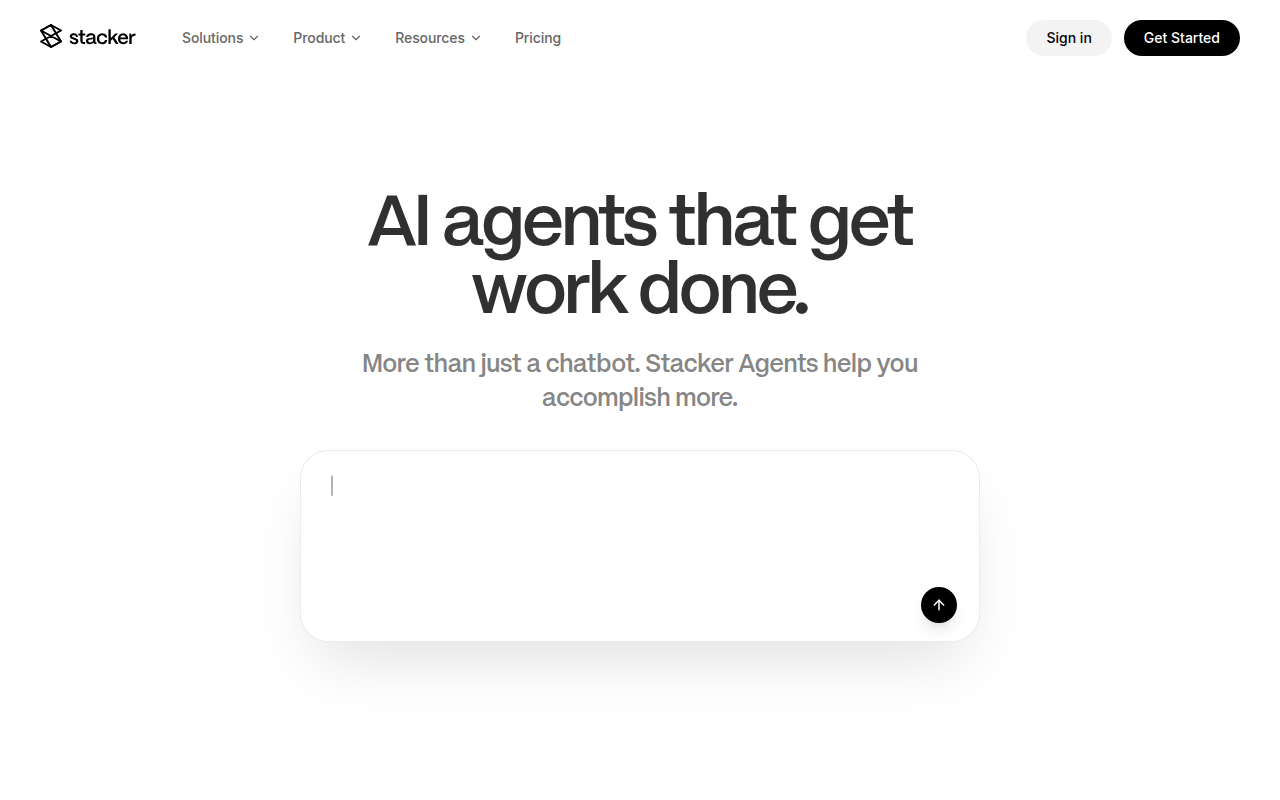
AI-native application platform for internal tools, CRMs, dashboards, and portals with prompt-based setup, no-code refinement, and scalable business permissions.
Stacker as a Lovable Alternative: Comparison & Decision Guide (2026)
Stacker is a solid Lovable alternative for business teams that want AI-assisted internal or external operations apps with portals, permissions, and managed data workflows instead of a startup-style code-centric MVP. For builders comparing it directly with Lovable, the real question is not whether it can generate an app from prompts. The real question is whether its workflow matches the kind of app you need to own after day one.
Stacker is best for operations teams, agencies, customer portals, vendor portals, internal tools, CRMs, dashboards, and organizations that need multi-user business apps more than product-led front-end originality. If your project needs a closer match to a startup-style product builder with broad product flexibility, Lovable usually stays easier to justify.
Stacker vs. Lovable: Quick Comparison
| Dimension | Stacker | Lovable |
|---|---|---|
| Primary approach | internal tools, CRMs, dashboards, client portals, supplier portals, and structured business applications with multiple user types | Prompt-first web app builder for startup-style products and MVPs |
| No-code support | Strong; the public product story is AI-native generation on top of no-code controls rather than manual app-building from scratch | Strong for prompt-driven product creation, but still closer to product-building than business-software administration |
| Learning curve | Lower than classic no-code tools for first drafts, but still more business-system oriented than Lovable's startup-product flow | Usually low for first drafts, then rises as product complexity and prompt precision grow |
| Output stack | Managed AI-native application platform with relational business data, portals, integrations, and no-code refinement | Web app output with a stronger product-MVP orientation |
| AI capability | AI-assisted app creation, AI-native setup, and an AI builder that can generate a starting app from a plain-language description | Prompt-to-app generation with iterative edits |
| Visual editing | Yes; Stacker positions AI generation together with no-code control instead of replacing visual refinement entirely | Yes |
| Figma import | Not publicly documented | Not publicly emphasized as the core differentiator |
| Templates / starter projects | Business-operations starting points and solution patterns for portals, CRMs, and internal applications | Templates and starter projects are part of the broader Lovable workflow |
| Deployment | Hosted deployment inside Stacker with managed access, user roles, and portal distribution | Hosted web deployment for generated apps |
| Custom domain | Not prominently documented on the public pricing snippet, but the platform is clearly built for branded external business experiences | Supported for public product launches |
| Database | Relational business-app data model with integrations and operational workflow support | Managed database path for generated apps |
| Authentication | Strong multi-user and portal-oriented permissions story is part of the core positioning | Auth support for generated apps |
| Mobile support | Web-first business app access; mobile-native publishing is not the center of the product story | Mostly web-first |
| Git/GitHub workflow | Not publicly documented | Closer to code ownership than classic no-code tools |
| Code export / portability | Code export is not the story; the value is managed delivery, permissions, and operational app structure rather than repo ownership | A major buyer expectation in the Lovable category |
| Collaboration | Very strong for operations because the app model is explicitly built around different user types, portals, and business processes | Useful for startup teams, but not primarily an enterprise workflow suite |
| Error handling / debugging | More suited to workflow and operations refinement than to classic software debugging or engineering customization | Product iteration is smoother than deep enterprise workflow debugging |
| Support quality | Clear marketing, pricing, documentation, and business-use-case materials suggest a mature go-to-market motion for operational teams | Documentation and community-driven onboarding |
| Pricing model | Stacker keeps pricing simpler than many operational app builders because the public page presents one paid plan plus credits instead of a long matrix of editions.; The free entry path is generous enough for evaluation, but the real cost question is how quickly your operational app burns through credits once teams build more than one portal or workflow.; For portal-heavy business apps, the value proposition can beat user-based tools because the platform emphasizes unlimited customer portals and a managed multi-user model. | Builder-style plans and credit logic |
| Free plan | Start free with $100 in credits and no credit card according to the public pricing page | Usually suitable for prototyping and evaluation |
| Paid plans | Public pricing starts at $50 per month for the Team plan with 250 credits per month | Paid tiers unlock more serious product work |
What Stacker Does Differently
It is built for multi-user business systems, not startup product storytelling
Lovable shines when a founder wants a product-like web app and a fast route to a first MVP. Stacker is sharper when the app exists to coordinate customers, suppliers, staff, or partners in a structured operational workflow.
Its AI builder lives inside a portal-and-operations framework
That changes the output. Instead of trying to become a flexible product canvas for everything, Stacker focuses the result around CRMs, dashboards, portals, and business process control.
It optimizes business governance more than code freedom
The reason to choose Stacker is not source-code export. It is that permissions, integrations, external-user access, and operational app patterns are treated as first-class concerns from the start.
Known Limitations
- It is less compelling than Lovable when the goal is a standalone product with a distinctive front end and a future engineering handoff.
- The platform story is strongly operational, so teams chasing consumer-facing product aesthetics may feel boxed in.
- Because code ownership is not the main promise, Stacker is weaker for companies that already know they want an app to leave the platform later.
- The AI builder direction is promising, but the long-term evaluation still depends on how much managed-platform structure your team is willing to accept.
Who Should Choose Stacker Over Lovable
Stacker makes more sense when the app is tightly shaped by its native strengths instead of by generic vibe-coding hype. In practice, that means you should choose it when its platform model directly reduces the hardest part of your workflow, not simply because it can also turn prompts into a UI.
- Choose Stacker when the app needs multiple user types, permissions, and portals more than product-polish freedom.
- Choose it when operations teams need to build internal or external business software without waiting on engineers.
- Choose it when a managed business-app platform is more valuable than code export.
- Choose it when CRMs, dashboards, client portals, or supplier portals are closer to the real use case than a startup MVP.
When Lovable Is Better
This is the section many alternative pages weaken, but it matters here because Lovable is still one of the clearer product-first builders in the category. If your use case leans toward a standalone product, faster aesthetic experimentation, or a cleaner mental model for startup MVP work, Lovable can be the more sensible default.
- Stay with Lovable when the project is a product-first MVP and a code-friendly evolution path matters.
- Stay with Lovable when front-end originality and startup-style product iteration are bigger priorities than portal governance.
- Stay with Lovable when you want a simpler mental model tied to product generation rather than operational app administration.
- Stay with Lovable when the app is meant to become a developer-owned software product rather than a managed business system.
Pricing and Cost Predictability
Stacker is not only about subscription price. It is about the shape of the bill once the app becomes useful, the number of people who touch it, and the platform rules that control ongoing iteration. That matters because the cheapest-looking AI builder can become the most expensive one if the limits map badly to the way your team actually works.
- Stacker keeps pricing simpler than many operational app builders because the public page presents one paid plan plus credits instead of a long matrix of editions.
- The free entry path is generous enough for evaluation, but the real cost question is how quickly your operational app burns through credits once teams build more than one portal or workflow.
- For portal-heavy business apps, the value proposition can beat user-based tools because the platform emphasizes unlimited customer portals and a managed multi-user model.
Prices are subject to change. Check the official pricing page before making a production choice.
Decision Matrix
This comparison is easiest when you stop asking which tool is generally better and start asking which tool is better for the exact kind of app you are trying to ship. The following quick calls capture the practical split between Stacker and Lovable.
- Need a CRM, dashboard, or external portal with strong user roles: Stacker
- Need a startup-style MVP with a clearer code-forward future: Lovable
- Need internal or external operations software for multiple audiences: Stacker
- Need product experimentation and front-end freedom first: Lovable
Lock-In, Ownership, and Long-Term Risk
Stacker's strength is exactly where lock-in grows: portals, permissions, relational business logic, and managed application delivery. If those pieces are what remove the hardest operational work for your team, the platform dependence can be rational and efficient.
If you already suspect the app needs to become a custom software asset with engineering-led ownership later, Stacker is harder to justify than Lovable because the platform value is tightly coupled to staying inside its managed operational model.
Workflow Fit for Teams
Compared with Lovable, Stacker feels like a business-app operating layer rather than a product ideation engine. It is well suited to teams that judge success by cleaner operations, better access control, and faster rollout of multi-user business workflows.
It is not the strongest choice for product teams that want an AI builder to be the first step toward a more custom engineering roadmap.
What Builders Are Saying
Third-party reviews position Stacker as a serious option for operational business apps, especially where portals and structured access matter. The positive pattern is managed multi-user delivery with AI-assisted setup; the caution is that it solves a more operational problem than Lovable's product-builder problem.
- https://hackceleration.com/stacker-review/
- https://www.capterra.com/p/203160/Stacker/
- https://makerstack.co/reviews/stacker-review/
Final Verdict
Stacker is a solid Lovable alternative for business teams that want AI-assisted internal or external operations apps with portals, permissions, and managed data workflows instead of a startup-style code-centric MVP.
The best way to test the fit is to rebuild one small but real workflow or product slice in both tools. If Stacker solves the long-term operational problem more honestly than Lovable does, it deserves the switch. If it only looks impressive in the first ten minutes, Lovable is probably still the stronger default.
Sources
- https://stacker.ai/
- https://stacker.ai/pricing
- https://stacker.ai/blog/introducing-stacker-ai
- https://hackceleration.com/stacker-review/
- https://www.capterra.com/p/203160/Stacker/
- https://makerstack.co/reviews/stacker-review/
FAQ
Is Stacker a good Lovable alternative?
Yes, for operational apps. It is a strong Lovable alternative when the real need is a CRM, dashboard, or portal rather than a code-minded startup MVP.
Does Stacker have a free plan?
Yes. The public pricing page says you can start free with $100 in credits and no credit card.
Who should choose Stacker over Lovable?
Operations and portal-focused teams. It is especially useful for internal tools, client portals, supplier workflows, and structured multi-user business apps.
What is the biggest caution?
Managed-platform dependence. The more value you get from portals, permissions, and operational structure, the more your app stays tied to the Stacker platform.