
Tabby
Self-hosted AI coding assistant offering full control over your development environment and data.
Tabby - Lovable alternative
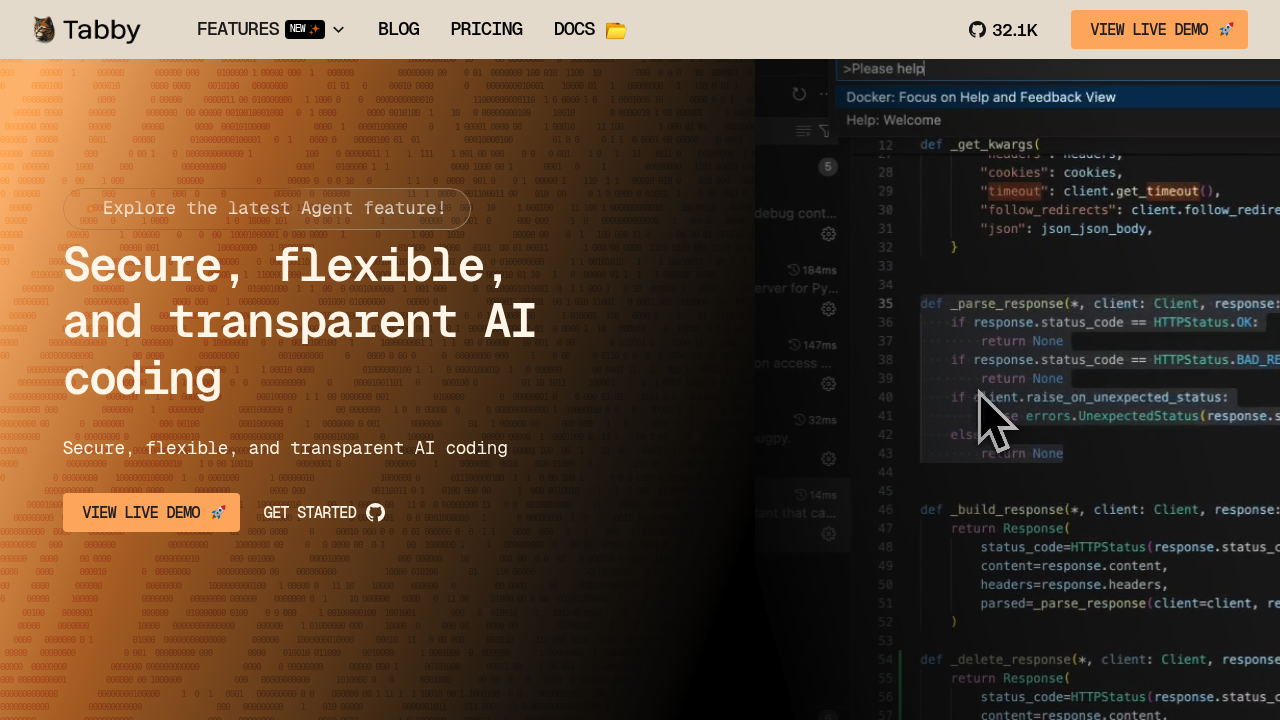
Tabby is an open-source, self-hosted AI coding assistant that provides code completion and chat capabilities. It runs entirely on your infrastructure without requiring external cloud services or databases. Solo developers who want complete ownership of their AI tools, prefer local deployment, or need to work with sensitive codebases might choose Tabby for its transparency and customization options.
Strengths
- Complete self-hosting control — Deploy on your own hardware without dependencies on external APIs or cloud services. No vendor lock-in for your development workflow.
- Open-source transparency — Full access to source code enables auditing, customization, and community contributions. Compatible with major coding LLMs including CodeLlama, StarCoder, and CodeGen.
- Consumer GPU support — Runs efficiently on consumer-grade hardware including Apple M1/M2 Metal and standard NVIDIA GPUs. No enterprise infrastructure required.
- Flexible model configuration — Connect local models via llama.cpp or integrate remote providers like OpenAI, Claude, and Ollama through HTTP connectors. Support for multiple models simultaneously.
- Repository context awareness — Indexes local repositories and documentation to provide context-aware suggestions. Uses Tree Sitter tags and semantic embeddings for improved accuracy.
- No ongoing subscription costs — Free to use with unlimited users after initial setup. Pay only for your own infrastructure and optional cloud model API calls.
Weaknesses
- Requires technical setup — Self-hosting demands familiarity with Docker, server configuration, and model management. Not plug-and-play compared to cloud services.
- Manual model management — Downloading, configuring, and updating AI models requires active maintenance. No automatic model optimization or updates.
- Limited UI polish — Administrative interface and developer experience less refined than commercial products. Community-driven development pace.
- Performance depends on hardware — Code completion speed and quality directly tied to your GPU capabilities and model choices. Underpowered hardware degrades experience.
- Smaller model ecosystem — Fewer pre-configured integrations and templates compared to established commercial platforms. More configuration work required.
Best for
Developers who prioritize data sovereignty, require full infrastructure control, work with sensitive code, or want to avoid recurring AI service subscriptions.
Pricing plans
- Open Source — Free — Up to 50 users on self-hosted deployment, unlimited code completions, all core features included.
- Tabby Cloud — Usage-based — Token-based billing for LLM usage, $20 free monthly credits, automatic billing above $10/month or at month-end. Tab completion always free with no usage limits.
- Team/Enterprise — Custom — Annual billing, flexible deployment options, enhanced security support, enterprise-first experience. Contact sales for pricing.
Tech details
- Type: Self-hosted AI coding assistant with optional cloud deployment
- IDEs: Visual Studio Code, Neovim, Vim, IntelliJ Platform (all JetBrains IDEs), via dedicated extensions
- Key features: Fill-in-the-Middle code completion, chat interface with Answer Engine, repository context indexing, inline code suggestions, GitLab/GitHub integration, LSP-aware completions, multi-model switching, shareable chat pages
- Privacy / hosting: Fully self-hosted on-premises with no external dependencies. All data remains local. Optional Tabby Cloud for managed hosting. No telemetry required.
- Models / context window: Supports StarCoder, CodeLlama, Mistral, Qwen2.5 Coder, CodeGemma, CodeQwen series locally via llama.cpp. Remote connection to GPT-4o, Claude, and other OpenAI-compatible APIs. Context windows vary by model (typically 2,000-8,000 tokens for completion, larger for chat models). Uses Nomic-Embed-Text for embeddings.
When to choose this over Lovable
- You need complete data sovereignty — All code and AI interactions remain on your infrastructure with no external data transmission.
- You work with sensitive or proprietary code — Self-hosting ensures confidential codebases never leave your environment or get used for model training.
- You want to avoid subscription costs — One-time setup investment with no recurring platform fees beyond your infrastructure and optional model API costs.
- You prefer infrastructure flexibility — Deploy anywhere (bare metal, private cloud, specific regions) with full control over resources and scaling.
When Lovable may be a better fit
- You want immediate productivity — Lovable offers zero-setup, browser-based development without infrastructure management or configuration overhead.
- You need full-stack application building — Lovable specializes in complete web application generation, not just code completion assistance.
- You prefer managed services — Lovable handles all infrastructure, model updates, and optimization automatically without technical maintenance burden.
Conclusion
Tabby delivers a self-hosted Lovable alternative for developers who prioritize infrastructure control and data privacy. Its open-source architecture and flexible model support make it suitable for teams with technical resources and specific security requirements. The lack of recurring subscription costs and transparent codebase appeal to privacy-conscious developers, though the setup complexity and hardware requirements create barriers for users seeking immediate productivity.
Sources
- Official site: https://www.tabbyml.com/
- Documentation: https://tabby.tabbyml.com/docs/welcome/
- Pricing: https://www.tabbyml.com/pricing
- GitHub: https://github.com/TabbyML/tabby
FAQ
What hardware do I need to run Tabby effectively?
Tabby runs on consumer-grade GPUs including NVIDIA cards and Apple M1/M2 with Metal support. Minimum requirements depend on your chosen model size—smaller 1B-3B parameter models work on 8GB VRAM while larger 7B+ models need 16GB or more. CPU-only inference is possible but significantly slower.
Can I use Tabby with multiple programming languages?
Yes, Tabby supports code completion across all major programming languages. The effectiveness depends on your chosen base model—models like StarCoder and CodeLlama are trained on diverse language datasets. Repository context indexing works language-agnostically using semantic embeddings.
How does Tabby compare to GitHub Copilot in terms of features?
Tabby provides core code completion and chat features similar to Copilot but requires self-hosting. Unlike Copilot's managed service, you control the models, data, and infrastructure. Tabby offers repository context awareness and LSP integration but may have less polished suggestions depending on your model choice and hardware.
What happens to my code when using Tabby?
All code remains on your infrastructure when self-hosting. Tabby does not send data externally unless you configure remote model connections (OpenAI, Claude, etc.), in which case only prompts go to those services. Local models process everything on-device with no external transmission.
Can I integrate Tabby with my existing CI/CD pipeline?
Tabby focuses on IDE-level code assistance rather than CI/CD integration. However, its OpenAPI interface allows custom integrations with existing infrastructure. Teams can programmatically access completion and chat endpoints for workflow automation, though this requires development work.
Is Tabby suitable for team collaboration and management?
Tabby includes team management features in version 0.7.0+ including user authentication, activity tracking, usage analytics, and secured access controls. The administrative UI provides team-wise usage reports and repository management, making it viable for small to medium development teams with self-hosting capabilities.