
Thunkable
Contact
Thunkable
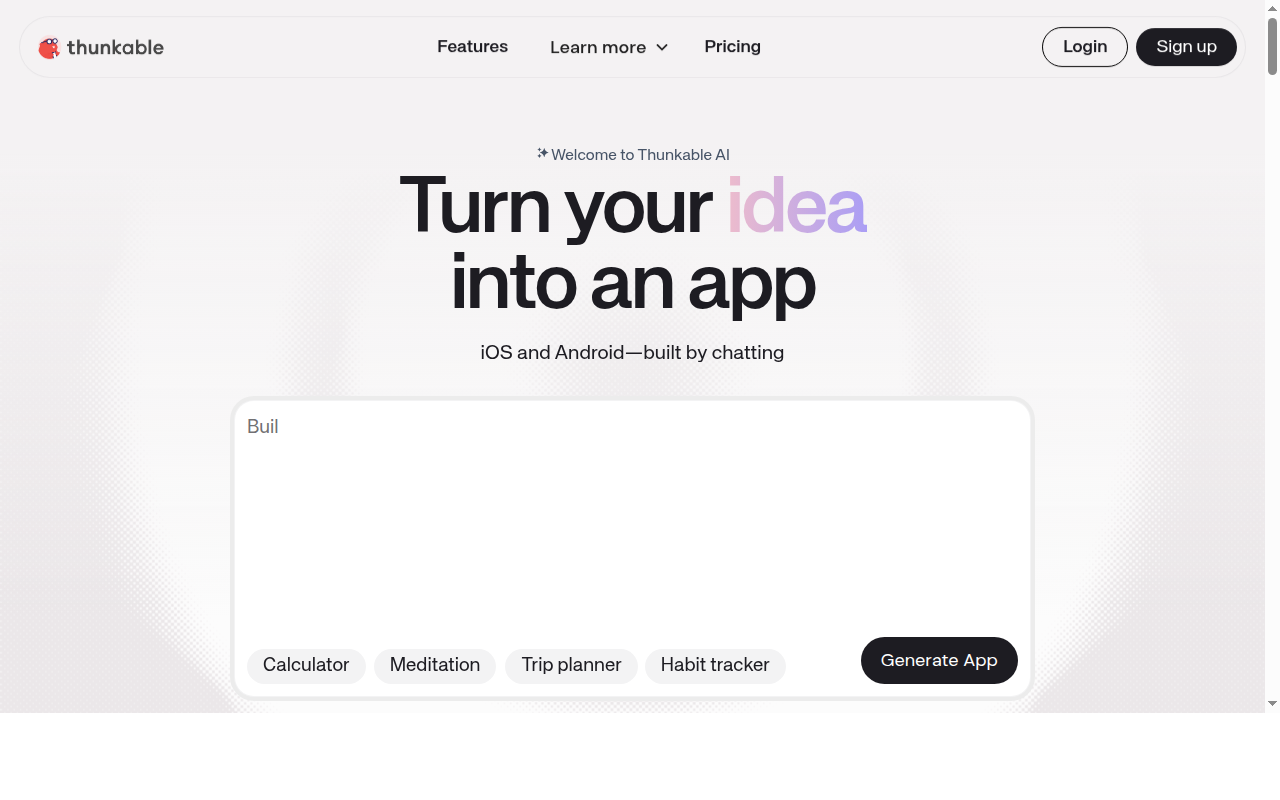
No-code native mobile app builder with visual drag-and-drop interface, live device testing, and App Store/Google Play publishing. Block-based logic for non-technical builders.
Thunkable as a Lovable Alternative: Comparison & Decision Guide (2026)
For makers who want to build no-code native mobile apps without any design or development skills, Thunkable is a mature and proven alternative to Lovable. Thunkable's visual drag-and-drop builder targets iOS and Android app creation specifically, while Lovable focuses on AI-generated web apps. If your primary deliverable is a web application with strong design or you rely on AI prompts to generate your product, Lovable has the advantage. But for education-focused builders, community creators, and anyone wanting live device testing with a genuine no-code mobile workflow, Thunkable is the better tool.
Thunkable vs. Lovable: Feature Comparison
| Feature | Thunkable | Lovable |
|---|---|---|
| Primary approach | Visual drag-and-drop no-code mobile app builder | AI prompt-to-app for consumer web apps |
| No-code support | Yes — fully visual, component-based builder | Yes — natural language primary |
| Learning curve | Low to moderate — visual blocks, some logic required | Low — describe and deploy in minutes |
| Output stack | Native iOS and Android apps | React + Supabase web apps |
| Visual editing | Full drag-and-drop component canvas | AI-driven with visual tweaks |
| Figma import | Not supported natively | Not supported natively |
| Templates | Yes — community and official templates for mobile apps | Limited, AI-generated |
| Deployment | iOS App Store and Google Play (paid plans); web preview | Cloud web deploy only |
| Custom domain | Not applicable (native mobile focus) | Yes |
| Database | Local storage, Airtable, Google Sheets, Firebase, REST API | Supabase (built-in) |
| Authentication | Sign-in blocks for email, Google, Apple, Firebase | Supabase auth built-in |
| Mobile support | Yes — native iOS and Android (primary use case) | Web-responsive only |
| Git/GitHub | Not supported | GitHub sync available |
| Code export | Not available (platform is fully visual) | Code accessible via GitHub |
| Collaboration | Team collaboration available on paid plans | Basic collaboration |
| Pricing model | Per-user subscription tiers | Per-seat subscription |
| Free plan | Yes — free forever with watermark and public projects | Yes — limited projects |
| Paid plans | Starts at ~$0–$189/month; 3 tiers from free to Pro | Starts ~$20/month |
What Thunkable Does Differently
- Purpose-built for native mobile — no compromises: Thunkable has been building the no-code mobile toolchain since 2016. Every feature — components, device sensors, camera, geolocation, notifications — is mobile-native by design, not a web app ported to mobile.
- Live testing on real devices: The Thunkable Live companion app lets you instantly preview your app on a real iOS or Android device as you build — no build process required. This real-device feedback loop is invaluable for mobile UX testing.
- Block-based logic builder: Thunkable uses a visual block-based programming model (inspired by MIT Scratch) that makes adding app logic accessible to non-programmers and ideal for educational settings — something neither Lovable nor most AI app builders offer.
- Established community and template library: With years of community building, Thunkable has a rich ecosystem of shared templates, tutorial videos, and community support — significantly more mature than newer AI-focused alternatives.
Known Limitations
- No web app output: Thunkable generates mobile apps only. If you need a web product — even a basic website — you'll need a completely different tool.
- Weakest vs. Lovable — AI-assisted building: Thunkable's builder is visual and manual. Lovable generates entire apps from a text prompt. For speed of initial creation, Lovable is dramatically faster.
- No code export: Unlike CatDoes or Lovable (via GitHub), Thunkable does not export source code. Your app lives on the platform.
- App Store publishing costs extra: The free plan does not allow App Store or Google Play publishing — you need at least a paid tier plus Apple Developer ($99/year) or Google Play ($25 one-time) accounts.
Who Should Choose Thunkable Over Lovable?
- Educators, students, and makers wanting to build native mobile apps without coding
- Entrepreneurs who need a native iOS or Android app and want a visual, component-based approach
- Teams wanting to test on real devices during the build process using Thunkable Live
- Builders integrating with Google Sheets, Airtable, or Firebase as their app database
- Anyone who wants a large community of templates and tutorials for mobile app development
When Lovable Is Still the Better Choice
- You're building a web-first product or need a public URL — Thunkable doesn't produce web apps
- You want AI to generate your entire app structure from a text prompt in seconds
- You need a built-in database (Supabase) with auth managed automatically
- GitHub integration for code access matters to you or your team
- Your users are on desktop or web — not primarily mobile device users
Pricing Comparison & Cost at Scale
Thunkable offers a Free plan with unlimited projects (watermarked) and no App Store publishing. Paid plans start at approximately $0–$189/month across three tiers (G2 data: 3 editions from $0 to ~$200/month). The exact paid plan structure includes a low-cost tier for basic publishing and a higher tier for team collaboration and priority support — see thunkable.com/pricing for current rates.
Compared to Lovable's ~$20/month entry, Thunkable is competitive at entry level. However, for serious mobile publishing including App Store submission, you should budget $50–$100+/month for Thunkable plus the mandatory Apple Developer ($99/year) or Google Play ($25 one-time) accounts — bringing the real cost above Lovable's equivalent tier. For pure web apps, Lovable is cheaper; for native mobile, Thunkable's total cost is higher but unique.
How This Tool Compares to Other Options
Thunkable vs. CatDoes: CatDoes uses an autonomous AI agent to build mobile apps from prompts, while Thunkable is a traditional visual drag-and-drop builder. Thunkable gives more manual control and has a larger community; CatDoes is faster for AI-generated initial builds. For educational use, Thunkable's block-based logic is far superior.
Thunkable vs. Retool: These serve completely different purposes — Thunkable for consumer mobile apps, Retool for internal business tools. Not meaningfully comparable.
Thunkable vs. Microsoft Power Apps: Power Apps can publish to mobile, but its primary output is enterprise web apps. Thunkable is simpler, more affordable, and designed purely for mobile-first creation for non-enterprise users. Power Apps requires more Microsoft ecosystem context.
Frequently Asked Questions
Can Thunkable publish apps to the App Store?
Yes — App Store and Google Play publishing is available on paid plans with your own developer account.
Is Thunkable free to use?
Yes — a free plan with unlimited projects exists, though apps display a watermark and can't be published to app stores.
Does Thunkable use AI to build apps?
Not as its primary interface — Thunkable is a visual drag-and-drop builder. Some AI-assisted features exist but it's not an AI-first platform like Lovable.
Can Thunkable build web apps?
No — Thunkable focuses exclusively on native iOS and Android apps. For web apps, use a different tool.
What databases does Thunkable support?
Thunkable integrates with Google Sheets, Airtable, Firebase Realtime Database, local device storage, and custom REST APIs.
Does Thunkable export source code?
No — Thunkable is a fully visual platform and does not export source code. Apps are built and managed on-platform.
Is Thunkable better than Lovable for mobile apps?
Yes — for native mobile apps specifically, Thunkable's purpose-built toolchain, live device testing, and App Store publishing workflow are clearly superior to Lovable's web-only output.