
Totalum
Contact
Totalum
Full-stack AI app builder for Next.js apps with built-in database, auth, hosting, file storage, and API/MCP access.
Totalum as a Lovable Alternative: Full-Stack AI Builder Guide (2026)
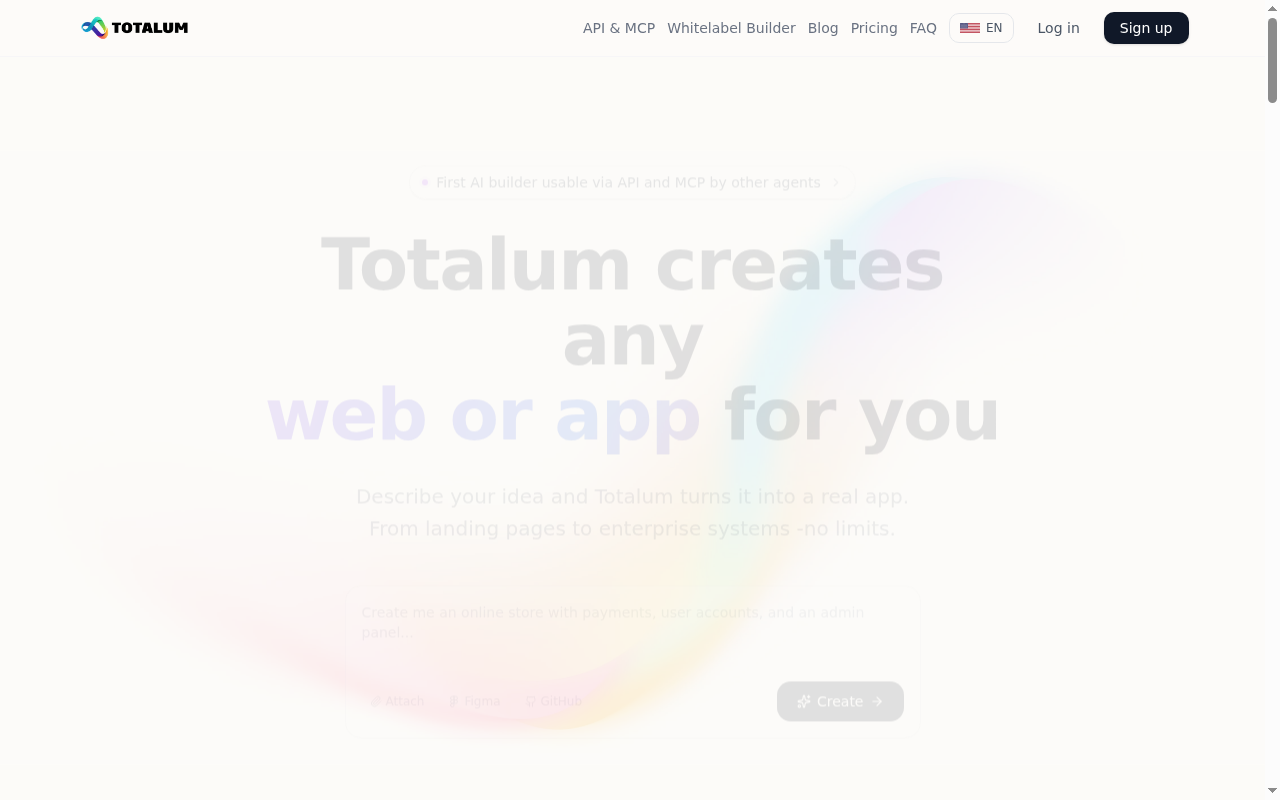
Totalum is one of the more compelling Lovable alternatives in 2026 if you want a fuller full-stack story out of the box. Its pitch is direct: generate a real Next.js application with database, authentication, hosting, file storage, integrations, and even API or MCP access for agent-driven workflows. Lovable is still easier to recommend for design-first prototyping and founder-friendly public MVP iteration. Totalum becomes more attractive once you care about operational completeness, source-code ownership, and shipping something closer to a real business application than a polished prototype.
The core difference is that Totalum is trying to collapse a bigger part of the stack. Instead of saying “prompt the UI and wire the rest later,” it says “prompt the app, get backend, auth, database, hosting, and deployment included.” For buyers who are tired of AI builders generating pretty interfaces but leaving infrastructure decisions unresolved, that is a serious advantage.
Totalum vs. Lovable: Quick Comparison
| Dimension | Totalum | Lovable |
|---|---|---|
| Primary approach | Full-stack AI app builder with built-in backend services | General AI web app builder with strong prototype polish |
| No-code support | High for non-technical users with clearer system scaffolding | High for fast startup-style iteration |
| Learning curve | Moderate because the platform includes more moving parts | Lower for pure first-pass product ideation |
| Frontend stack | Next.js, TypeScript, Tailwind per current public docs | Modern web output, often frontend-first in perception |
| Backend included | Yes, built-in database, auth, hosting, file storage story | Less self-contained; external services are more common |
| Database model | Included with plan-sized quotas | Often separate setup or external dependency |
| Authentication | Built-in via documented platform story | Possible, but more dependent on generated stack choices |
| Deployment | Included | Hosted app flow, but not the same all-in-one systems story |
| Code ownership | Strongly emphasized | Important, but not always the center of the pitch |
| API / MCP access | Yes, a major differentiator | Not the defining differentiator |
| Custom domain | Included on Business and above | Supported |
| Best fit | Real business apps, internal tools, SaaS foundations, agent-driven workflows | Rapid public-web product iteration |
| Weakest point | Can be heavier than needed for simple UI-first prototypes | Can leave more infrastructure ambiguity for serious apps |
What Makes Totalum Different
Totalum is one of the few tools in this category that publicly leans into being more than a frontend generator. It talks about backend, built-in database, admin panel, hosting, downloadable source code, file storage, integrations, and agent access through API and MCP. That matters because a lot of Lovable comparisons break down once the project moves beyond UI and into the boring but expensive questions: where does data live, how do users authenticate, what happens with files, how do I deploy, and how much manual glue work is still left?
Totalum’s answer is that those pieces should already be bundled. If the promise holds for your use case, it can reduce the common “half-built app” problem that many vibe-coded projects hit after the first week. For agencies, operators, and SaaS founders, that makes Totalum a stronger Lovable alternative than tools that mainly optimize for first impressions.
Where Totalum Beats Lovable
Totalum beats Lovable when the product must behave like a real business system quickly. That includes customer portals, internal admin software, lightweight CRMs, marketplaces, education platforms, analytics dashboards, and apps that need structured data and authentication from the start. It is also stronger if you want AI agents to participate in the build workflow through documented API and MCP access, because that is an explicit part of the product story rather than a side effect.
The pricing model also reflects a more complete system. Even the public plan table is about credits plus database size, panel users, hosting, domains, and integrations. That is closer to how actual business apps are purchased. Lovable can still be the faster emotional sell, but Totalum is better aligned with buyers who think in systems instead of demos.
Where Lovable Is Still Better
Lovable is still the better choice when you want the fastest path to a polished, founder-friendly prototype and you do not yet know how much backend depth you really need. For broad-market MVP discovery, the extra system surface in Totalum can be unnecessary overhead. If the app is still an idea with unclear data structure and uncertain distribution, Lovable’s lighter-feeling loop may be more productive.
Lovable can also be easier for very early-stage users who care more about the app looking impressive than about the database, admin panel, or deployment architecture. Totalum’s strength is completeness, but completeness is not always what a first-time builder needs in week one.
Pricing and Cost Predictability
Totalum’s public pricing is relatively transparent. The current published plans include a free tier, a Starter tier around 24.95 euros per month, a Business tier around 49.95 euros per month, a Professional tier around 99.95 euros per month, and an Enterprise plan at 300 euros per month. The paid plans scale credits, database size, and functionality such as admin panel access, deployment, custom domain support, and larger operational limits.
Compared with Lovable, this looks more like “platform pricing” than “creative builder pricing.” That can be a win if you want a single bill for more of the application stack. It can be a loss if you only wanted a quick prototype and did not need the bundled infrastructure. The critical question is whether the all-in-one bundle replaces enough third-party services to justify the higher conceptual weight.
Limitations You Should Not Ignore
- Totalum can be overkill if your real need is only rapid UI ideation. Lovable is often faster to love for simple product mockups and design-led experiments.
- Its strength is an all-in-one stack, but that also increases platform dependence. The more you rely on built-in database, hosting, and auth, the more carefully you should validate export and migration paths.
- The pricing can look efficient when replacing multiple services, but it can feel heavier than Lovable if your app never grows beyond a prototype.
- The platform’s comparative weakness against Lovable is spontaneity. Totalum feels more like software infrastructure and less like a playful frontend-first idea machine.
- Because Totalum promises a broader system, buyers should verify the exact maturity of each subsystem for their use case instead of assuming every included feature is equally deep.
Code Ownership, Portability, and Lock-In
Totalum deserves credit for making source-code ownership part of the public story. That makes it a more serious Lovable alternative for teams that want the option to leave later. The platform explicitly says projects are real Next.js applications and that the source is downloadable. That is the right direction.
Still, source-code export does not erase operational lock-in by itself. If your application also depends on Totalum-managed hosting, database, authentication, and file storage conventions, migration effort can still be real. The smart interpretation is this: Totalum gives you a better exit story than many builders, but you should still test the exit before betting the company on it.
Why Non-Technical Founders Might Prefer Totalum
Non-technical founders often hit a wall with AI builders when the first nice-looking frontend needs user accounts, file uploads, admin dashboards, content management, or integrations. Totalum is attractive because it tries to remove that second wall, not just the first one. For a founder who wants a working SaaS shell rather than only a beautiful shell, that matters more than incremental frontend polish.
It is also attractive for agencies or service businesses that want to produce client software repeatedly, because API and MCP access turn Totalum into something closer to reusable infrastructure. That is a different value proposition from Lovable’s more founder-centric surface.
When Totalum Is the Better Lovable Alternative
Choose Totalum when your app needs real backend capabilities early, when you want one platform to cover database, auth, hosting, and deployment, when source ownership matters, or when AI agents need to drive creation through API and MCP. It is especially strong for internal tools, customer portals, business software, structured SaaS foundations, and agencies building repeatable systems for clients.
When You Should Stay With Lovable
Stay with Lovable when you are still exploring the shape of the product, when design-led prototyping is the main goal, or when you want the lightest path to a public-facing MVP without buying into a bigger systems story yet. Lovable is still easier to justify at the “find the product” stage. Totalum gets more attractive at the “build the business app” stage.
FAQ
Is Totalum a good Lovable alternative?
Yes, especially for full-stack needs. Totalum is stronger when the app needs backend, auth, hosting, and data structure from the beginning.
What is Totalum’s biggest advantage?
System completeness. It bundles more of the real app stack than many AI builders that mainly optimize for frontend generation.
What is the biggest drawback versus Lovable?
Heaviness. If you only need a quick polished prototype, Totalum can feel like more platform than the project requires.
Does Totalum reduce lock-in?
Partly, yes. It emphasizes downloadable source code, but teams still need to validate how easy migration is if they rely heavily on built-in services.
Who should choose Totalum first?
Founders, agencies, and operators building real business software. It is a better fit when the product is expected to behave like software infrastructure, not just a demo.