
v0 by Vercel
Contact
v0 by Vercel
AI-powered app and UI builder by Vercel that generates fully functional React/Next.js applications from natural language prompts, with one-click deployment to Vercel's global edge network.
v0 by Vercel: A Lovable Alternative for teams that want a Git-native Next.js app workflow (2026)
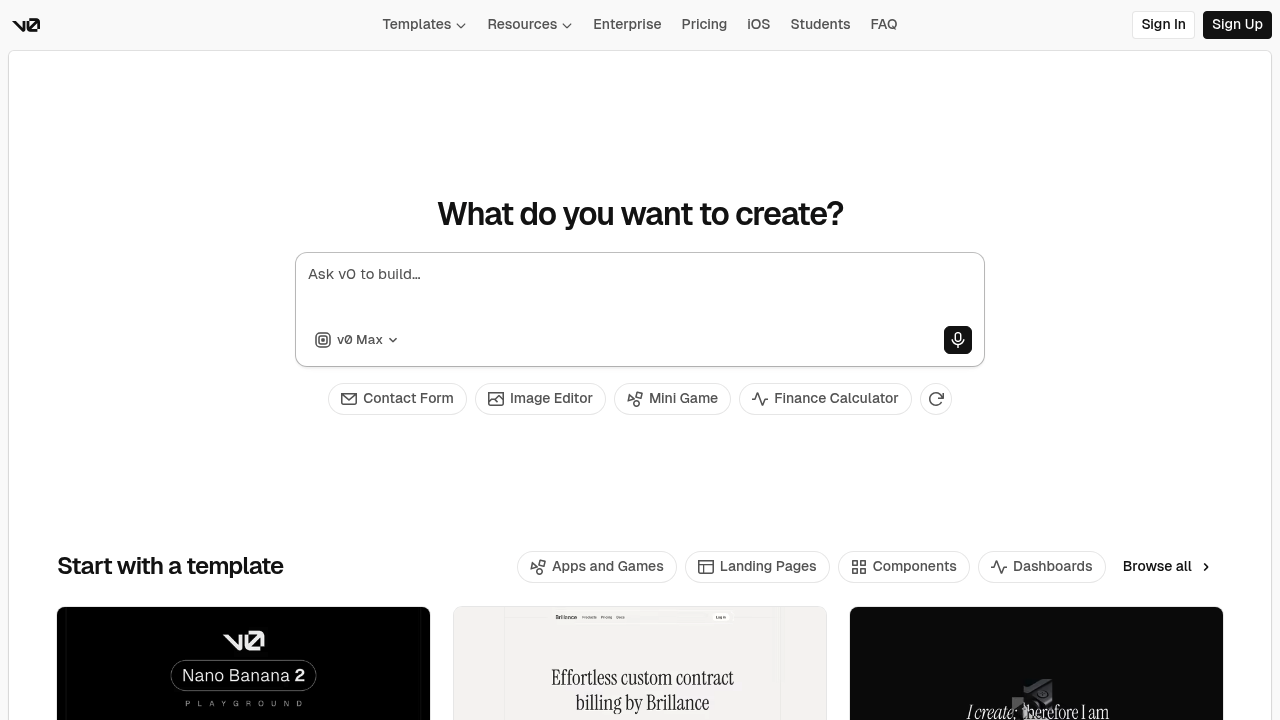
v0 by Vercel is a AI app builder developed by Vercel. As a Lovable alternative, it fits best when a team wants stronger Next.js, GitHub, and Vercel-native delivery rather than the fastest Supabase-first path.
v0 by Vercel is an AI-powered development platform for building production-ready web apps from prompts, screenshots, and Figma files. The product now combines a chat workflow, a full VS Code-style editor, production-like previews, and Git integration in one place.
Compared with Lovable, v0 is less opinionated about a single backend path and more opinionated about a Vercel-style delivery workflow. That difference matters most for teams that already ship in GitHub and care about branches, pull requests, and deployment previews.
v0 by Vercel vs. Lovable: Quick Comparison
| Decision area | v0 by Vercel | Lovable |
|---|---|---|
| Primary approach | Prompt-first builder with a full editor and Git-centric app workflow | Prompt-first AI app builder with visual edits and fast iteration |
| Output stack | Next.js, React, TypeScript, Tailwind CSS, shadcn/ui | React + TypeScript with a Supabase-first workflow |
| AI builder style | Agentic workflow that can plan tasks, generate code, and iterate inside a full editor | Single conversational builder focused on fast product scaffolding |
| Visual editing | Design Mode plus live previews | Prompt edits plus visual tweaking inside the builder |
| Figma import | Yes; official Figma integration is documented | Supported via Builder.io Figma integration |
| Deployment path | One-click publish on Vercel, with export and external deployment still possible | Deploy externally after export or GitHub sync |
| Data layer | Bring your own database or service; no single default is enforced | Supabase is the default path for app data |
| Authentication | Implement with your chosen stack; no single built-in auth default is documented | Supabase Auth is the default route for auth flows |
| Native mobile output | No documented native mobile runtime; strongest for web apps | No documented native mobile runtime; strongest for web apps |
| Git workflow | Deep GitHub workflow with automatic branches, commits, PRs, and merge flow | GitHub sync is supported |
| Code portability | High inside the React/Next.js ecosystem | High: generated React code can be taken out of the platform |
| Collaboration | Team plans support shared chats and collaboration | Team collaboration is built in with shared projects |
| Debugging style | Production-like previews via Vercel Sandbox plus in-editor fixes | Paste errors and ask the builder to repair the app |
| Pricing model | Subscription plus usage credits and token-based model pricing | Credit-based plans with a free daily allowance |
| Entry pricing | Free $0/month; Premium $20/month | Free plan with daily credits; Starter $20/mo |
| Scale pricing | Team $30/user/month; Business $100/user/month; Enterprise custom | Launch $50/mo; Scale $100/mo |
What v0 by Vercel Does Differently
Git-native delivery
v0 treats GitHub as a first-class workflow instead of an afterthought. Official docs describe automatic branching, automatic commits, PR creation, and PR merging without leaving the product, which is stronger than a simple export-and-deploy loop.
Higher-fidelity UI iteration
The current v0 workflow combines prompt-based generation, Design Mode, screenshots, and Figma input. That makes it especially strong when the work starts from a design system or when a product team wants a cleaner handoff from design to working React code.
Production-like previews
v0 now runs previews in Vercel Sandbox, so server-side code, API routes, databases, and environment variables behave more like a real deployment. Lovable is faster for quick scaffolding, but v0 gives more confidence when a team is already thinking about real production behavior.
Vercel ecosystem fit
If the team already uses Vercel for hosting, environment variables, domains, and release previews, v0 feels unusually coherent. The upside is speed and fewer moving parts; the downside is that the workflow naturally pulls you toward the Vercel way of shipping.
Known Limitations
- The platform is strongest when you are comfortable with the React + Next.js + Vercel world. If your team wants a more stack-neutral experience, v0 can feel narrower than Replit and less immediately straightforward than Lovable.
- Pricing is less predictable than a simple monthly app-builder subscription because monthly credits, daily credits, and token-based model pricing all matter. Heavy debugging or large-context prompting can change the real cost profile faster than on Lovable.
- There is no single built-in backend default that plays the same role Supabase plays in Lovable. That gives advanced teams flexibility, but it also means more architecture choices for solo founders who mostly want the shortest path to a working app.
- Native mobile output is not positioned as a core strength in the way some broader builders frame it. For responsive web apps this is fine, but it is not the best pick when the roadmap clearly includes app-store-first delivery.
- The product assumes the user is comfortable with branches, previews, and iterative engineering workflows. Non-technical founders can absolutely use it, but the experience is more engineering-shaped than Bubble or Lovable.
Who Should Choose v0 by Vercel Over Lovable?
- Choose v0 if your team already thinks in GitHub branches, pull requests, and preview deployments.
- Choose it when Figma, screenshots, or a strong design system are the starting point for the build.
- Choose it when the target output should stay close to modern Next.js conventions and Vercel hosting.
- Choose it when engineers, designers, and PMs need to collaborate around the same production-bound codebase.
When Lovable Is Still the Better Choice
- Stay with Lovable if you want the shortest path to a Supabase-backed web app with fewer architecture decisions.
- Stay with Lovable if the builder must feel simpler for a non-technical founder who mainly wants to prompt, approve, and ship.
- Stay with Lovable if the team does not want a Git- and PR-centered workflow in the early MVP stage.
- Stay with Lovable if predictable plan-based app building matters more than token-driven usage nuance.
Pricing Comparison & Cost at Scale
Plan overview
- Free — $0/month with $5 of included monthly credits and a 7 messages/day limit.
- Premium — $20/month with $20 included monthly credits, $2 free daily credits on login, and larger limits.
- Team — $30/user/month with $30 included monthly credits per user and shared collaboration.
- Business — $100/user/month with training opt-out by default and enterprise-focused controls.
Prices are subject to change. Check the official pricing pages for the latest details.
Approximate cost profile vs. Lovable
| Scenario | v0 by Vercel | Lovable | Notes |
|---|---|---|---|
| Casual solo prototyping | $0 to $20/month | $0 to $20/month | Both can start free, but v0 becomes attractive once GitHub, Figma, or Vercel workflows matter. |
| Serious solo MVP | $20/month plus any extra credit usage | $20/month | Lovable is simpler to forecast; v0 becomes worth it if the workflow saves engineering time. |
| Small product team | $30/user/month or higher | $50 to $100/month shared plan path | v0 often costs more directly, but it can replace part of the handoff and preview tooling stack. |
How This Tool Compares to Other Options in Directory 2930
- Versus Replit, v0 is narrower in stack choice but cleaner for Next.js-heavy product teams.
- Versus Bubble, v0 offers far stronger code ownership and Git workflow, while Bubble offers a stronger visual data/workflow layer.
- Versus Framer or Webflow, v0 is better for real product apps, not just high-end websites and CMS workflows.
FAQ
Is v0 free?
Yes, there is a free plan with $5 of included monthly credits and a 7-message daily limit. Most serious app work usually starts on the $20 Premium plan.
Can v0 replace Lovable?
Yes, especially for teams that want a Git-native Next.js workflow. It is a stronger replacement for engineering-shaped product work than for ultra-simple founder-led MVPs.
How does v0 compare on code ownership?
Very well. v0 generates standard React and Next.js output and makes GitHub workflow central, so portability is one of its strongest advantages over closed runtimes.
Does v0 work with Figma?
Yes. Official docs describe a Figma integration that extracts both visual layout and design tokens for higher-fidelity generation.
When is Lovable still smarter?
Lovable is usually the smarter default when the team wants faster Supabase-first scaffolding, simpler pricing, and less Git workflow overhead in the earliest stage.